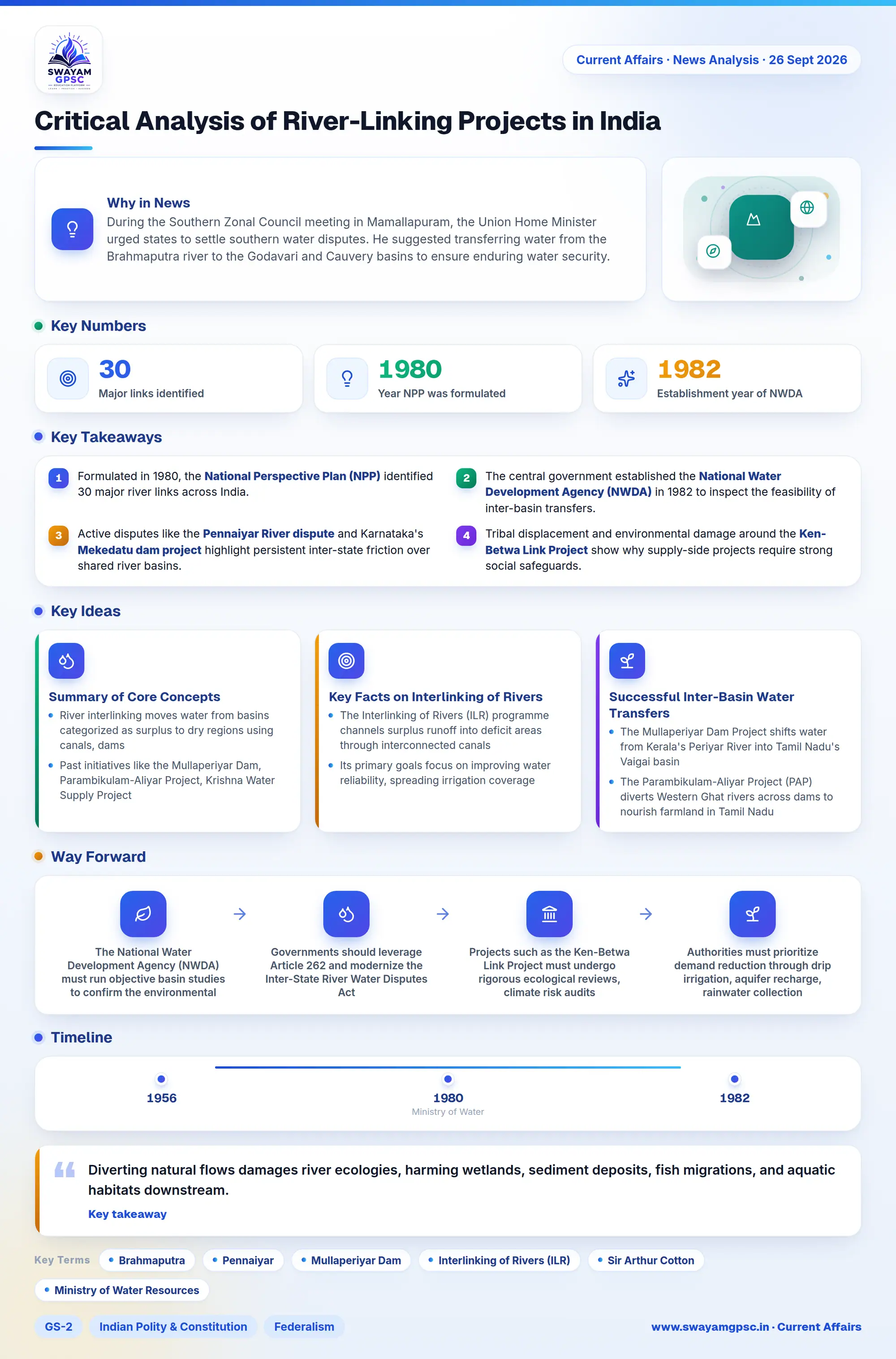
Critical Analysis of River-Linking Projects in India
#GS-2 #Indian Polity & Constitution #Federalism #GS-3 #Economy #Infrastructure #Environment #Climate Change #Water Resources #Inter-State River Water Disputes
Key takeaways
- Formulated in 1980, the National Perspective Plan (NPP) identified 30 major river links across India.
- The central government established the National Water Development Agency (NWDA) in 1982 to inspect the feasibility of inter-basin transfers.
- Active disputes like the Pennaiyar River dispute and Karnataka's Mekedatu dam project highlight persistent inter-state friction over shared river basins.
- Tribal displacement and environmental damage around the Ken-Betwa Link Project show why supply-side projects require strong social safeguards.
- Resolving inter-state water standoffs requires utilizing constitutional provisions under Article 262 and the Inter-State River Water Disputes Act, 1956.
Why in News
- During the Southern Zonal Council meeting in Mamallapuram, the Union Home Minister urged states to settle southern water disputes.
- He suggested transferring water from the Brahmaputra river to the Godavari and Cauvery basins to ensure enduring water security.
- This discussion gains traction amid existing disputes such as Pennaiyar and Mekedatu, underlining serious friction in inter-state river management.
Summary of Core Concepts
- River interlinking moves water from basins categorized as surplus to dry regions using canals, dams, and diversion channels.
- Past initiatives like the Mullaperiyar Dam, Parambikulam-Aliyar Project, Krishna Water Supply Project, and Indira Gandhi Canal Project prove basin transfers can work.
- Even so, expansive water transfers trigger major environmental damage, displacement troubles, and disputes between states.
- Hydrological specialists state that expanding water supply alone cannot fix India's scarcity, demanding aggressive conservation, demand management, and groundwater safeguards.
Key Facts on Interlinking of Rivers
- The Interlinking of Rivers (ILR) programme channels surplus runoff into deficit areas through interconnected canals, dams, and flow structures.
- Its primary goals focus on improving water reliability, spreading irrigation coverage, curbing seasonal flood and drought impacts, generating hydropower, and boosting regional growth.
- Water transfers originated in the nineteenth century when Sir Arthur Cotton suggested linking rivers for irrigation routes and boat navigation.
- The Ministry of Water Resources designed the National Perspective Plan (NPP) in 1980, outlining 30 major transfer links split between Himalayan and Peninsular components.
- The central government instituted the National Water Development Agency (NWDA) in 1982 to inspect the feasibility of these planned canal links.
Successful Inter-Basin Water Transfers
- The Mullaperiyar Dam Project shifts water from Kerala's Periyar River into Tamil Nadu's Vaigai basin, supplying drinking water and farm irrigation.
- The Parambikulam-Aliyar Project (PAP) diverts Western Ghat rivers across dams to nourish farmland in Tamil Nadu, illustrating inter-state water sharing.
- The Krishna Water Supply Project channels water from the Krishna River across state borders to meet urban drinking needs in Hyderabad.
- The Indira Gandhi Canal Project transports discharge from the Sutlej and Beas river system into Rajasthan, converting parts of the Thar Desert into farmland.
Arguments in Favour of River Linking
- Transferring surplus water narrows regional deficits, as seen in the Ken-Betwa Link Project that aids drought-stricken Bundelkhand across Madhya Pradesh and Uttar Pradesh.
- Enhanced canal irrigation helps farmers cultivate diverse crops, raise harvest yields, and grow farm earnings across arid lands.
- Interlinking helps mitigate flood and drought hazards by siphoning dangerous flood surges into parched river basins.
- Water diversion networks secure critical drinking water and process water for expanding towns, factories, and thirsty rural communities.
- Heavy infrastructure projects spur local employment, upgrade rural logistics, and stimulate broader economic growth through shipping and agricultural services.
- Connecting river channels fosters unified water planning across state borders, creating an integrated method for governing national drainage systems.
Challenges and Arguments Against
- Diverting natural flows damages river ecologies, harming wetlands, sediment deposits, fish migrations, and aquatic habitats downstream.
- Demonstrating environmental friction, Kerala resists the Pamba-Achankovil-Vaippar Link Project to protect the sensitive Vembanad wetland ecosystem.
- Rivers cross multiple political borders, igniting bitter state conflicts over water shares, stored quantities, and allocation quotas.
- Disputes like the Pennaiyar River dispute show friction, where Tamil Nadu alleged that Karnataka breached an 1892 water agreement.
- Karnataka's planned Mekedatu dam project on the Cauvery faces ongoing legal and political pushback from Tamil Nadu regarding lower river flow.
- Water disputes struggle under weak dispute settlement frameworks, where tribunals set up under the Inter-State River Water Disputes Act, 1956 face severe delays.
- Canal construction requires massive land takeovers, causing widespread displacement of forest dwellers, as observed with indigenous communities resisting the Ken-Betwa Link Project.
- Huge construction budgets, engineering hurdles, ongoing upkeep costs, and long construction timelines place severe financial strain on public finances.
- Shifting rainfall regimes driven by climate change make historical surplus and deficit estimates unreliable for long-term diversion plans.
- Pouring resources into mega-engineering works diverts money and focus away from grassroots water harvesting, micro-irrigation, and demand control.
Way Forward
- The National Water Development Agency (NWDA) must run objective basin studies to confirm the environmental and social safety of transfer links.
- Governments should leverage Article 262 and modernize the Inter-State River Water Disputes Act, 1956 to fast-track dispute resolutions through cooperative federalism.
- Projects such as the Ken-Betwa Link Project must undergo rigorous ecological reviews, climate risk audits, and fair rehabilitation schemes.
- Authorities must prioritize demand reduction through drip irrigation, aquifer recharge, rainwater collection, and restoration of neglected water bodies.
- Water planning must actively involve village communities, local farmers, and hydrologists in river basin boards to resolve water disputes locally.
Conclusion
- While specific inter-basin diversions solve local water shortages, nationwide canal linking is not a universal cure for India's water crisis.
- A durable water strategy demands demand-side efficiency, groundwater restoration, and cooperative federalism that safeguards rivers and riverside communities alike.
Frequently Asked Questions
- Interlinking of Rivers (ILR) describes transferring surface water from surplus basins to dry river basins through canals and reservoirs.
- The project seeks to alleviate water shortages, widen irrigation, limit flood and drought damage, and satisfy drinking water demands.
- The National River Linking Project (NRLP) serves as the central framework connecting river systems to balance regional water volumes.
- Altering natural flow rates disrupts fish migration, degrades riverine wetlands, and damages healthy sediment movement downstream.
- Because rivers traverse multiple states, successful water schemes depend on interstate teamwork backed by Article 262 and the Inter-State River Water Disputes Act, 1956.