8th Anniversary of Ayushman Bharat: Transforming Healthcare
#GS-2 #Governance & Social Justice #Health #Poverty #Government Policies & Interventions #Welfare Schemes
Key takeaways
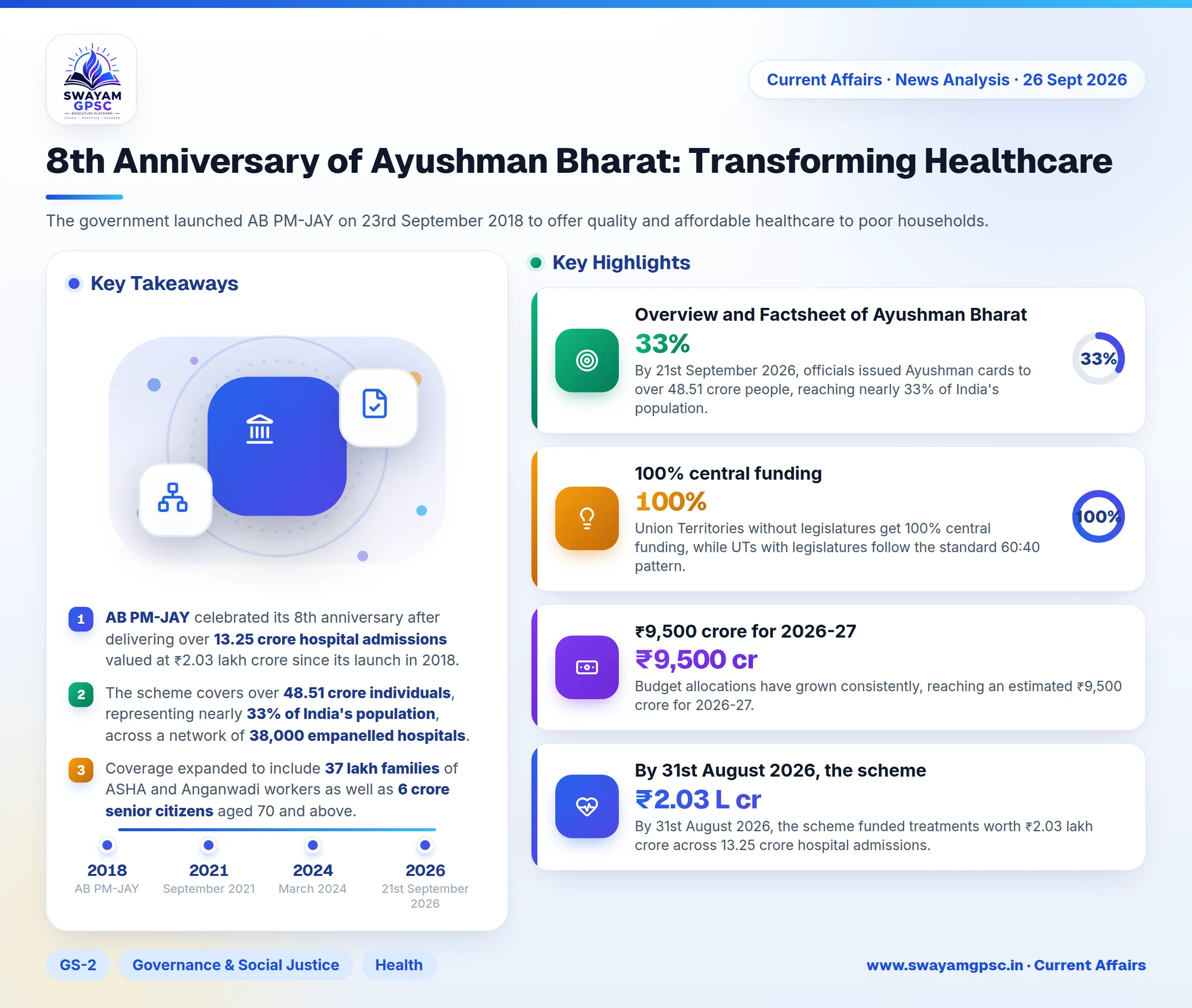
- AB PM-JAY celebrated its 8th anniversary after delivering over 13.25 crore hospital admissions valued at ₹2.03 lakh crore since its launch in 2018.
- The scheme covers over 48.51 crore individuals, representing nearly 33% of India's population, across a network of 38,000 empanelled hospitals.
- Coverage expanded to include 37 lakh families of ASHA and Anganwadi workers as well as 6 crore senior citizens aged 70 and above.
- The government backed the program with a ₹9,500 crore budget allocation for 2026-27 alongside a ₹64,180 crore outlay for the PM-ABHIM infrastructure scheme.
Why in News
- The Government of India recently celebrated the 8th anniversary of Ayushman Bharat Pradhan Mantri Jan Arogya Yojana (AB PM-JAY).
- The event highlighted how the scheme has expanded healthcare access and reduced medical costs for vulnerable families.
- These collective efforts aim to help India achieve Universal Health Coverage (UHC).
Overview and Factsheet of Ayushman Bharat
- The government launched AB PM-JAY on 23rd September 2018 to offer quality and affordable healthcare to poor households.
- As a public health assurance scheme, it covers secondary and tertiary healthcare services for hospital treatments.
- By 21st September 2026, officials issued Ayushman cards to over 48.51 crore people, reaching nearly 33% of India's population.
- The scheme operates as part of a wider framework alongside Ayushman Aarogya Mandirs (AAM) for primary care.
- It also integrates with the Ayushman Bharat Digital Mission (ABDM) for digital records and PM-ABHIM for physical infrastructure.
- The central government funds the scheme as a Centrally Sponsored Scheme with a 60:40 Centre-State funding ratio for most states.
- Himalayan and North-Eastern regions like Himachal Pradesh, Uttarakhand, and J&K receive a 90:10 sharing ratio.
- Union Territories without legislatures get 100% central funding, while UTs with legislatures follow the standard 60:40 pattern.
- Budget allocations have grown consistently, reaching an estimated ₹9,500 crore for 2026-27.
- This funding boost lowers out-of-pocket health expenditure by offering free hospital treatments.
- By 31st August 2026, the scheme funded treatments worth ₹2.03 lakh crore across 13.25 crore hospital admissions.
- Over 38,000 empanelled public and private hospitals currently deliver these services across India.
Expanding Financial Protection and Access
- The scheme offers cashless treatment covering 1,961 procedures across 27 medical specialities to protect families from major debt.
- In March 2024, the government included around 37 lakh families of ASHAs, Anganwadi Workers, and Anganwadi Helpers.
- By 21st September 2026, authorities distributed over 44.81 lakh Ayushman cards to these frontline health workers.
- The program expanded in 2024 to include all citizens aged 70 years and above, covering nearly 6 crore senior citizens.
- More than 1.36 crore Ayushman Vay Vandana cards have reached these senior citizens by 21st September 2026.
Identification of Eligible Beneficiaries
- Rural selection relies on Socio-Economic Caste Census (SECC) 2011 deprivation factors, including landless laborers and female-headed households.
- Urban selection targets 11 occupational categories, including street vendors, ragpickers, construction workers, and domestic help.
Additional Vulnerable Groups Covered
- Building and Other Construction Workers (BOCW) and their families receive direct healthcare coverage under the scheme.
- Road accident victims obtain fast financial support for treatment through the PM-RAHAT initiative.
- Transgender community members gain access to gender-affirming care and healthcare benefits under the SMILE initiative.
- Children orphaned by the pandemic receive medical coverage through the PM CARES for Children Scheme.
- Sanitation staff and waste handlers get enrolled in the scheme under the NAMASTE Scheme.
- Vulnerable tribal communities receive targeted health coverage under the PM-JANMAN initiative.
Key Features of Ayushman Arogya Mandirs
- Ayushman Arogya Mandirs (AAMs) act as the second pillar of Ayushman Bharat to deliver neighborhood primary care.
- The government upgrades local health centers by adding better facilities, trained staff, diagnostic tools, and internet access.
- These centers treat non-communicable diseases, mental health issues, emergency trauma cases, and eye or dental problems.
- The government also establishes AYUSH Arogya Mandirs to offer traditional care like Ayurveda, Yoga, Unani, Siddha, and Homoeopathy.
- Local health staff and ASHAs use these clinics to raise health awareness and monitor patients in the community.
- Patients use e-Sanjeevani telemedicine at these clinics to consult specialists at larger district or state hospitals.
- These centers have recorded over 540 crore visits, demonstrating major growth in primary healthcare delivery.
Ayushman Bharat Digital Mission Details
- The government launched the Ayushman Bharat Digital Mission (ABDM) in September 2021 to digitize health records.
- Every citizen receives a unique ABHA ID to securely store medical history, diagnostic reports, and insurance claims.
Key Components of ABDM
- The Healthcare Professionals Registry (HPR) acts as a verified directory of registered doctors and medical practitioners.
- The Health Facility Registry (HFR) maintains a public database of verified hospitals, clinics, labs, and pharmacies.
- The Unified Health Interface (UHI) lets patients find services and book appointments across various health apps.
- The Aarogya Setu 2.0 application acts as a single point to manage personal health records and digital appointments.
Features of PM-ABHIM Infrastructure Mission
- The government started PM-ABHIM in October 2021 under Budget 2021-22 to upgrade health labs and emergency care.
- With a total outlay of ₹64,180 crore (2021-2026), it aims to build resilient healthcare capacity against future pandemics.
- The scheme sets up 23,224 rural health and wellness centres across 10 high-focus states.
- It also funds 13,736 urban health and wellness centres to improve access in crowded city neighborhoods.
- The mission establishes 3,389 Block Public Health Units in 11 high-focus states to track disease outbreaks.
- It funds 744 Integrated Public Health Laboratories to ensure every district has proper diagnostic facilities.
- The mission adds 631 Critical Care Hospital Blocks in districts with populations over 5 lakh to handle medical emergencies.
Way Forward
- Ayushman Bharat successfully combines health insurance, local primary care, digital tech, and modern infrastructure.
- Continued administrative focus on expanding these four pillars will help India achieve true Universal Health Coverage.