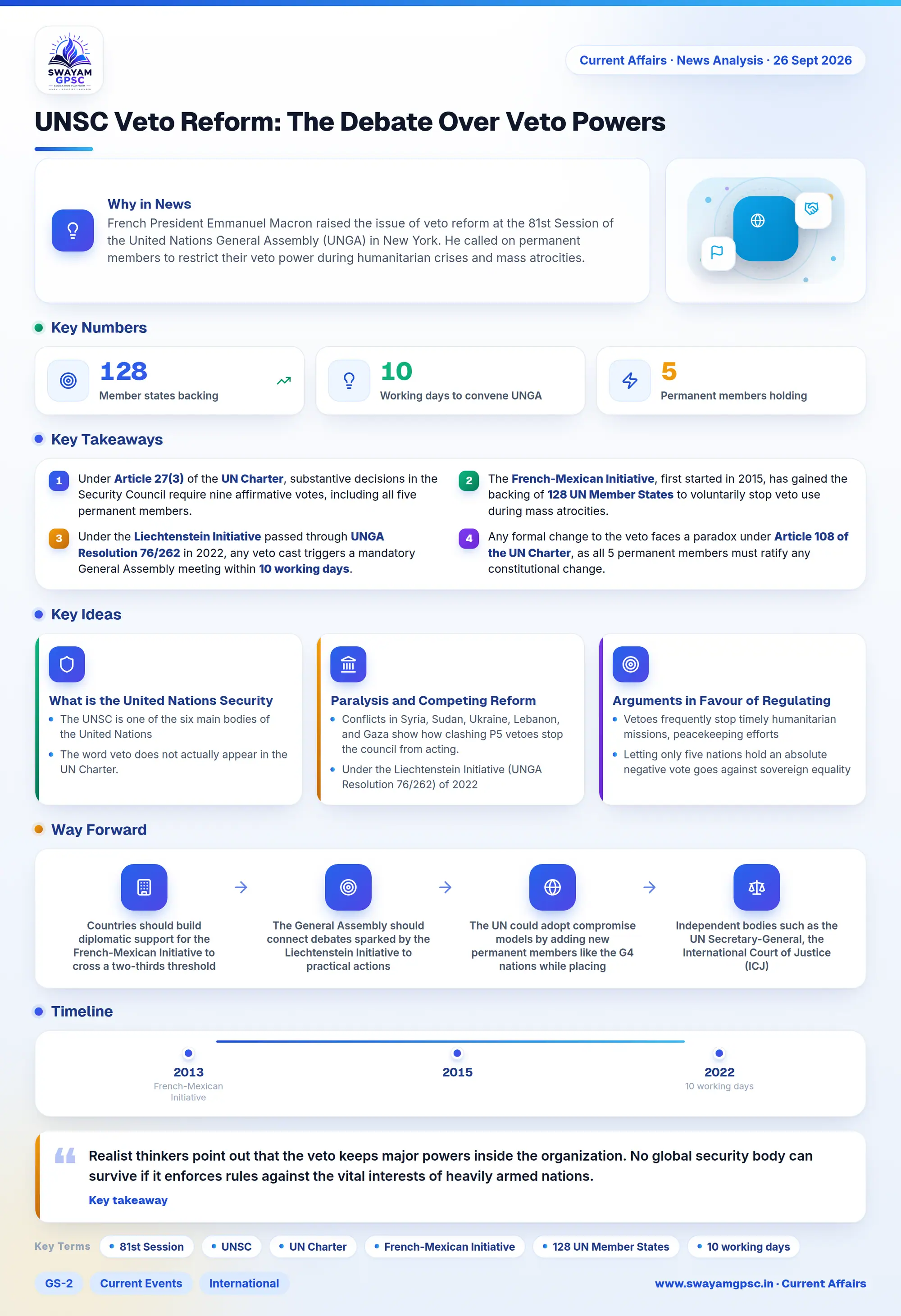
UNSC Veto Reform: The Debate Over Veto Powers
#GS-2 #Current Events #International #UNSC Reform #United Nations #Veto Power #P5
Key takeaways
- Under Article 27(3) of the UN Charter, substantive decisions in the Security Council require nine affirmative votes, including all five permanent members.
- The French-Mexican Initiative, first started in 2015, has gained the backing of 128 UN Member States to voluntarily stop veto use during mass atrocities.
- Under the Liechtenstein Initiative passed through UNGA Resolution 76/262 in 2022, any veto cast triggers a mandatory General Assembly meeting within 10 working days.
- Any formal change to the veto faces a paradox under Article 108 of the UN Charter, as all 5 permanent members must ratify any constitutional change.
Why in News
- French President Emmanuel Macron raised the issue of veto reform at the 81st Session of the United Nations General Assembly (UNGA) in New York.
- He called on permanent members to restrict their veto power during humanitarian crises and mass atrocities.
What is the United Nations Security Council (UNSC)?
- The UNSC is one of the six main bodies of the United Nations, created under the UN Charter in 1945 to maintain global peace and security.
- The word veto does not actually appear in the UN Charter. Instead, Article 27(3) states that decisions on non-procedural issues need nine positive votes, including the agreeing votes of all permanent members.
- France and Mexico proposed the French-Mexican Initiative in 2013 and formally launched it in 2015. This plan asks the P5 to voluntarily stop using the veto during genocide, crimes against humanity, and major war crimes.
- The initiative views the veto as a duty to keep global peace, rather than an unchecked power granted to big nations.
- A total of 128 UN Member States support this initiative, including 21 countries that joined in mid-2026. France and the UK are the first permanent members to back it.
Paralysis and Competing Reform Initiatives
- Conflicts in Syria, Sudan, Ukraine, Lebanon, and Gaza show how clashing P5 vetoes stop the council from acting.
- Under the Liechtenstein Initiative (UNGA Resolution 76/262) of 2022, the UNGA President must call a formal meeting within 10 working days whenever a veto is used. This requires the vetoing nation to defend its action before the full General Assembly.
- The Accountability, Coherence, and Transparency group created the ACT Code of Conduct. It urges all council members to promise never to vote against credible resolutions designed to prevent or stop mass atrocity crimes.
Arguments in Favour of Regulating or Abolishing the Veto
- Vetoes frequently stop timely humanitarian missions, peacekeeping efforts, and weapons bans while innocent civilians suffer in conflict areas.
- Letting only five nations hold an absolute negative vote goes against sovereign equality, which is guaranteed under Article 2(1) of the UN Charter.
- The current P5 setup reflects the world of 1945 rather than present-day reality. It leaves out regional leaders like the G4 nations (India, Brazil, Germany, and Japan) as well as the entire African continent.
- Tools like the Liechtenstein Initiative make countries pay a higher political and diplomatic price when they block resolutions.
Challenges in Reforming the Veto
- Realist thinkers point out that the veto keeps major powers inside the organization. No global security body can survive if it enforces rules against the vital interests of heavily armed nations.
- Under Article 108 of the UN Charter, any amendment requires a two-thirds vote in the UNGA and approval by two-thirds of member countries, which must include all five permanent members. Therefore, the P5 holds an automatic structural veto over changing their own veto rights.
- The P5 remains divided internally. Major powers like the US, Russia, and China refuse to give up their veto powers, and countries define humanitarian crises differently to suit their own political agendas.
- Giving veto power to new permanent members could cause more gridlock, because more nations would have the power to stop collective action.
Way Forward
- Countries should build diplomatic support for the French-Mexican Initiative to cross a two-thirds threshold of 129+ Member States in the UNGA, turning voluntary restraint into a recognized global standard.
- The General Assembly should connect debates sparked by the Liechtenstein Initiative to practical actions, such as independent inquiry panels or aid routes under Resolution 377A (Uniting for Peace).
- The UN could adopt compromise models by adding new permanent members like the G4 nations while placing a long-term hold on their veto use, balancing broader representation with effective decision-making.
- Independent bodies such as the UN Secretary-General, the International Court of Justice (ICJ), or the OHCHR should be authorized to confirm atrocities and trigger voluntary veto restraint protocols.
Conclusion
- The UN Charter makes legal abolition of the veto nearly impossible. However, practical solutions like voluntary restraint during mass atrocities and mandatory post-veto reviews increase the diplomatic cost of blocking action.
- Making the Security Council credible and effective requires turning the veto from a selfish geopolitical shield into a responsible instrument for collective global security.