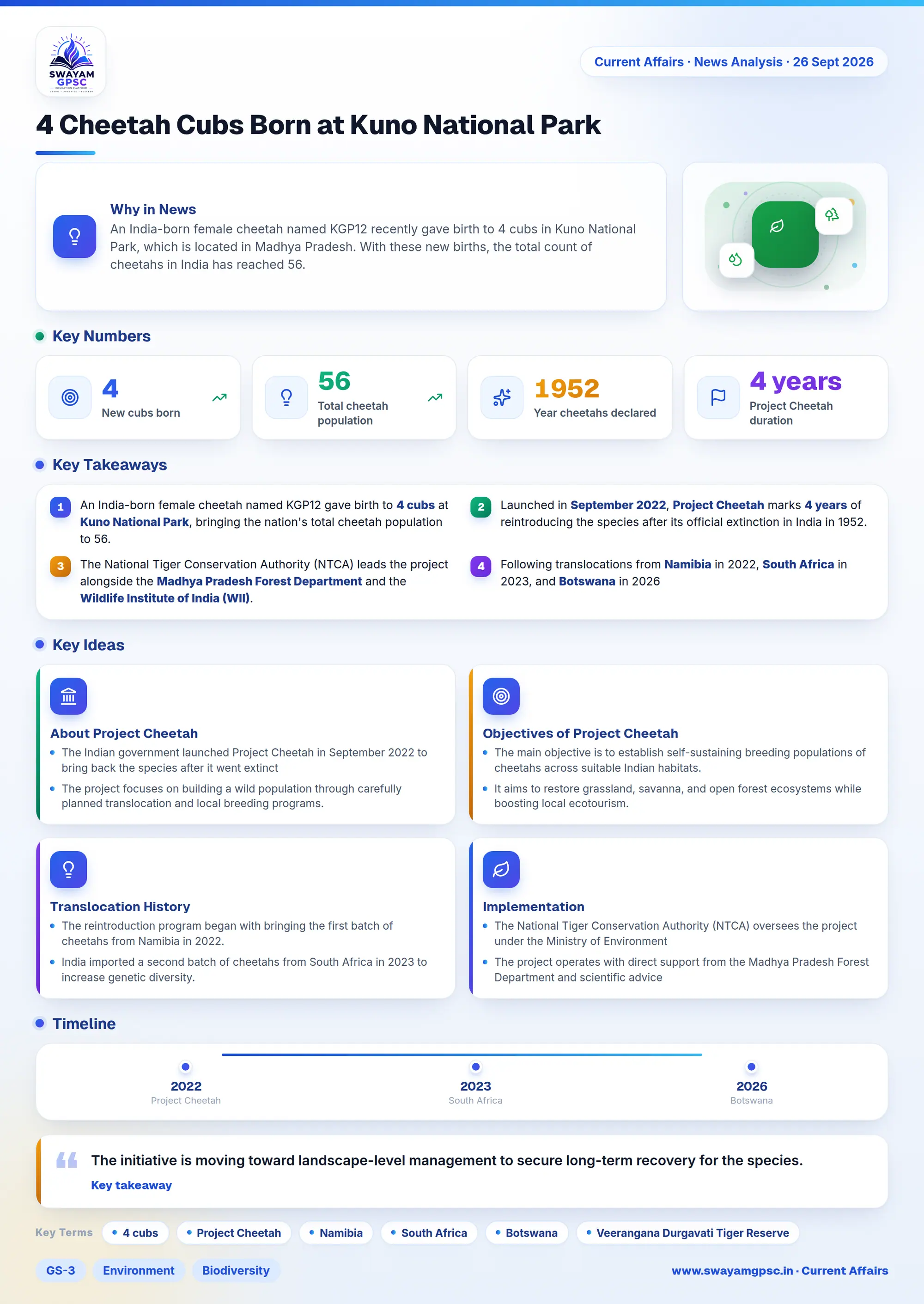
4 Cheetah Cubs Born at Kuno National Park
#GS-3 #Environment #Biodiversity #Wildlife #Current Events #National #Gujarat
Key takeaways
- An India-born female cheetah named KGP12 gave birth to 4 cubs at Kuno National Park, bringing the nation's total cheetah population to 56.
- Launched in September 2022, Project Cheetah marks 4 years of reintroducing the species after its official extinction in India in 1952.
- The National Tiger Conservation Authority (NTCA) leads the project alongside the Madhya Pradesh Forest Department and the Wildlife Institute of India (WII).
- Following translocations from Namibia in 2022, South Africa in 2023, and Botswana in 2026, authorities are now preparing Gujarat's Banni Grasslands and MP's Veerangana Durgavati Tiger Reserve as future habitats.
Why in News
- An India-born female cheetah named KGP12 recently gave birth to 4 cubs in Kuno National Park, which is located in Madhya Pradesh.
- With these new births, the total count of cheetahs in India has reached 56.
- This event marks a major success for Project Cheetah, which has now completed 4 years since its inception.
About Project Cheetah
- The Indian government launched Project Cheetah in September 2022 to bring back the species after it went extinct in 1952.
- The project focuses on building a wild population through carefully planned translocation and local breeding programs.
Objectives of Project Cheetah
- The main objective is to establish self-sustaining breeding populations of cheetahs across suitable Indian habitats.
- It aims to restore grassland, savanna, and open forest ecosystems while boosting local ecotourism.
- The project also focuses on minimizing human-wildlife conflict through proactive community management.
Translocation History
- The reintroduction program began with bringing the first batch of cheetahs from Namibia in 2022.
- India imported a second batch of cheetahs from South Africa in 2023 to increase genetic diversity.
- Another group of cheetahs arrived from Botswana in 2026 to further strengthen the program.
Implementation
- The National Tiger Conservation Authority (NTCA) oversees the project under the Ministry of Environment, Forest and Climate Change (MoEFCC).
- The project operates with direct support from the Madhya Pradesh Forest Department and scientific advice from the Wildlife Institute of India (WII).
Future Expansion
- Authorities are currently preparing Veerangana Durgavati Tiger Reserve in Madhya Pradesh as an additional habitat for cheetahs.
- Officials are also evaluating the Banni Grasslands in Gujarat and Nauradehi Wildlife Sanctuary in Madhya Pradesh for future releases.
Ecological Significance
- The initiative is moving toward landscape-level management to secure long-term recovery for the species.
- This strategy ensures sufficient prey base, connected corridors, and ideal open habitats for the expanding cheetah population.