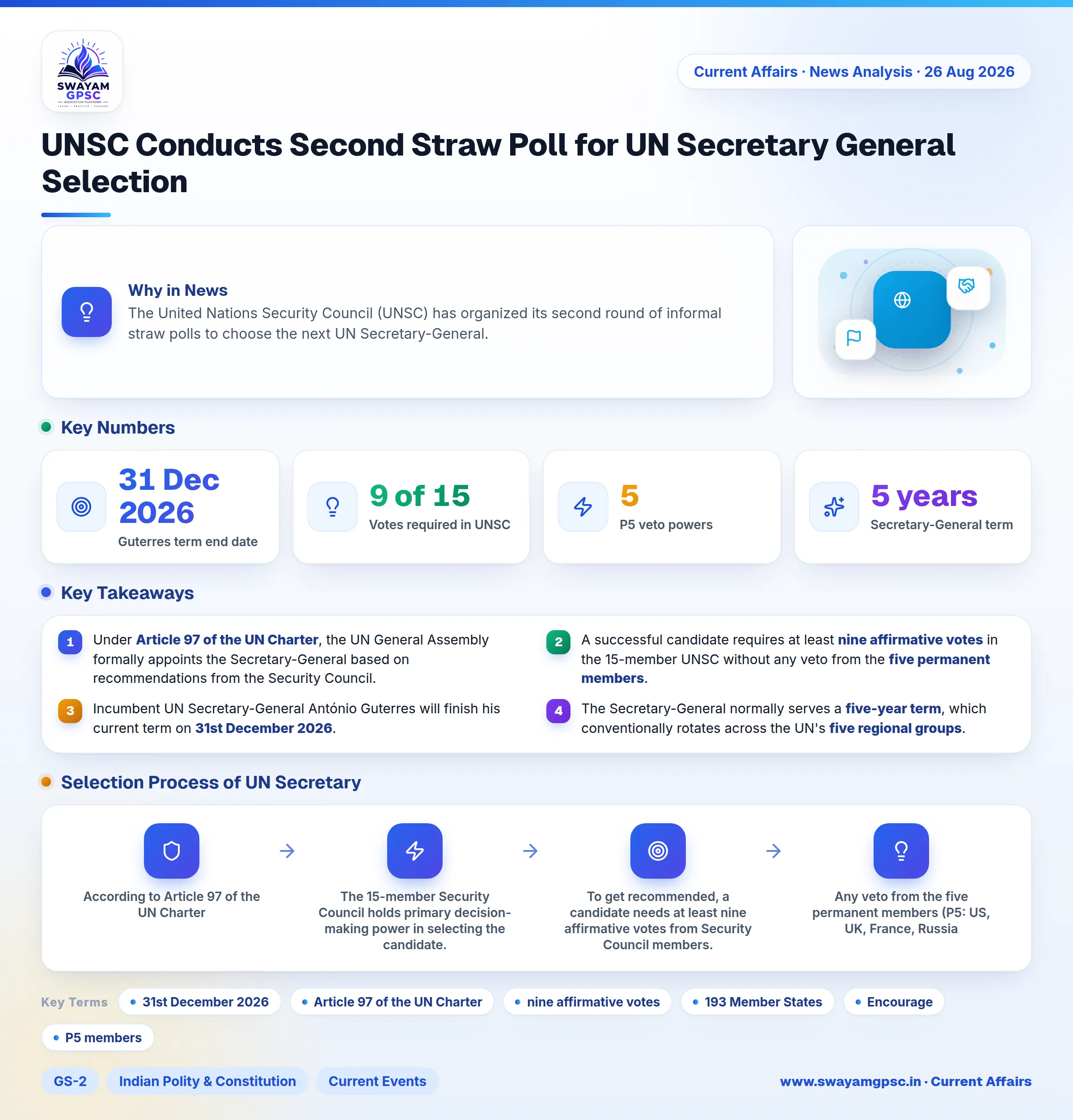
UNSC Conducts Second Straw Poll for UN Secretary General Selection
#GS-2 #Indian Polity & Constitution #Current Events #International #Important International Institutions
Key takeaways
- Under Article 97 of the UN Charter, the UN General Assembly formally appoints the Secretary-General based on recommendations from the Security Council.
- A successful candidate requires at least nine affirmative votes in the 15-member UNSC without any veto from the five permanent members.
- Incumbent UN Secretary-General António Guterres will finish his current term on 31st December 2026.
- The Secretary-General normally serves a five-year term, which conventionally rotates across the UN's five regional groups.
Why in News
- The United Nations Security Council (UNSC) has organized its second round of informal straw polls to choose the next UN Secretary-General.
- This selection process is taking place because current Secretary-General António Guterres will finish his second term on 31st December 2026.
Selection Process of UN Secretary General
- According to Article 97 of the UN Charter, the General Assembly appoints the Secretary-General based on recommendations from the Security Council.
- The 15-member Security Council holds primary decision-making power in selecting the candidate.
- To get recommended, a candidate needs at least nine affirmative votes from Security Council members.
- Any veto from the five permanent members (P5: US, UK, France, Russia, and China) will block a candidate instantly.
- The appointment process starts when the Presidents of the General Assembly and Security Council send a joint letter inviting nominations from all 193 Member States.
- Nominated candidates present their qualifications and vision statements through public interactive sessions with member nations and civil society groups.
- The UNSC conducts private straw polls where members rate candidates as Encourage, Discourage, or No Opinion.
- During advanced voting rounds, P5 members use voting papers of distinct colors to show their specific stances.
- A Discourage vote cast by any P5 member acts as an official veto against that candidate.
- Voting rounds continue until one candidate secures at least nine out of 15 votes with no P5 vetoes.
- After the Security Council agrees on one name, it sends the recommendation to the 193-member General Assembly for final appointment.
- While a simple majority vote is legally required in the General Assembly, members traditionally make the appointment through unanimous agreement.
- Although the UN Charter leaves term lengths open, established tradition grants a five-year term that is usually renewed once.
- The post rotates among the UN's five regional groups to ensure balanced geographic representation across the globe.