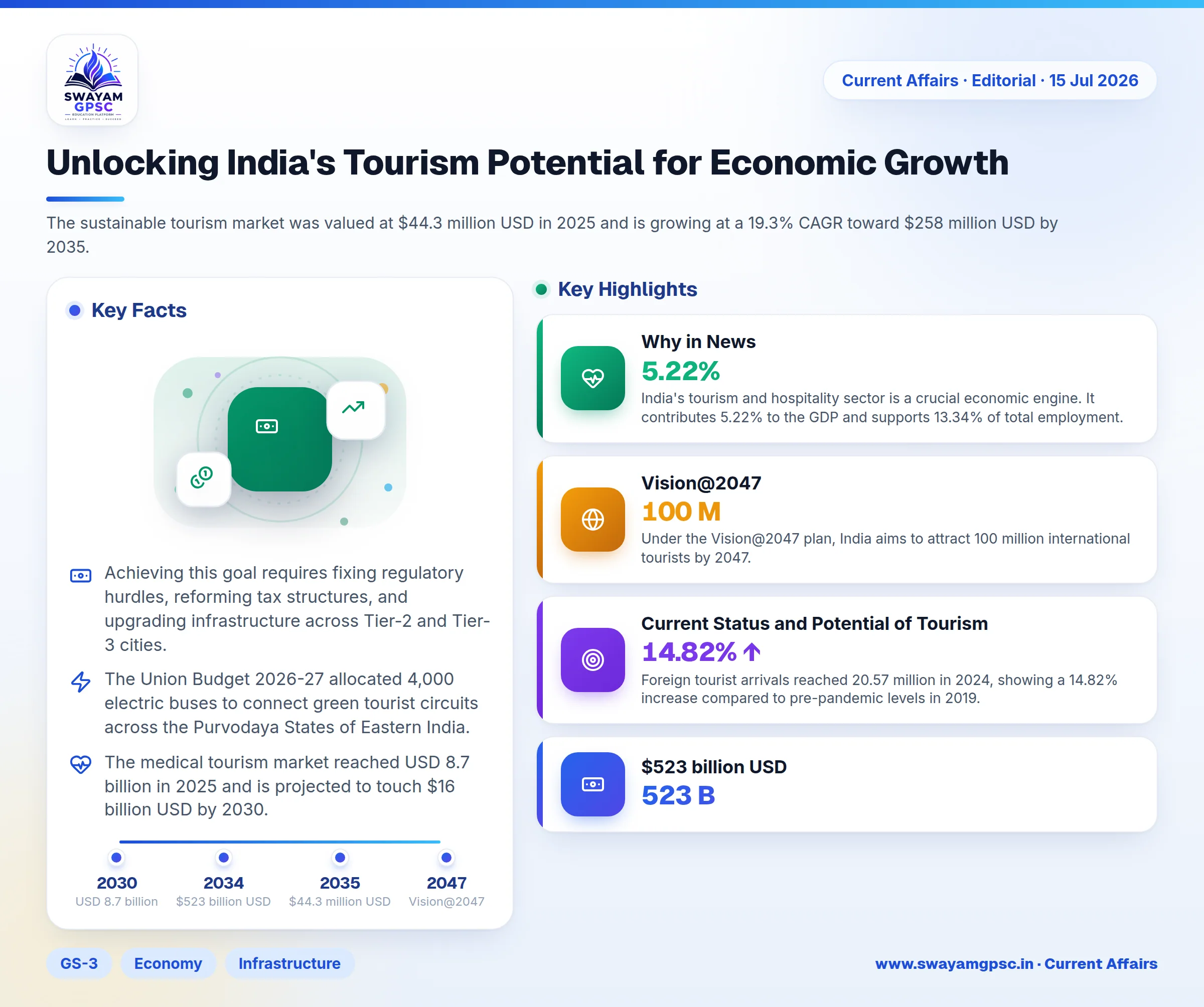
Unlocking India's Tourism Potential for Economic Growth
#GS-3 #Economy #Infrastructure #Employment #Sustainable Development #Environment #Current Events #National
Why in News
- India's tourism and hospitality sector is a crucial economic engine. It contributes 5.22% to the GDP and supports 13.34% of total employment.
- Under the Vision@2047 plan, India aims to attract 100 million international tourists by 2047.
- Achieving this goal requires fixing regulatory hurdles, reforming tax structures, and upgrading infrastructure across Tier-2 and Tier-3 cities.
Current Status and Potential of Tourism
- Foreign tourist arrivals reached 20.57 million in 2024, showing a 14.82% increase compared to pre-pandemic levels in 2019. Meanwhile, domestic tourist visits grew to 18.6 billion between 2014 and 2024.
- According to the World Travel & Tourism Council (WTTC), India's tourism GDP will touch $523 billion USD by 2034, making India the 4th largest tourism economy in the world.
- Under the Swadesh Darshan Scheme, the government sanctioned 76 thematic projects worth ₹5,290 crore, while 40 iconic projects were approved across 23 states under the Special Assistance to States for Capital Investment (SASCI) scheme.
- The Union Budget 2026-27 allocated 4,000 electric buses to connect green tourist circuits across the Purvodaya States of Eastern India.
- Spiritual tourism is booming at major sites like Ayodhya Ram Mandir, Puri Jagannath Temple, and Kedarnath, with Odisha hosting over 56 lakh visitors in the first five months of 2026 alone. Modern corridors like Kashi Vishwanath Corridor in Varanasi and Mahakal Lok Corridor in Ujjain have multiplied daily visitors.
- The medical tourism market reached USD 8.7 billion in 2025 and is projected to touch $16 billion USD by 2030. Patients from Bangladesh, Iraq, Yemen, and Africa visit top hospitals in Delhi, Mumbai, and Chennai for affordable treatment, supported by five Regional Medical Hubs.
- The sustainable tourism market was valued at $44.3 million USD in 2025 and is growing at a 19.3% CAGR toward $258 million USD by 2035. Initiatives like Tons Trails across 37 villages in Uttarakhand and homestays in Kerala lead this shift, while India hosts the 1st International Big Cat Alliance (IBCA) Summit 2026 in New Delhi with 95 nations.
- India's Digital Public Infrastructure (DPI) has simplified travel through Unified Payments Interface (UPI) and biometric entry via DigiYatra at major airports, leading to online channels generating 60% of total booking revenues.
- Premium hotel occupancy is projected at 72-74% for FY2026, making India the 2nd largest hotel investment market in Asia-Pacific with $340 million in transactions, while local homestays receive MUDRA loans to build capacity.
- To improve service standards, the government has trained 5.54 lakh workers, successfully placing 59,210 candidates. Additionally, plans are underway to establish a National Institute of Hospitality and upskill 10,000 heritage tour guides.
Challenges
- Public harassment, verbal abuse, and aggressive staring by some locals damage foreign tourist experiences and hurt India's traditional Atithi Devo Bhava culture.
- Overcharging and language barriers lead to financial exploitation. For example, two French tourists in Agra were charged 50 Euros (approx. ₹5,000) for a ₹500 taxi ride under fake fees.
- High visa fees and strict paperwork in India create entry barriers compared to nearby countries like Thailand and Malaysia that offer visa-free travel.
- Business operations face delays because hotel projects need at least 60 licences from multiple government departments, and the sector still lacks uniform industry status.
- High taxation reduces competitiveness, as luxury hotel rooms face an 18% GST tax bracket, combined with heavy state taxes on tourist buses and Aviation Turbine Fuel (ATF).
- Unplanned overtourism and uncontrolled construction cause severe ecological damage, water scarcity, and landslide risks in fragile hill stations like Shimla and Joshimath.
- Poor last-mile connectivity, dirty public toilets, and bad road conditions outside the Golden Triangle circuit discourage high-spending international visitors from exploring smaller towns.
- Despite supporting 8.4 crore direct and indirect jobs, the sector suffers from a severe shortage of professionally trained staff, as output from Institutes of Hotel Management (IHMs) remains inadequate.
Way Forward
- Launch crowd-funded Destination Bonds starting at ₹1,000 to allow tourists to fund local projects like coral reef restoration in Lakshadweep in exchange for micro-dividends and free entry.
- Create a travel app using Soulbound Token (SBT) badges to reward tourists with Bharat Perks like priority temple visits and Vande Bharat train discounts when visiting offbeat sites.
- Convert historical Dak Bungalows into a Dak Nomad network equipped with satellite internet, paired with a 365-day visa requiring remote workers to spend 30% of their time in rural districts.
- Establish dedicated Tourist Police across all 28 states and 8 union territories, supported by Special Fast-Track Tourist Courts to resolve crimes against tourists quickly.
- Conduct civic awareness drives through programs like Paryatan Mitra to train local vendors, while enforcing strict fines for littering and vandalism at heritage sites.
- Offer instant visas-on-arrival for major source countries like the US and Japan, alongside discounted off-season visas to maintain tourist inflow throughout the year.
- Grant official industry status to hospitality and list projects under the Harmonized Master List (HML) of Infrastructure to enable single-window clearance.
- Enforce dynamic visitor limits at fragile destinations and offer tax rebates to hotels that earn Green Key eco-certifications.