Internet Access as a Fundamental Right: Jurisprudence, Challenges, and Implementation
#GS-2 #Indian Polity & Constitution #Constitution #Fundamental Rights #Judicial Review #Judiciary #Governance & Social Justice #E-Governance #Good Governance #GS-3 #Science & Technology #ICT #Cyber Security #Economy #Infrastructure #Current Events #National
Key takeaways
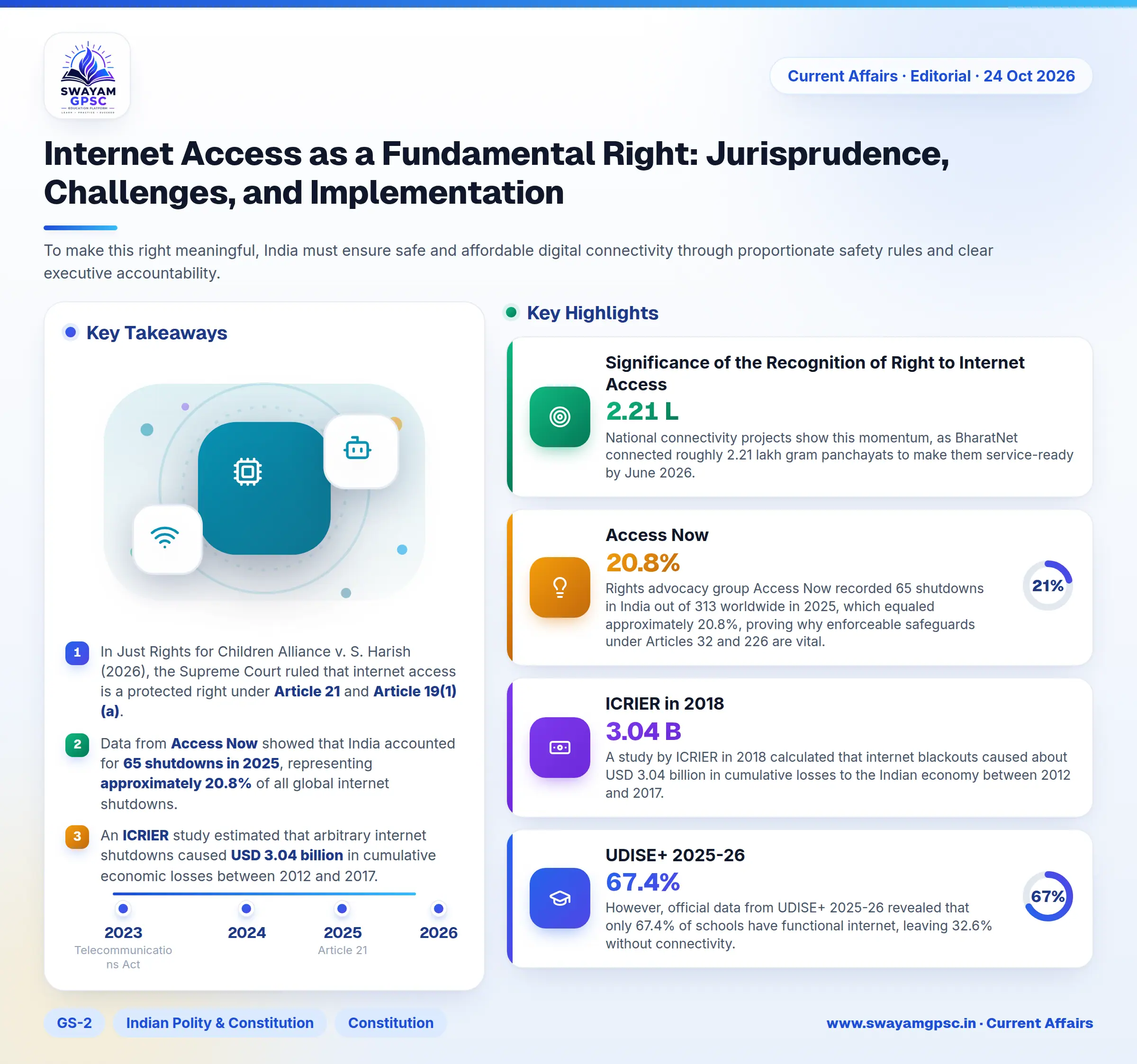
- In Just Rights for Children Alliance v. S. Harish (2026), the Supreme Court ruled that internet access is a protected right under Article 21 and Article 19(1)(a).
- Data from Access Now showed that India accounted for 65 shutdowns in 2025, representing approximately 20.8% of all global internet shutdowns.
- An ICRIER study estimated that arbitrary internet shutdowns caused USD 3.04 billion in cumulative economic losses between 2012 and 2017.
- Official UDISE+ 2025-26 data reveals that 32.6% of schools across India still lack functional internet facilities.
- Between financial years 2023-24 and 2025-26, India logged 53.88 lakh cyber-fraud complaints involving financial losses exceeding ₹56,087 crore.
Why in News
- In October 2026, the Supreme Court delivered a landmark judgment in Just Rights for Children Alliance v. S. Harish, recognising internet access under Article 21 and Article 19(1)(a).
- The judgment links digital connectivity directly with personal liberty, freedom of expression, education, and public participation, extending these constitutional protections to children.
- Renowned technologist Tim Berners-Lee has long advocated that internet connectivity must be viewed as a basic human right necessary for fair access to modern knowledge and life opportunities.
- However, millions of citizens still struggle with digital exclusion, arbitrary government shutdowns, and harmful online exploitation.
- To make this right meaningful, India must ensure safe and affordable digital connectivity through proportionate safety rules and clear executive accountability.
Key Judicial Pronouncements on the Right to Internet Access
- In Just Rights for Children Alliance v. S. Harish (2026), the Supreme Court formally confirmed that using the internet is protected under Article 21 alongside Article 19(1)(a) for all citizens, including minors.
- The Court rejected blanket bans that keep children offline to combat child sexual exploitation, choosing instead proportionate safety rules like parental oversight and protective account settings.
- The bench observed that barring children from digital spaces due to regulatory or tech-platform failures mistakes the victim for the problem, noting that digital safety and user freedom must coexist.
- At the same time, the Court clarified that authorities retain the power to restrict categories of online content that are clearly harmful to children.
- Earlier in Pragya Prasun v. Union of India (2025), the Court affirmed that digital access forms an inseparable part of life and liberty under Article 21.
- This ruling tackled inaccessible digital KYC systems hurting acid-attack survivors and visually impaired citizens by ordering accessible design alternatives, reasonable accommodation, and human reviews for rejected cases.
- The decision established a positive duty on the State to build accessible and inclusive digital welfare systems.
- In Anuradha Bhasin v. Union of India (2020), concerning the internet shutdown after the removal of Article 370 in Jammu and Kashmir, the Supreme Court ruled that expressing speech under Article 19(1)(a) and running businesses under Article 19(1)(g) through the internet are constitutionally protected fundamental rights.
- The Court ruled that any suspension of internet services must pass the constitutional test of proportionality, cannot remain indefinite, and must be the least intrusive measure available.
- It further ordered that all executive internet shutdown orders must be published openly so citizens can challenge them through judicial review.
- In Foundation for Media Professionals v. Union Territory of Jammu and Kashmir (2020), the Court addressed restrictions that limited mobile data to 2G speeds during the pandemic by forming a Special Committee led by the Union Home Secretary.
- The Court directed officials to consider narrower, district-level restrictions and test the return of high-speed mobile internet in select districts.
- The bench maintained scrutiny over security restrictions, though it stopped short of ordering an immediate territory-wide restoration of 4G speeds.
- In Faheema Shirin v. State of Kerala (2019), the Kerala High Court held that internet access forms an integral part of the Right to Privacy and the Right to Education under Article 21.
- The High Court struck down an unreasonable girls' hostel rule that seized student mobile phones during study hours and ordered the petitioner restored to her hostel accommodation.
Significance of the Recognition of Right to Internet Access as a Fundamental Right
- Placing digital access within Article 21 establishes a positive constitutional duty for the government to fix digital exclusion, inaccessible services, and weak network coverage.
- This creates a solid legal foundation to expand public broadband networks, raise digital literacy, and design accessible government portals for marginalized groups.
- National connectivity projects show this momentum, as BharatNet connected roughly 2.21 lakh gram panchayats to make them service-ready by June 2026.
- Constitutional recognition subjects network blackouts to strict legal standards of purpose, rational link, necessity, and proportionality, curbing arbitrary police and executive suspensions.
- Under Section 20 of the Telecommunications Act, 2023 and the Telecommunications (Temporary Suspension of Services) Rules, 2024, every shutdown order must be published with written reasons, explore softer alternatives, and remain capped at 15 days.
- Rights advocacy group Access Now recorded 65 shutdowns in India out of 313 worldwide in 2025, which equaled approximately 20.8%, proving why enforceable safeguards under Articles 32 and 226 are vital.
- Recognising digital trade under Article 19(1)(g) creates vital constitutional protections for gig workers, remote freelancers, small traders, and digital entrepreneurs who depend entirely on daily connectivity.
- Any government restrictions hitting digital livelihoods must strictly comply with Article 19(6) and satisfy proportionate administrative tests.
- A study by ICRIER in 2018 calculated that internet blackouts caused about USD 3.04 billion in cumulative losses to the Indian economy between 2012 and 2017.
- Giving constitutional weight to connectivity ensures that economic losses and lost daily earnings are formally weighed before administrators shut down local networks.
- Constitutional status forces welfare administrators to design inclusive systems, set up assisted desks, provide flexible verification, and maintain functional grievance portals.
- Digital welfare systems now handle vital public services, using DBT for welfare payments, UPI and Aadhaar-enabled Payment Systems for daily banking, and DigiLocker for verified personal records.
- The official dashboard lists 320 schemes across 56 ministries under the direct benefit framework, illustrating the vast scale of India's digital welfare delivery.
- Recognising connectivity as a fundamental right allows citizens to demand offline alternatives and manual help whenever network glitches or biometric errors block their pensions and food rations.
- Internet connectivity enables students from all economic backgrounds to access educational platforms like DIKSHA, SWAYAM, digital archives, and remote application forms.
- However, official data from UDISE+ 2025-26 revealed that only 67.4% of schools have functional internet, leaving 32.6% without connectivity.
- Constitutional recognition supports the legal demand that school curricula digitization must be matched by public funding for campus connectivity, student devices, and teacher training.
- True educational equality means a child's learning journey and academic prospects should never depend on family wealth or home zip codes.
- Protecting digital access aligns India's domestic legal standards with UN Human Rights Council Resolution 32/13 (2016), which states that rights held offline must be protected online.
- It also reinforces international commitments under UNCRC Article 13 on children's freedom of expression and UNCRC Article 17 regarding children's access to constructive information.
- These global conventions offer helpful guidance for creating child-friendly online governance that balances state security, digital safety, and individual personal freedoms.
- Constitutional recognition expands fair legal access by supporting e-filing, remote courtroom hearings, and digitized case trackers across the judiciary.
- A central government report from August 2026 showed that courts conducted over 4.18 crore cumulative video-conferencing hearings and set up 2,584 e-Sewa Kendras by June 2026.
- These digital court facilities dramatically lower travel expenses and physical hurdles for rural litigants, outstation witnesses, and people with severe physical disabilities.
Challenges Associated with Making Internet Access a Fundamental Right
- Courts and policymakers face tough questions when defining the baseline enforceable right, such as whether it guarantees basic network signals, subsidized devices, high-speed data, or round-the-clock uptime.
- India's regulatory benchmark defines broadband as a minimum download speed of 2 Mbps, but this slow speed cannot sustain heavy tasks like telemedicine, online schooling, or remote office work.
- Without concrete service benchmarks, legal disputes over sluggish networks and dropouts will cause conflicting court orders and administrative confusion.
- Turning constitutional promises into actual connectivity demands sustained public funds for last-mile cabling, backup electricity, network maintenance, and subsidized tariffs in remote villages.
- The huge outlay of ₹1,39,579 crore approved for the Amended BharatNet Programme shows the massive capital investments needed for nationwide fiber networks.
- Unfunded constitutional entitlements risk creating strong public expectations without the municipal budgets, inter-agency coordination, or field engineers needed to deliver them.
- The public's actual enjoyment of internet access depends almost entirely on private telecom operators who control local pricing, network coverage, service repairs, and customer disconnections.
- Data released by TRAI in August 2026 revealed that Reliance Jio and Bharti Airtel jointly held roughly 84% of reported broadband subscriptions, highlighting extreme market concentration.
- Regulators must figure out how to enforce public rights on private companies while balancing fair investor profits, open market competition, and reasonable contract terms.
- A citizen can live within network range but still remain excluded if they lack digital literacy, local-language options, accessible screen formats, or the skill to complete online forms.
- The NSO’s Comprehensive Modular Survey: Telecom, 2025 found that only 63.4% of rural youth aged 15-29 could carry out online banking, compared to 79.7% in urban areas.
- If governments assume that network coverage alone equals inclusion, they may push for digital-only public services that push vulnerable and less-skilled citizens toward predatory middle-men.
- Law enforcement agencies face genuine operational challenges in checking online terror planning, violence instigation, state-backed fake news, and leaked operational plans.
- During Operation Sindoor in 2025, the central government directed internet providers to block over 1,400 URLs carrying harmful content, showing the difficulty of targeting malicious accounts without infringing on general speech.
- Courts must ensure that state security agencies present concrete evidence and use narrowly tailored curbs rather than imposing blanket network blackouts.
- Efforts to make digital access safe can tempt authorities to demand mandatory identity checks, age scans, user tracking, and excessive personal data collection.
- A 2026 UNICEF study on social-media age restrictions highlighted the risks of using government identity databases, noting that poorly designed identity gates cause privacy breaches and unjustified account lockouts.
- Policymakers must carefully design age checks that protect personal anonymity and user safety without forcing every regular citizen to submit national ID documents to browse the web.
- Enforcing a universal right to digital connectivity is risky if police departments and banks lack the investigative tools to protect citizens from organized cyber crime.
- A July 2026 Home Ministry report revealed that citizens filed about 53.88 lakh cyber-fraud complaints involving losses exceeding ₹56,087 crore between financial years 2023-24 and 2025-26.
- Welfare beneficiaries who are pushed onto online portals often suffer severe losses when scam artists steal their savings and police portals fail to recover their stolen funds.
- Guaranteeing internet access to children creates serious regulatory duties to safeguard young minds from manipulative commercial feeds, grooming, sexual exploitation, and cyberbullying.
- A September 2026 report by UNICEF titled Through Children’s Eyes revealed that around 20 million children across 21 surveyed countries faced online sexual abuse in a single year.
- The core policy challenge lies in forcing digital platforms to implement strict child protections without spying on youth privacy or restricting their access to educational information.
Way Forward
- Parliament and state legislatures should enact a formal Digital Access Guarantee that sets clear legal standards for service availability, affordability, accessibility, and minimum operational speeds.
- This legal framework should separate immediate rights, like protection against arbitrary shutdowns, from capital-heavy duties like building remote fiber lines through phased schedules.
- Regulatory standards must verify whether connections are fast enough to complete vital tasks, fulfilling the Supreme Court's mandate in Pragya Prasun v. Union of India (2025).
- The government should deploy the Digital Bharat Nidhi to reward operators based on working home connections, verified uptime, and rapid fault resolution rather than raw cable laying.
- Infrastructure tenders must mandate shared cell towers, ring-fenced fiber lines, local battery reserves, and satellite backups to keep remote and disaster-prone belts connected.
- Gujarat set a practical example with its 2025 Amended BharatNet agreement, which covers 14,654 gram panchayats with a mandatory service uptime target of over 98%.
- The administration should launch targeted digital vouchers for low-income students, disabled individuals, and poor households to purchase open-market internet packs.
- States should set up community device-lending banks, supply refurbished tablets, and support women-led self-help groups running local PM-WANI Wi-Fi hotspots.
- Public Wi-Fi networks can expand rapidly by leveraging the May 2026 PM-WANI reforms, which introduced quick QR-code authentication for secondary devices alongside flexible, low-cost daily data packs.
- All government digital portals must undergo compulsory user testing and comply strictly with GIGW 3.0 and WCAG 2.1 Level AA web accessibility rules.
- Public welfare departments must retain offline desks and alternative identification procedures so that temporary internet dropouts do not deny citizens their legal welfare entitlements.
- Every proposed regional internet shutdown should require a written proportionality assessment that explicitly considers public hardship and tests softer administrative alternatives.
- The government should build a public online database recording all shutdown orders, citing their legal reasons, geographic limits, sunset dates, and review board decisions.
- Digital platforms and public services frequented by children should implement privacy-by-design standards, default incognito settings, simple consent flows, and one-click abuse reporting tools.
- Safety systems should mandate strictly targeted scans for child sexual abuse material, backed by clear legal safeguards and independent audits to stop executive mission-creep.
- The government should establish district-level cyber assistance cells connecting local police stations and bank branches directly with the I4C and the national 1930 helpline.
- Law enforcement should upgrade the operational capacity of the Money Restoration and Grievance Redressal Modules, launched in April 2026, to freeze stolen funds and return money to scam victims rapidly.
- Authorities should launch an accessible, multilingual single-window grievance portal accessible via phone, text, and physical centers to handle consumer broadband complaints.
- Regulators must enforce automatic financial refunds for sustained service outages and publish monthly district-wise telecom performance scorecards.
Conclusion
- As entrepreneur Richard Branson observed, denying people internet access deprives millions of an equal opportunity to build better lives.
- Judicial recognition of internet connectivity is only the first step; India must urgently eliminate digital infrastructure gaps, curb arbitrary shutdowns, and make the digital ecosystem secure and inclusive.