SCO: Strategic Opportunities and Key Challenges for India
#GS-2 #Current Events #National #International #Indian Polity & Constitution #Executive #Governance & Social Justice #Regulatory Bodies #GS-3 #Economy #Infrastructure #Growth #Trade #Energy #India and its Neighbourhood #Effect of Policies & Politics of Countries on India's Interests #Groupings & Agreements Involving India and/or Affecting India's Interests
Key takeaways
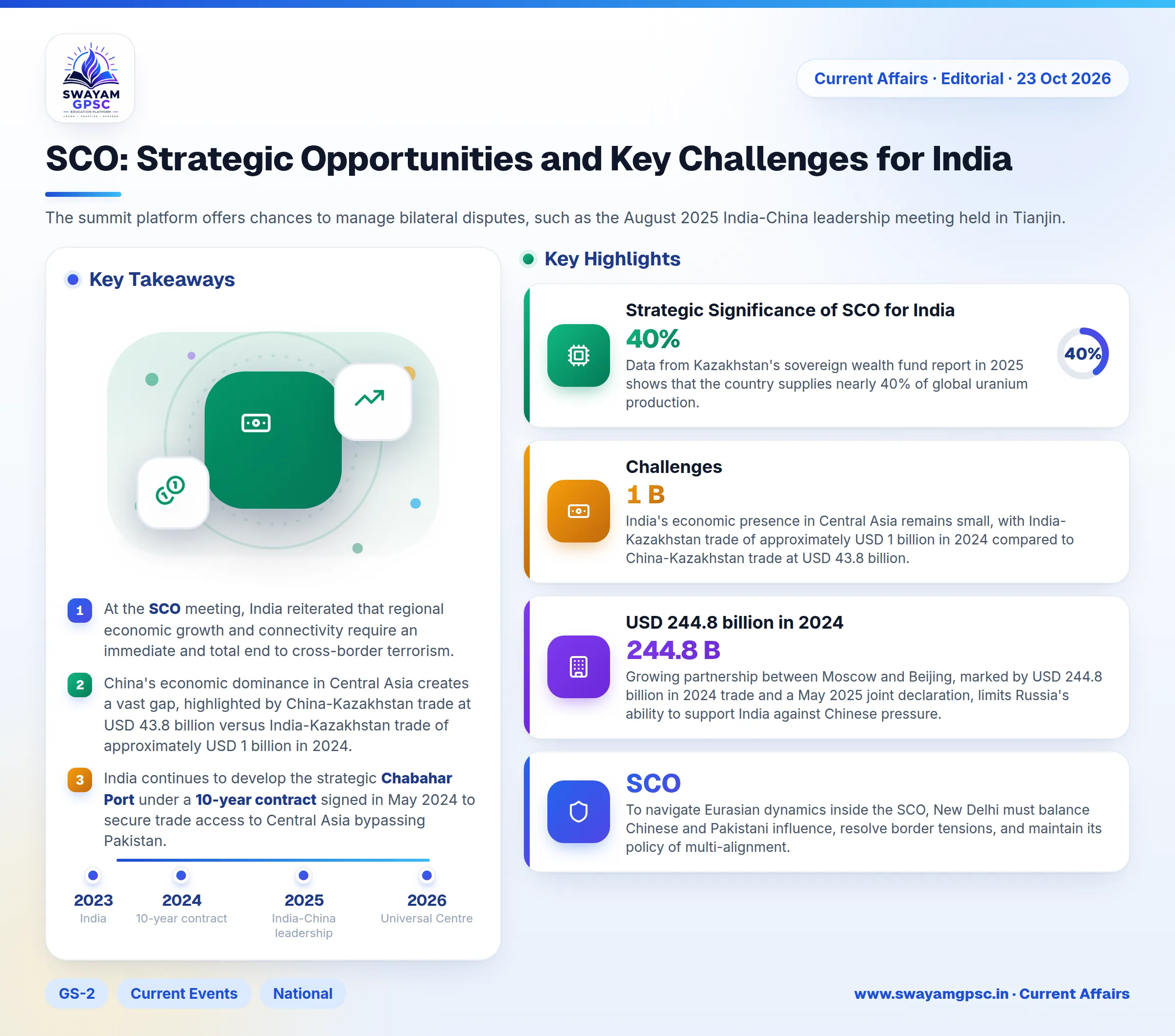
- At the SCO meeting, India reiterated that regional economic growth and connectivity require an immediate and total end to cross-border terrorism.
- China's economic dominance in Central Asia creates a vast gap, highlighted by China-Kazakhstan trade at USD 43.8 billion versus India-Kazakhstan trade of approximately USD 1 billion in 2024.
- India continues to develop the strategic Chabahar Port under a 10-year contract signed in May 2024 to secure trade access to Central Asia bypassing Pakistan.
- Central Asian resource access remains vital for India, with Kazakhstan alone providing nearly 40% of global uranium production according to official reports.
- India preserves its foreign policy independence by remaining active in non-Western forums like the 10-member SCO while building partnerships within the Quad and G7.
Why in News
- At the Shanghai Cooperation Organisation (SCO) Council of Heads of Government meeting in Tajikistan, India emphasized that regional economic cooperation requires ending cross-border terrorism.
- External Affairs Minister S. Jaishankar highlighted that India now acts as a shaper and decider in global politics rather than a passive onlooker.
- To navigate Eurasian dynamics inside the SCO, New Delhi must balance Chinese and Pakistani influence, resolve border tensions, and maintain its policy of multi-alignment.
Strategic Significance of SCO for India
- The SCO is a 10-member grouping that gives India a permanent seat alongside Russia, China, Iran, and four Central Asian nations to protect its continental interests.
- Membership allows India to practice multi-alignment by engaging with competing global powers while preserving its independent decision-making.
- The summit platform offers chances to manage bilateral disputes, such as the August 2025 India-China leadership meeting held in Tianjin.
- India uses the Regional Anti-Terrorist Structure (RATS) to fight terrorism, radicalization, and terror funding through joint efforts like the Pabbi-Anti terror joint exercise.
- During 2025, India led a Joint Information Operation targeting Al-Qaeda and its affiliated organisations.
- India supported expanding the security structure at the October 2026 meeting by welcoming permanent offices for the Universal Centre in Tashkent and the Anti-Drug Centre in Dushanbe.
- The SCO gives India a direct platform to address security, peace, and humanitarian issues in Afghanistan, as highlighted at the Bishkek Summit in September 2026.
- India has built long-term goodwill in the region by executing over 500 development partnership projects across all 34 Afghan provinces.
- India uses the SCO to advance major trade routes like Chabahar Port and the International North-South Transport Corridor (INSTC) to connect with Central Asian markets.
- The 10-year contract signed in May 2024 to operate the Shahid Beheshti terminal at Chabahar provides a solid commercial base for Indian regional trade.
- India reaffirmed its support for these trade corridors during the October 2026 SCO meeting while referencing a Mumbai symposium on infrastructure funding.
- Active participation stops the SCO from turning into an anti-Western bloc controlled entirely by China or used for Pakistan-backed narratives.
- India uses its veto power to block anti-India statements and reject non-transparent initiatives like the Belt and Road Initiative (BRI) and the China-Pakistan Economic Corridor (CPEC) in PoK.
- Engagement with Eurasian energy giants strengthens the Connect Central Asia Policy, securing strategic items like Kazakh uranium, Uzbek gold/rare-earth reserves, and Turkmen natural gas.
- Data from Kazakhstan's sovereign wealth fund report in 2025 shows that the country supplies nearly 40% of global uranium production.
- At the September 2026 SCO trade ministers' meeting, India requested focused cooperation in critical minerals, energy security, renewable energy, and green hydrogen.
- The Multilateral Trade and Economic Cooperation Action Plan for 2026-2030 was adopted in October 2026 to make paperless trade and cross-border payments easier for smaller businesses.
- India prioritized partnership in pharmaceuticals, agriculture, manufacturing and electronics while seeking lower transit costs for its exports.
- India shares its expertise in Digital Public Infrastructure, financial tools, and entrepreneurship across Eurasia by creating platforms like the SCO Startup Forum.
- The Startup Forum in Dushanbe held in September 2026 demonstrated this success by drawing over 1,000 participants including investors and tech leaders.
- India deepens cultural ties and educational exchanges across Eurasia, having hosted more than 140 meetings and events, including 14 ministerial meetings during its 2022-23 chairmanship.
- The 2026 Bishkek Summit formally acknowledged India's plans to host the upcoming SCO Civilisation Dialogue Forum later in 2026.
- India balances its membership in Western groups like the Quad, I2U2, and G7 with non-Western blocs like the SCO and BRICS+ under a non-Western but not anti-Western stance.
Overview of the Shanghai Cooperation Organisation
- The SCO is a permanent international body created on 15th June 2001 in Shanghai, China to improve security, political stability, and trade across Eurasia.
- It grew out of the Shanghai Five group formed in 1996 by China, Russia, Kazakhstan, Kyrgyzstan, and Tajikistan, before Uzbekistan joined in 2001.
- The 10 members of the group are Belarus, China, India, Iran, Kazakhstan, Kyrgyzstan, Pakistan, Russia, Tajikistan, and Uzbekistan.
- India and Pakistan became full members in 2017, followed by Iran in 2023 and Belarus in 2024.
- The main goals of the group are keeping regional peace, stopping extremism, and expanding trade, energy, and educational ties.
- The organization follows the Shanghai Spirit, which focuses on mutual trust, equality, respect for different cultures, and shared growth.
- The central Secretariat operates from Beijing, while the Regional Anti-Terrorist Structure executive body stays in Tashkent.
India and the SCO
- India originally joined as an SCO observer in 2005 before securing full membership status in June 2017.
- India led the Council of Heads of Government in 2020 and held the 2022-2023 presidency, hosting the July 2023 virtual summit.
- The SECURE framework proposed at the 2018 Qingdao Summit guides India's focus on Security, Economy, Connectivity, Unity, Sovereignty, and Environment.
- India participated in the SCO Peace Mission 2018 joint exercise and chaired RATS in 2021-2022.
- India started the Startup Forum and permanently leads the Startups and Innovation Working Group while advancing Traditional Medicine.
- The city of Varanasi served as the first Cultural and Tourism Capital in 2022-23, and Mumbai hosted an infrastructure financing meeting in October 2026.
Challenges
- China uses its financial strength inside the group to promote the Belt and Road Initiative (BRI) and announced 100 technological cooperation projects over 3 years at the Bishkek Summit.
- India opposes the China-Pakistan Economic Corridor (CPEC) because it runs through Indian sovereign territory illegally occupied by Pakistan.
- Member states disagree on terrorism definitions, leading India to reject a joint document at the June 2025 Qingdao Defence Ministers' Meeting due to weak text on cross-border terror.
- A July 2025 parliamentary reply confirmed that the Qingdao meeting ended with no agreed outcome document because consensus was absent.
- Pakistan refuses to give India land transit rights, forcing India to rely on longer sea routes to access Central Asian markets.
- Alternative trade routes using Iran's Chabahar Port and the INSTC face operational delays, high costs, and geopolitical hurdles.
- India's economic presence in Central Asia remains small, with India-Kazakhstan trade of approximately USD 1 billion in 2024 compared to China-Kazakhstan trade at USD 43.8 billion.
- Western sanctions against Iran create payment and insurance problems for Indian firms, as seen in February 2026 when Parliament learned US sanction waivers were expiring.
- A July 2026 parliamentary response acknowledged that the sanctions waiver had expired, leaving the project dependent on ongoing diplomatic talks.
- Member nations hold different views on Afghanistan, highlighted when Russia formally recognised the Taliban government in July 2025 while India demands women's rights and inclusion first.
- Growing partnership between Moscow and Beijing, marked by USD 244.8 billion in 2024 trade and a May 2025 joint declaration, limits Russia's ability to support India against Chinese pressure.
- Attempts by Russia and China to turn the group into an anti-Western alliance conflict with India's foreign policy goal of remaining non-Western but not anti-Western.
Way Forward
- India should form smaller groups with Central Asian nations on specific topics using Article 16 of the SCO Charter, which allows select members to run joint projects without all members joining.
- India needs to propose a unified terrorism protocol with strict guidelines for sharing evidence and tracking digital financial crimes like cryptocurrency abuse.
- Establishing a clear corridor arrangement for the Chabahar Port and INSTC will reduce customs delays, lower freight costs, and speed up transit times.
- India can boost exports by linking its technical industries with Central Asian partners, such as joining Indian food processing tools with Kazakh farming resources.
- Setting up a dedicated export desk for small businesses will help Indian firms use diplomatic access to secure actual business orders.
- India can expand its digital footprint across Central Asia by sharing open-source Digital Public Infrastructure tools and running joint startup challenges.
- Securing supply agreements for rare-earth metals and energy with Central Asian nations will protect India's clean energy transition and high-tech manufacturing.
- Setting up an inter-ministerial cell to track all SCO commitments will ensure Indian project targets are met on time with complete transparency.