UNFPA Demographic Futures Survey 2026 Key Insights
#GS-1 #Geography #Population #GS-2 #Indian Society #Vulnerable Sections #GS-3 #Current Events #International #Demographics #UNFPA
Why in News
- The United Nations Population Fund (UNFPA) released its major global study titled Lives, Choices and Futures - Demographic Futures Survey 2026.
About the UNFPA Demographic Futures Survey 2026
- This cross-national study examines the aspirations, relationship patterns, and family decisions of young adults aged 18 to 39.
- The survey collected comparative data from 108,926 internet-connected young adults across 73 countries and territories to understand adulthood transitions.
Key Findings of the Report
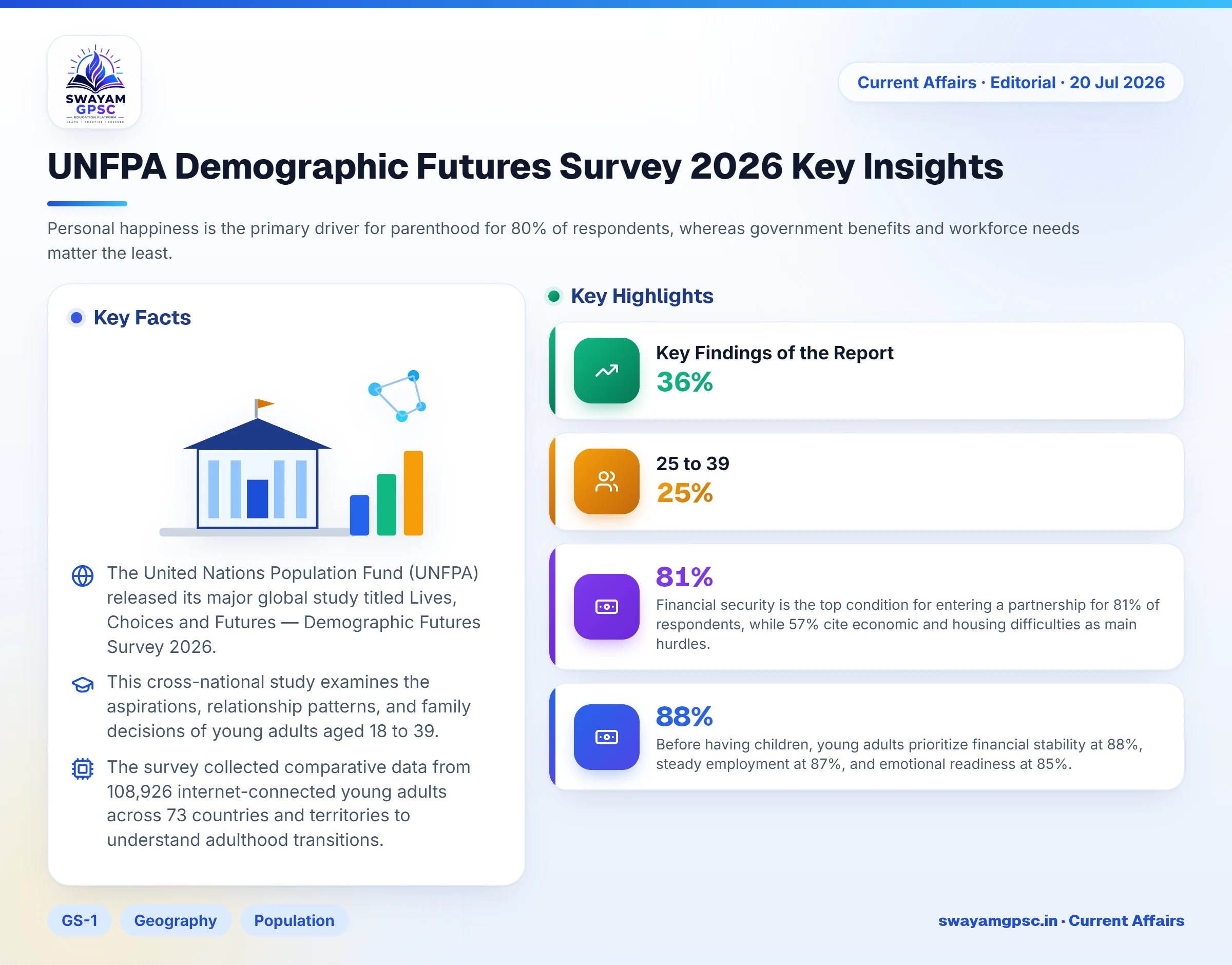
- Marriage remains popular, as over two-thirds of young adults prefer living arrangements with marriage, including 36% favoring marriage before cohabitation and 34% after cohabiting.
- A significant gap exists between desires and reality, where 25% of respondents aged 25 to 39 who want a partner are currently single, including 30% of men and 19% of women.
- Financial security is the top condition for entering a partnership for 81% of respondents, while 57% cite economic and housing difficulties as main hurdles.
- Before having children, young adults prioritize financial stability at 88%, steady employment at 87%, and emotional readiness at 85%.
- Personal happiness is the primary driver for parenthood for 80% of respondents, whereas government benefits and workforce needs matter the least.
- High living costs and housing constraints form the largest barrier to parenthood for 72% globally, followed by partner availability and health issues.
- Actual fertility is declining, as older adults aged 35 to 39 have fewer children than the ideal family size desired by younger cohorts aged 18 to 39.
- In India, women aged 18 to 39 desire an ideal size of 2.1 children but actually have 1.0 child by age 35 to 39, while Indian men desire 2.2 children versus 1.1 actual.
Positives Identified in the Survey
- Youth optimism remains strong, with 66% of global respondents feeling positive about their future, led by West & Central Africa at 62% very positive.
- In India, nearly 85% of childless respondents aged 35 to 39 express a strong desire to become parents if conditions allow.
- Around 58% of respondents agree that young people in their countries have solid life opportunities, especially in developing nations.
- Young adults find partners through personal networks at 33%, work or school at 28%, and digital platforms at 16%.
Challenges
- High living costs, expensive housing, and job instability delay both relationship formation and family expansion for young adults.
- Broad societal worries affect youth, as over three-quarters express anxiety about war, safety risks, economic insecurity, and social inequality.
- Gender inequality in childcare remains high, with 29% disapproving of a full-time working mother with a child under three compared to 20% for a working father.
- Only 39% of respondents feel their governments offer enough institutional support to young families, while employers also offer limited work-life balance support.
Way Forward
- Governments must create economic policies that promote job stability, wage growth, and affordable housing options for young adults.
- Countries need to expand public childcare and provide gender-equitable parental leave so parents can balance careers and family life effectively.
- Societies should address workplace gender bias and encourage an equal sharing of household work and childcare responsibilities.
- Population policies must move away from strict birth target goals to empowering personal reproductive choices and offering strong public support.
Conclusion
- The UNFPA 2026 report shows that declining birth rates stem from economic and social constraints rather than a loss of interest in family life.
- Governments must reduce structural hurdles and provide stable employment and housing so young people can freely form the families they desire.