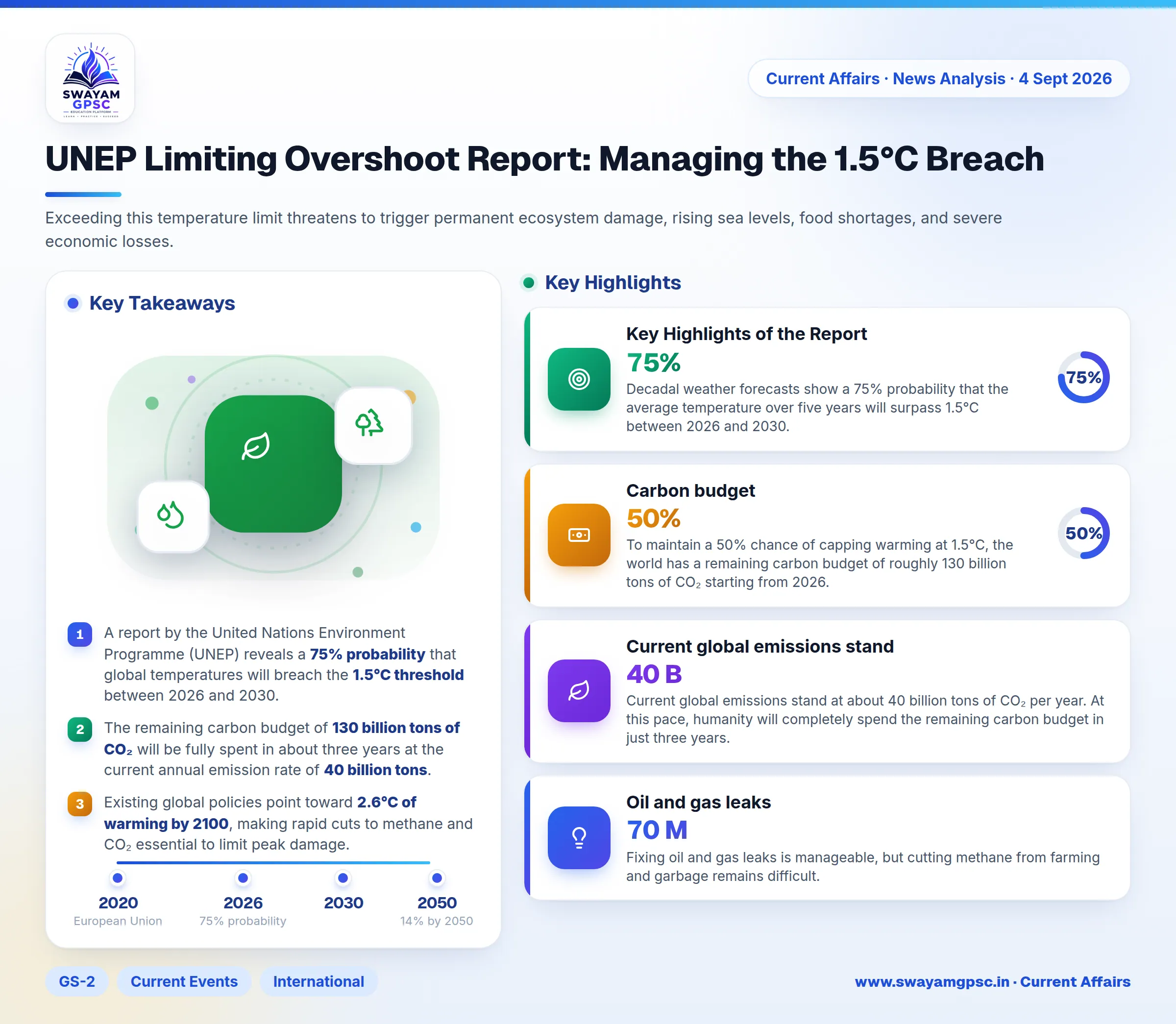
UNEP Limiting Overshoot Report: Managing the 1.5°C Breach
#GS-2 #Current Events #International #GS-3 #Environment #Climate Change #Pollution #Sustainable Development #International Treaties & Agreements
Key takeaways
- A report by the United Nations Environment Programme (UNEP) reveals a 75% probability that global temperatures will breach the 1.5°C threshold between 2026 and 2030.
- The remaining carbon budget of 130 billion tons of CO₂ will be fully spent in about three years at the current annual emission rate of 40 billion tons.
- Existing global policies point toward 2.6°C of warming by 2100, making rapid cuts to methane and CO₂ essential to limit peak damage.
- Developing nations face USD 395 billion in annual climate needs, yet existing pledges total only USD 800 million, requiring non-debt financial transfers.
Why in News
- The United Nations Environment Programme (UNEP) published a report named Limiting Overshoot: Navigating Exceedance of 1.5°C and Pathways Towards Return. It warns that global warming will almost certainly cross the 1.5°C threshold under Paris Agreement temporarily in the near future.
- The report presents an overshoot, peak, and decline strategy to limit maximum temperatures and guide the planet back toward safe environmental limits over several decades.
Summary
- The UNEP report warns that crossing the 1.5°C target temporarily is now nearly unavoidable. To control peak warming, nations must quickly cut carbon dioxide and methane, expand renewable energy, and use carbon removal responsibly.
- Exceeding this temperature limit threatens to trigger permanent ecosystem damage, rising sea levels, food shortages, and severe economic losses. To counter these threats, the report urges transformational adaptation, expanded loss and damage funds, climate justice, and stronger global partnership.
Key Highlights of the Report
- Human activities have already driven global temperatures to 1.4°C above pre-industrial levels, with warming increasing by about 0.25°C per decade.
- Decadal weather forecasts show a 75% probability that the average temperature over five years will surpass 1.5°C between 2026 and 2030.
- To maintain a 50% chance of capping warming at 1.5°C, the world has a remaining carbon budget of roughly 130 billion tons of CO₂ starting from 2026.
- Current global emissions stand at about 40 billion tons of CO₂ per year. At this pace, humanity will completely spend the remaining carbon budget in just three years.
- Delaying action creates cumulative costs. Every extra five years of high emissions adds 0.1°C to peak warming, while post-2015 emissions have already raised the lowest reachable peak by 0.2°C.
- Existing national policies put the planet on track for a median warming of 2.6°C by 2100, with potential outcomes ranging between 1.9°C and 3.6°C.
- Even if countries fully meet all Nationally Determined Contributions (NDCs) and long-term Net-Zero targets, global peak warming will still reach 1.8°C.
- Breaching the target brings severe dangers. Every fraction of a degree increase raises the risk of triggering irreversible environmental tipping points.
- Cutting methane mitigation offers the most effective short-term climate action, as methane emissions currently cause about 0.5°C of global warming.
- Because methane has a brief atmospheric lifetime, reducing it cools the atmosphere much faster than matching cuts in carbon dioxide.
- Fixing oil and gas leaks is manageable, but cutting methane from farming and garbage remains difficult. Removing 60-70 million tonnes of hard-to-abate methane emissions equals the cooling impact of removing 220 gigatonnes (Gt) of CO₂.
- Launched at COP26 by the European Union and the United States, the Global Methane Pledge includes over 155 countries aiming to cut human-made methane by 30% from 2020 levels by 2030. However, major emitters such as India, China, Russia, and Iran have not signed it.
- The United States, historically the largest contributor to global emissions, formally exited the Paris Agreement and announced departures from the UNFCCC, IPCC, and Green Climate Fund.
- The 2026 conflict in West Asia triggered a major oil shock by reducing daily production by over 14 million barrels. High fuel prices risk forcing governments back to coal and short-term fossil fuel use.
The Overshoot, Peak, and Decline Pathway
- Exceedance (Overshoot) marks the initial phase where global warming goes above the 1.5°C target before reaching its highest point.
- Plateau / Peak represents the stage when global temperatures reach their maximum point above 1.5°C and flatten out before beginning to drop.
- Decline is the period when global temperatures steadily fall from their maximum level due to sustained net-negative global emissions.
- Stabilization happens when global temperatures fall back to or below the 1.5°C target, keeping climate risks at a safer level.
Compounding Costs of Breaching 1.5°C
- By 2100, glaciers outside Greenland and Antarctic ice sheets could lose 25-40% or more of their mass. This loss will add 9 to 15.4 cm to sea-level rise, while slow sea-ice recovery keeps absorbing extra solar heat.
- Sea levels will continue rising for centuries due to warming deep oceans and melting ice sheets. Every 100 years above 1.5°C could add 40 cm of median sea-level rise by 2300.
- Ocean acidification and deoxygenation will persist for centuries because deep ocean currents and chemical balances take a long time to recover.
- Global food production could drop by as much as 14% by 2050 unless nations adopt effective agricultural adaptation strategies.
- Prolonged warming increases the threat of disrupting or collapsing the Atlantic Meridional Overturning Circulation (AMOC), which could take centuries to recover.
- Combined warming and deforestation could turn the Amazon from a carbon sink into a net carbon source through widespread forest dieback.
- Portions of the West Antarctic Ice Sheet may face permanent collapse even under relatively low levels of global warming.
UNEP Recommendations for Managing Climate Overshoot
- World leaders must expand the Fund for Responding to Loss and Damage (FRLD) before peak warming occurs and direct money using tools like the Multidimensional Vulnerability Index (MVI).
- Developing nations need USD 395 billion annually to tackle climate impacts, but current promises total only USD 800 million. Rich nations must fill this gap using non-debt financial grants.
- In developing nations, every USD 1 invested in resilient infrastructure can generate around USD 4 in avoided disaster losses, proving the economic value of climate-resilient infrastructure.
- Countries must immediately execute deep cuts in CO₂ and methane because the window to prevent a prolonged 1.5°C overshoot is closing fast.
- Governments should shift long-term targets from basic Net-Zero goals to legally binding Net-Negative GHG targets after mid-century.
- Under the Common But Differentiated Responsibilities and Respective Capabilities (CBDR-RC) rule, developed economies must reach net-negative emissions first to leave atmospheric space for developing nations.
- Nations must raise the share of renewables to 60-70% of global electricity generation by 2030, backed by stronger power grids, battery storage, and flexible demand.
- Deployment of Carbon Dioxide Removal (CDR) must support aggressive emission reductions rather than replace them. Strong rules must manage land limits and risks for conventional methods like afforestation and novel tools like Direct Air Capture.
- The international community must create legal protections under UNCLOS to preserve the sovereignty and Exclusive Economic Zones (EEZs) of Small Island Developing States (SIDS) even if rising seas submerge their land.
- Governments must protect jobs, expand social safety nets, involve communities, and distribute transition costs fairly to ensure a just transition.
- Policy makers should treat protected areas as climate infrastructure, safeguarding natural ecosystems while preventing downgrading, downsizing and extractive encroachment.
- Global partners should invest in long-term weather monitoring tools in poor regions and strengthen the science-policy interface by blending scientific, Indigenous, and local knowledge.
Way Forward
- The UNEP report emphasizes that breaching 1.5°C reflects past delays but is not a reason for resignation.
- Global action must focus on combining rapid emission cuts with adaptation, because preventing every fraction of warming and investing in climate-resilient infrastructure protects vulnerable populations from irreversible harm.