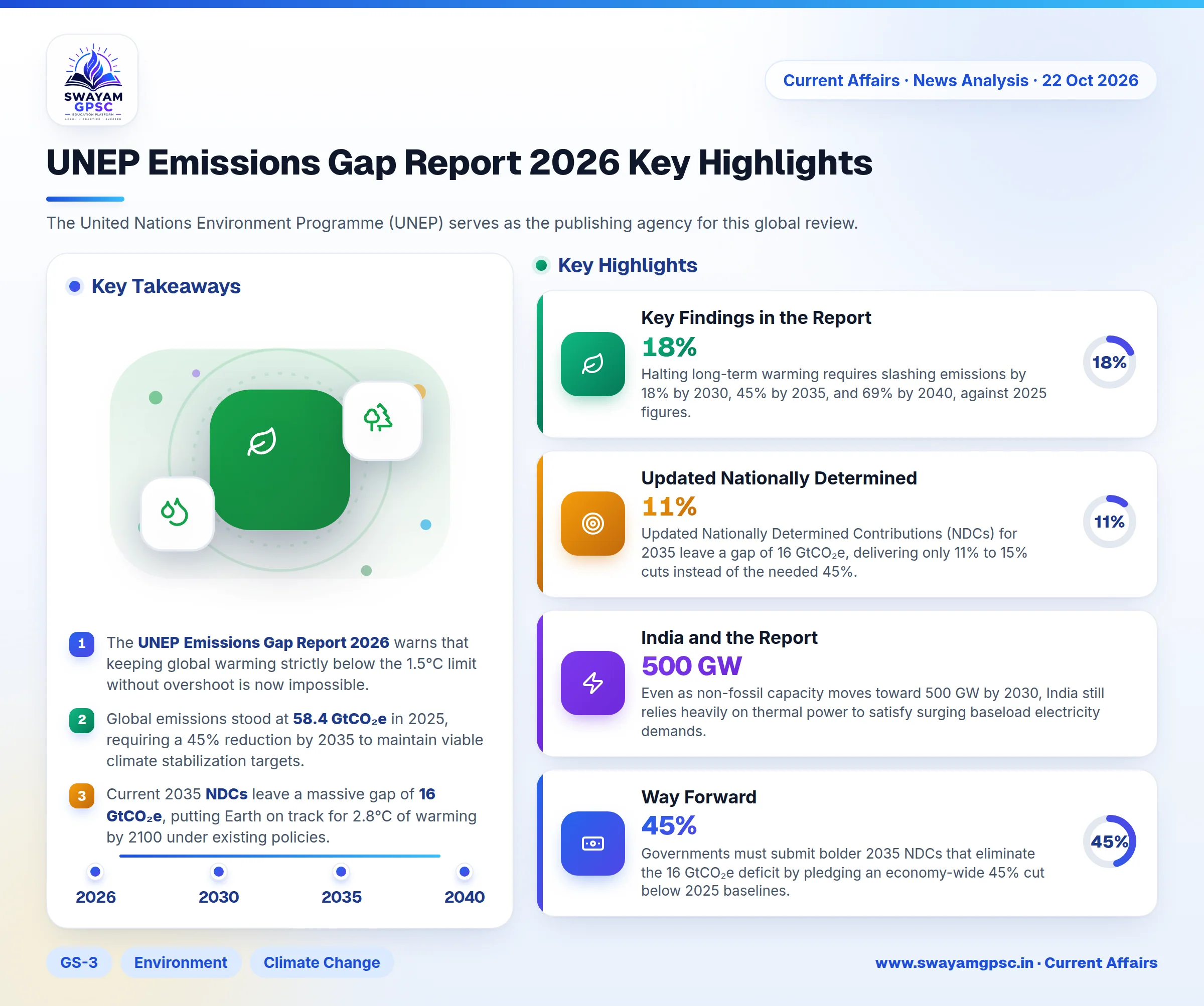
UNEP Emissions Gap Report 2026 Key Highlights
#GS-3 #Environment #Climate Change #Sustainable Development #International #Current Events
Key takeaways
- The UNEP Emissions Gap Report 2026 warns that keeping global warming strictly below the 1.5°C limit without overshoot is now impossible.
- Global emissions stood at 58.4 GtCO₂e in 2025, requiring a 45% reduction by 2035 to maintain viable climate stabilization targets.
- Current 2035 NDCs leave a massive gap of 16 GtCO₂e, putting Earth on track for 2.8°C of warming by 2100 under existing policies.
- India is projected to meet its 2030 and 2035 NDC pledges under current policies, with 2035 per capita emissions estimated at only 3.6 tCO₂e.
- Limiting temperature overshoot demands removing approximately 320 GtCO₂ over this century using carbon dioxide removal systems.
Why in News
- The United Nations Environment Programme (UNEP) published the Emissions Gap Report 2026: The Point of Return.
- The assessment cautions that keeping global warming strictly below the 1.5°C limit without overshoot is no longer possible.
About the Report
- This release marks the 17th edition of the yearly assessment measuring the difference between national climate pledges and pathways needed for the Paris Agreement.
- The United Nations Environment Programme (UNEP) serves as the publishing agency for this global review.
Key Findings in the Report
- Insufficient worldwide cuts have made overshooting the 1.5°C threshold virtually inevitable.
- Worldwide emissions stayed near 58.4 GtCO₂e in 2025, as falling land-use emissions offset expanding fossil fuel use.
- Halting long-term warming requires slashing emissions by 18% by 2030, 45% by 2035, and 69% by 2040, against 2025 figures.
- Updated Nationally Determined Contributions (NDCs) for 2035 leave a gap of 16 GtCO₂e, delivering only 11% to 15% cuts instead of the needed 45%.
- Current national policies risk warming of 2.8°C by 2100, whereas honoring all conditional pledges could curb it to 2.1°C.
- Managing temperature overshoot demands extracting roughly 320 GtCO₂ this century, presenting massive technical, ecological, and economic hurdles.
- Solar generation expanded sevenfold faster than 2015 forecasts, but persistent coal, oil, and gas consumption continues to hamper climate gains.
India and the Report
- Existing policies put India on course to meet its 2030 and 2035 Nationally Determined Contribution goals without extra domestic curbs.
- Because India frames targets around emissions intensity of GDP, its gross carbon volumes expand alongside economic expansion despite higher efficiency.
- India's forecasted 2035 per capita volume of 3.6 tCO₂e sits much lower than levels in China at 9.3 tCO₂e, Russia at 11.5 tCO₂e, and Saudi Arabia at 15.2 tCO₂e.
- Even as non-fossil capacity moves toward 500 GW by 2030, India still relies heavily on thermal power to satisfy surging baseload electricity demands.
Challenges
- Political shifts and withdrawals among major emitters damage global consensus and weaken collective efforts.
- For instance, the exit of the United States from the Paris Agreement undermines unified momentum and could add 0.1°C to 0.25°C to 2100 warming.
- Over-relying on speculative carbon removal systems offers false hope while hitting harsh ecological limits.
- For example, approaches like Bioenergy with Carbon Capture and Storage (BECCS) and direct air capture spark severe resource conflicts over land, water, and clean power to scrub 320 GtCO₂.
- Although coal use nears a peak before 2030, global reliance on petroleum products and transport sectors continues to grow.
- For example, public and private capital continues backing new liquefied natural gas plants and offshore oil wells, locking in fossil use through 2035.
- Forest clearing persists worldwide, requiring a tenfold speedup in preservation work to halt loss by 2030 under the global stocktake target.
- For instance, ongoing farming expansion across tropical rainforests cancels out carbon captured by afforestation initiatives elsewhere.
Way Forward
- Governments must submit bolder 2035 NDCs that eliminate the 16 GtCO₂e deficit by pledging an economy-wide 45% cut below 2025 baselines.
- Nations need to triple clean power and push the global electricity adoption share to 35% by 2035 under targets agreed in the Global Stocktake.
- Authorities must halt permits for unmitigated fossil projects, phase out fossil fuel subsidies, and channel funds into large battery storage and green hydrogen.
- Policymakers should introduce integrated mixes of carbon pricing, sector rules, and public investments tailored to local economies with rigorous impact checks.
- The international community must build transparent oversight systems and environmental limits for carbon removal technologies to avert illicit land acquisitions.
Conclusion
- The findings make clear that humanity cannot escape exceeding the 1.5°C guardrail, turning climate action into a drive to shorten this overshoot.
- Rapid clean power deployment cannot counteract sustained fossil combustion and delayed peaking dates among major industrial economies.
- Preventing catastrophic climate shifts demands translating updated 2035 NDC pledges into rapid, deep emission reductions to secure recovery before century's end.