Understanding UAPA and Preventive Detention Laws
#GS-3 #Economy #Infrastructure #Governance & Social Justice #Current Events #National #Terrorism in Hinterland & Border Areas #Various Security Forces & Agencies & Their Mandate
Key takeaways
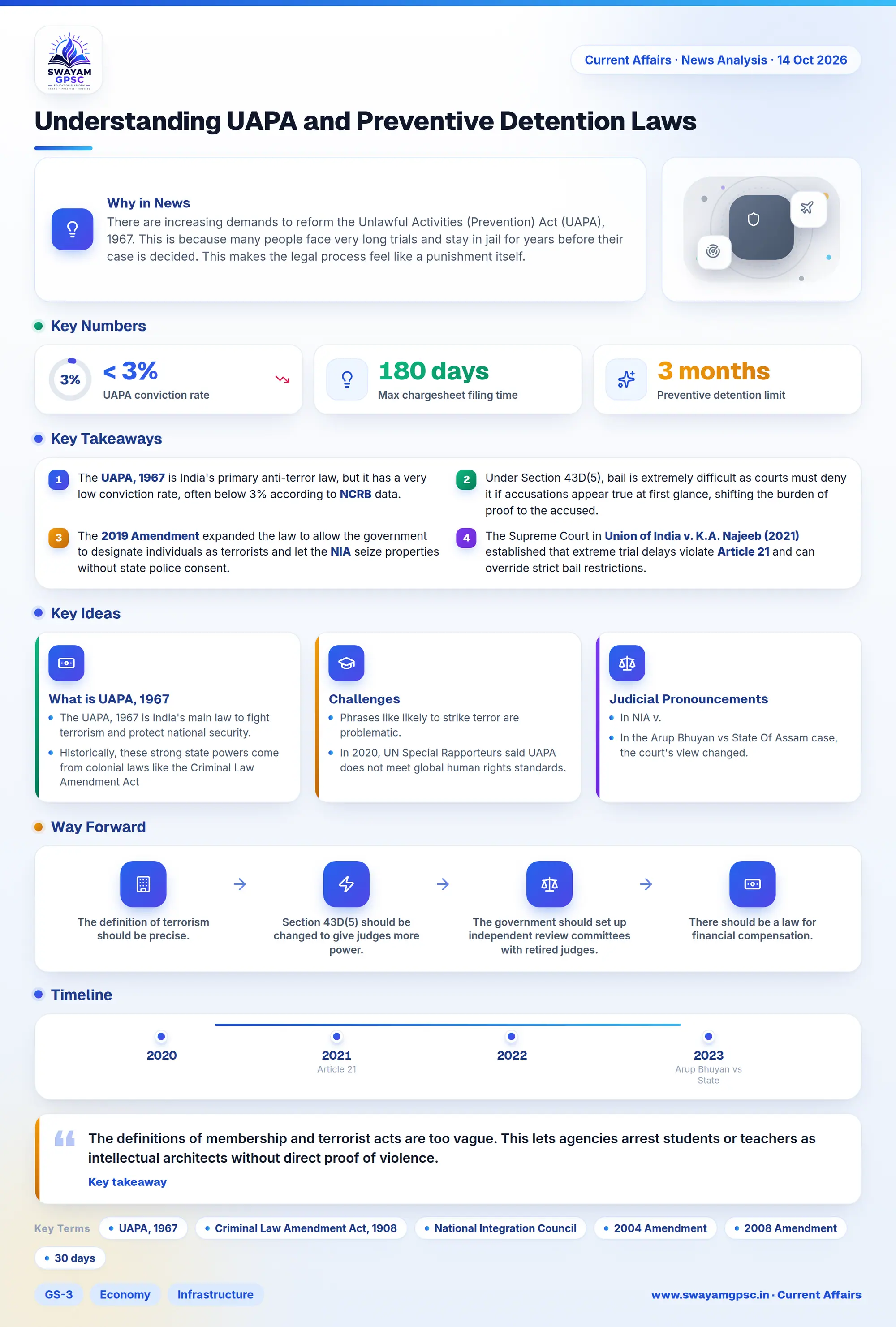
- The UAPA, 1967 is India's primary anti-terror law, but it has a very low conviction rate, often below 3% according to NCRB data.
- Under Section 43D(5), bail is extremely difficult as courts must deny it if accusations appear true at first glance, shifting the burden of proof to the accused.
- The 2019 Amendment expanded the law to allow the government to designate individuals as terrorists and let the NIA seize properties without state police consent.
- The Supreme Court in Union of India v. K.A. Najeeb (2021) established that extreme trial delays violate Article 21 and can override strict bail restrictions.
- Preventive detention under Article 22 allows the state to detain individuals without trial for up to 3 months before Advisory Board review is needed.
Why in News
- There are increasing demands to reform the Unlawful Activities (Prevention) Act (UAPA), 1967. This is because many people face very long trials and stay in jail for years before their case is decided. This makes the legal process feel like a punishment itself.
What is UAPA, 1967
- The UAPA, 1967 is India's main law to fight terrorism and protect national security. It started by focusing on people trying to separate parts of India from the country, but it now covers modern terrorism and economic threats.
- Historically, these strong state powers come from colonial laws like the Criminal Law Amendment Act, 1908 and the Rowlatt Act, 1919.
- The law began based on suggestions from the National Integration Council under PM Jawaharlal Nehru to stop communalism and regional conflicts.
- It was created to implement the 16th Constitutional Amendment (1963). This amendment allows the government to put reasonable limits on free speech and assembly to protect India's sovereignty.
- In 1967, the law only dealt with unlawful activities. It did not actually use the word terrorism in its original version.
- After the Prevention of Terrorism Act (POTA), 2002 was cancelled in 2004, its main rules were added to the UAPA. This included definitions for terrorist acts and organisations.
- The 2004 Amendment added Chapter IV. It defined terrorist acts as violent actions that threaten national security or create terror.
- After the 26/11 attacks, the 2008 Amendment made Section 15 broader. It added the phrase by any other means, allowing more types of actions to be called terrorism.
- Under Section 43D, getting bail is very hard. Anticipatory bail is not allowed, and regular bail is denied if the court thinks the police accusations seem true at first glance.
- Section 43E says that if someone is found with arms or explosives, the law assumes they are guilty. The accused person must then prove they are innocent.
- The law allows police to keep a person in custody for 30 days. Also, the police can take up to 180 days to file a chargesheet.
- The 2012 Amendment added economic security to the law. This includes fake currency and threats to food, energy, or the environment. It also made trusts and societies legally responsible.
- The 2019 Amendment gave the government power to label individuals as terrorists, not just groups. It also let the National Investigation Agency (NIA) seize property without asking state police first.
Challenges
- The definitions of membership and terrorist acts are too vague. This lets agencies arrest students or teachers as intellectual architects without direct proof of violence. This goes against the rule that there is no crime without a clear law.
- Phrases like likely to strike terror are problematic. They punish people for what they might do, rather than what they actually did.
- In 2020, UN Special Rapporteurs said UAPA does not meet global human rights standards. They mentioned it clashes with the International Covenant on Civil and Political Rights (ICCPR) and the Universal Declaration of Human Rights (UDHR).
- The law flips the basic rule of being innocent until proven guilty. Since judges often accept the police chargesheet as true for bail hearings, the accused must prove innocence before the trial even starts.
- Data from the National Crime Records Bureau (NCRB) shows a very low conviction rate, often below 3%. This means thousands are arrested, but very few are actually found guilty.
- Cases like the Bhima Koregaon arrests show the danger. For example, Father Stan Swamy died in custody while waiting for his trial to finish.
- The law creates a chilling effect on freedom. When journalists and activists are arrested, it hurts Article 19(1)(a) and Article 21. People become too scared to speak or participate in democracy.
- Poor and marginalised communities suffer the most. They often lack the money or legal help needed to fight these tough laws.
Judicial Pronouncements
- In NIA v. Zahoor Ahmad Shah Watali (2019), the Supreme Court ruled that judges should not hold a mini-trial during bail hearings. They must accept the police evidence as it is.
- In the Arup Bhuyan vs State Of Assam case, the court's view changed. In 2011, the court said just being a member of a banned group is not a crime without violence. However, in 2023, a three-judge bench reversed this. Now, simply staying a member of an unlawful association is a crime.
- In Union of India v. K.A. Najeeb (2021), the court created the Meltdown Doctrine. It said that if a trial is delayed for too long, the strict bail rules of Section 43D(5) no longer apply because the right to a speedy trial under Article 21 is more important.
- In Thwaha Fasal v. Union of India (2021), the court said that having radical books or knowing terror members is not enough for UAPA charges. The police must prove the person had a clear criminal intent.
Way Forward
- The definition of terrorism should be precise. It should follow UN Special Rapporteur guidelines and require a clear political motive and intent to cause serious harm.
- Section 43D(5) should be changed to give judges more power. India could follow the UK Terrorism Act 2000 model, where the state must prove why detention is absolutely necessary.
- The government should set up independent review committees with retired judges. Like in the old POTA, 2002 law, these committees would check if a case has merit before the trial starts.
- There should be a law for financial compensation. People who spend years in jail and are then found innocent should be paid. This follows the logic in Rudul Sah v. State of Bihar (1983).
- Trials must have a strict time limit, such as two years. If the trial is not finished by then, the person should automatically get default bail.
Conclusion
- The UAPA is necessary for national security, but it must not destroy human rights. The government must balance security with due process to ensure democratic values remain strong.
Prelims in Focus: Preventive Detention
- Preventive detention means locking someone up to stop them from committing a future crime. It is not a punishment for a past crime, but a way to protect national security or public order.
- Article 22(3) says that people held under preventive detention do not get the usual arrest rights, like being brought before a magistrate within 24 hours.
- Article 22(4) says a person cannot be held for more than three months unless an Advisory Board approves it.
- Article 22(5) requires the government to tell the detained person why they are being held and give them a chance to explain their side.
- Article 22(6) allows the government to hide some facts if telling them would hurt the public interest.
- Article 22(7) gives Parliament the power to decide the maximum time for detention and how the Advisory Board should work.
- The Union government handles detention for defence and foreign affairs under Union List Entry 9. Both Union and State governments can act for public order under Concurrent List Entry 3.
- Detention happens based on executive subjective satisfaction. While courts check if the process was followed, they usually do not question the executive's decision unless it is clearly wrong.
- In Ameena Begum v. State of Telangana (2023), the Supreme Court said these powers must be checked strictly to protect personal liberty.
- In Shaik Nazneen v. State of Telangana (2022), the court said routine law-and-order problems are not the same as threats to public order, so preventive detention should not be used for small crimes.
- In Mazdoor Kisan Shakti Sangathan (2018), the court ruled that peaceful protests must be protected and not crushed using disproportionate restrictions.
- Preventive detention is different from BNSS Section 163. Section 163 just restricts certain activities or gatherings, while preventive detention actually locks the person up.