Understanding Totalisers for EVM Vote Counting
#GS-2 #Indian Polity & Constitution #Constitutional Bodies #Current Events #National #Elections #EVM #Totaliser
Key takeaways
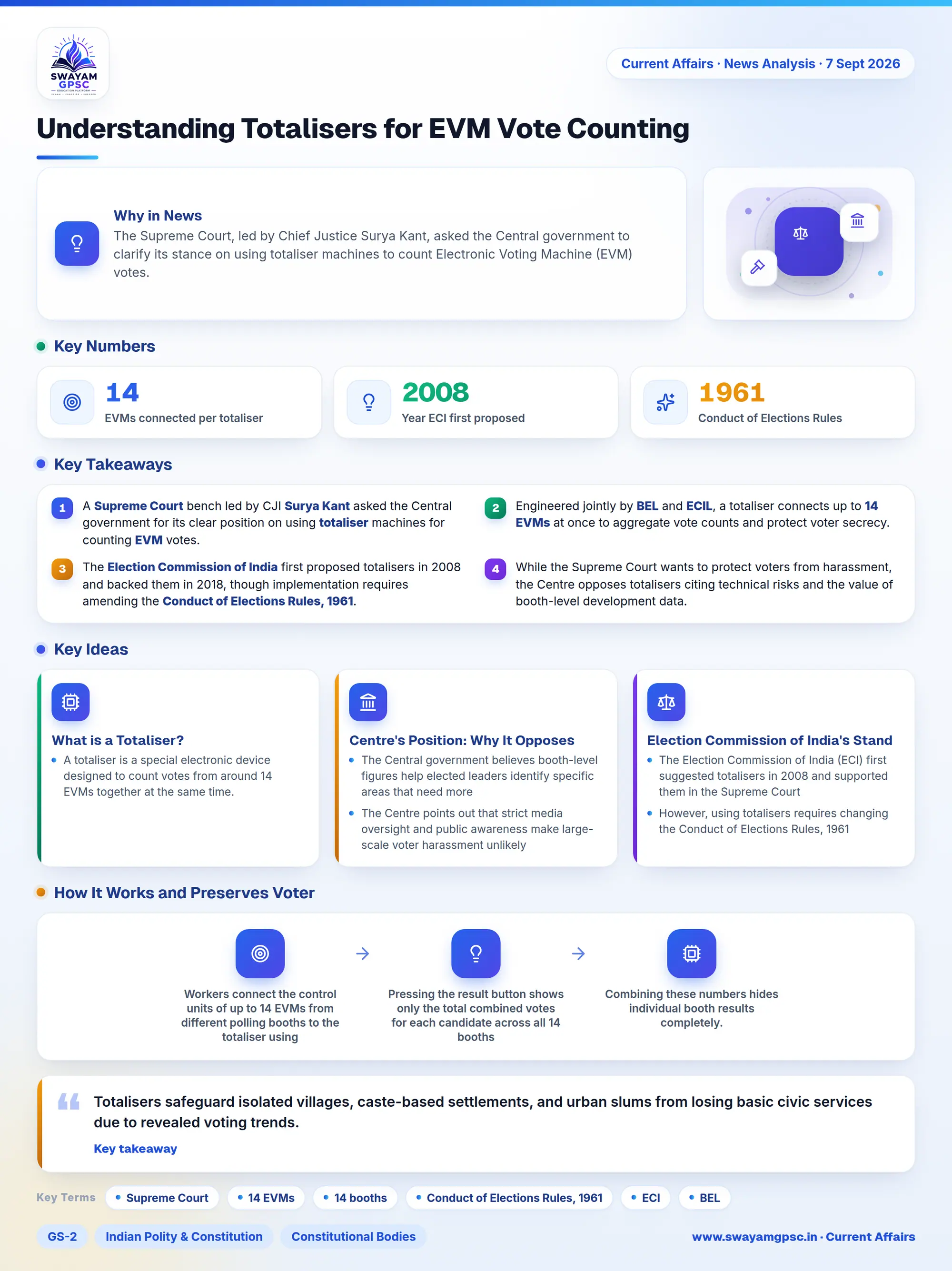
- A Supreme Court bench led by CJI Surya Kant asked the Central government for its clear position on using totaliser machines for counting EVM votes.
- Engineered jointly by BEL and ECIL, a totaliser connects up to 14 EVMs at once to aggregate vote counts and protect voter secrecy.
- The Election Commission of India first proposed totalisers in 2008 and backed them in 2018, though implementation requires amending the Conduct of Elections Rules, 1961.
- While the Supreme Court wants to protect voters from harassment, the Centre opposes totalisers citing technical risks and the value of booth-level development data.
Why in News
- The Supreme Court, led by Chief Justice Surya Kant, asked the Central government to clarify its stance on using totaliser machines to count Electronic Voting Machine (EVM) votes.
What is a Totaliser?
- A totaliser is a special electronic device designed to count votes from around 14 EVMs together at the same time. Public sector companies Bharat Electronics Limited (BEL) and Electronics Corporation of India Limited (ECIL) built this technology together.
How It Works and Preserves Voter Secrecy?
- Workers connect the control units of up to 14 EVMs from different polling booths to the totaliser using cables.
- Pressing the result button shows only the total combined votes for each candidate across all 14 booths at once.
- Combining these numbers hides individual booth results completely. Since booths usually represent specific villages or areas, hiding booth data protects local voters from being identified by their voting choices.
Centre's Position: Why It Opposes Totalisers
- The Central government believes booth-level figures help elected leaders identify specific areas that need more development work and welfare schemes.
- The Centre points out that strict media oversight and public awareness make large-scale voter harassment unlikely today.
- Connecting EVMs to a totaliser might require unsealing machines before counting, which could create data leaks and security risks.
Election Commission of India's Stand
- The Election Commission of India (ECI) first suggested totalisers in 2008 and supported them in the Supreme Court in 2018 to protect voter privacy.
- However, using totalisers requires changing the Conduct of Elections Rules, 1961, and may complicate VVPAT verification, Form 17C matching, and finding booth-level errors.
Supreme Court's Stand
- The Supreme Court noted that revealing booth-by-booth voting choices leaves small communities open to harassment or political revenge.
- The court requested the Centre to explain its technical and legal worries while asking the ECI to submit a fresh proposal.
Significance
- Totalisers safeguard isolated villages, caste-based settlements, and urban slums from losing basic civic services due to revealed voting trends.
- This mechanism prevents local leaders from threatening citizens with cuts to water, power, or government scheme benefits.