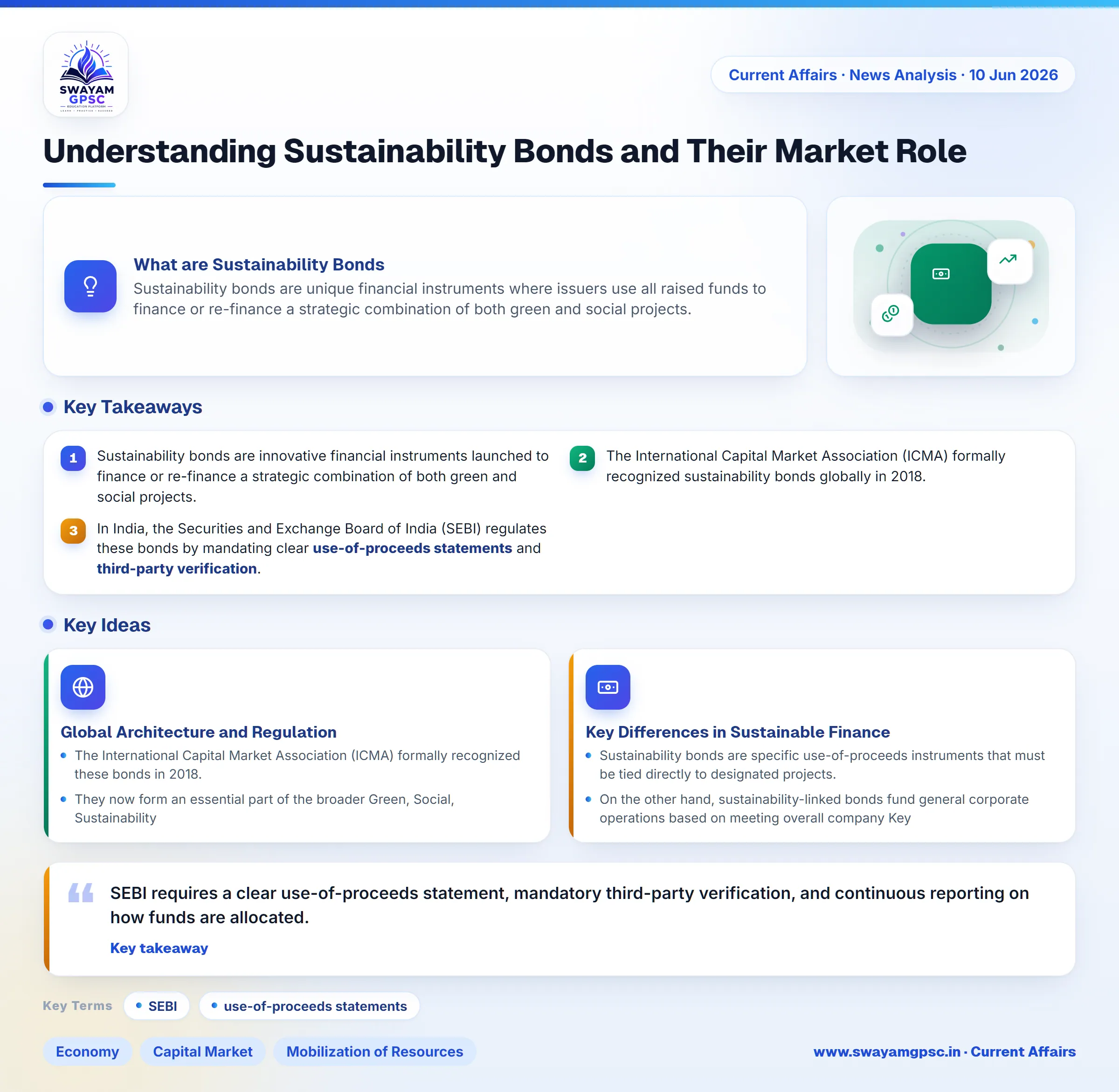
Understanding Sustainability Bonds and Their Market Role
#Economy #Capital Market #Mobilization of Resources #GS-3
Key takeaways
- Sustainability bonds are innovative financial instruments launched to finance or re-finance a strategic combination of both green and social projects.
- The International Capital Market Association (ICMA) formally recognized sustainability bonds globally in 2018.
- In India, the Securities and Exchange Board of India (SEBI) regulates these bonds by mandating clear use-of-proceeds statements and third-party verification.
What are Sustainability Bonds
- Sustainability bonds are unique financial instruments where issuers use all raised funds to finance or re-finance a strategic combination of both green and social projects.
- Unlike regular bonds, these instruments create a dual impact by helping issuers tackle multiple Sustainable Development Goals (SDGs) at the same time.
- For example, a single bond can fund green projects like renewable energy alongside social projects like affordable housing or healthcare.
Global Architecture and Regulation
- The International Capital Market Association (ICMA) formally recognized these bonds in 2018.
- They now form an essential part of the broader Green, Social, Sustainability, and Sustainability-Linked (GSS+) Bond Market.
- In India, the Securities and Exchange Board of India (SEBI) strictly regulates these financial instruments to ensure proper governance.
- SEBI requires a clear use-of-proceeds statement, mandatory third-party verification, and continuous reporting on how funds are allocated.
Key Differences in Sustainable Finance
- Sustainability bonds are specific use-of-proceeds instruments that must be tied directly to designated projects.
- On the other hand, sustainability-linked bonds fund general corporate operations based on meeting overall company Key Performance Indicators (KPIs).
- Green bonds focus exclusively on environmental benefits, while social bonds target vulnerable or underserved populations.