Understanding Stagnation in India's Corporate Investment
#GS-3 #Economy #Growth #Taxation #Infrastructure #Employment #GS-2 #Current Events #National
Key takeaways
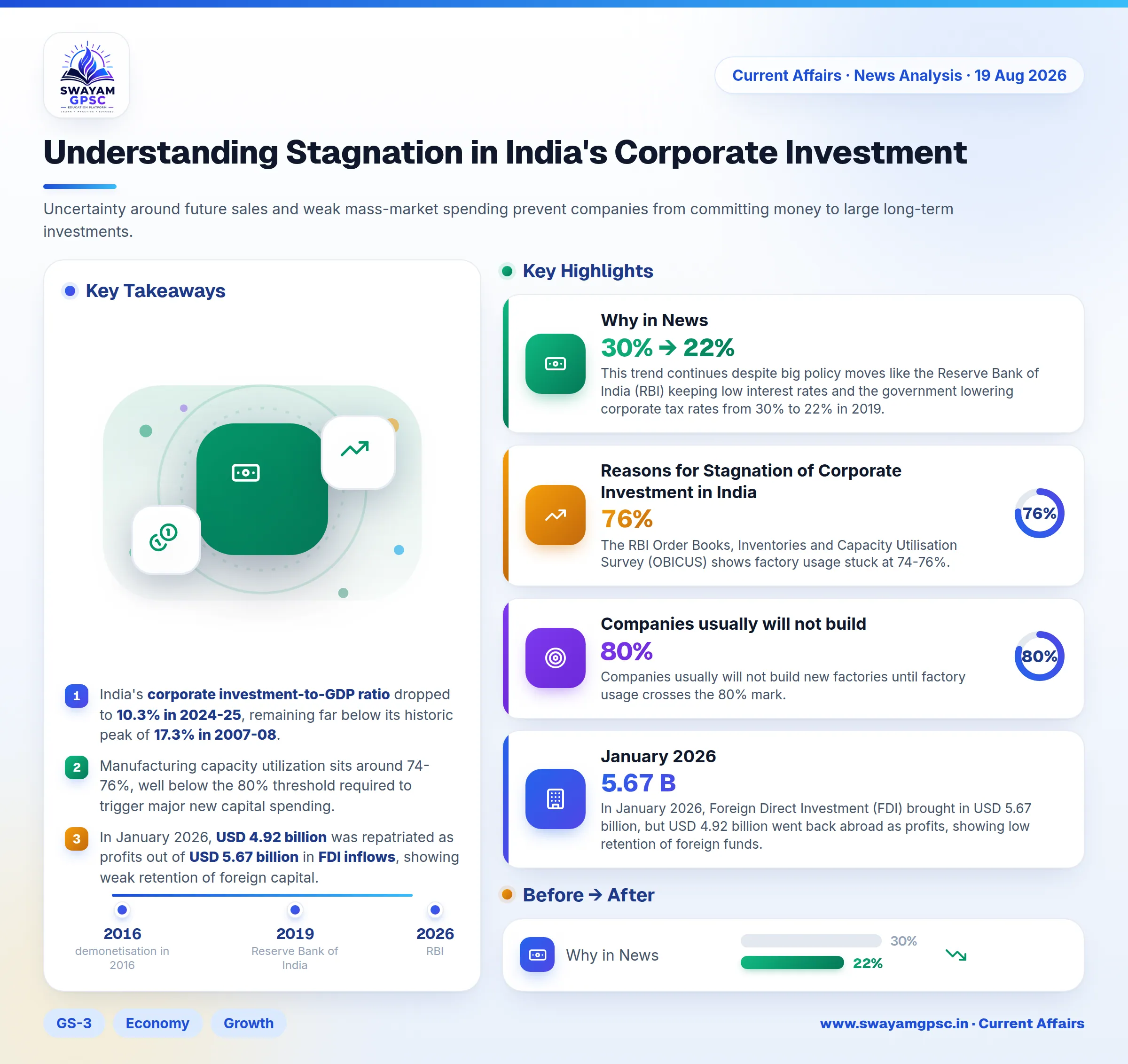
- India's corporate investment-to-GDP ratio dropped to 10.3% in 2024-25, remaining far below its historic peak of 17.3% in 2007-08.
- Manufacturing capacity utilization sits around 74-76%, well below the 80% threshold required to trigger major new capital spending.
- In January 2026, USD 4.92 billion was repatriated as profits out of USD 5.67 billion in FDI inflows, showing weak retention of foreign capital.
- Despite a steep tax cut in 2019 that lowered domestic corporate tax rates to 22%, private firms prefer building cash buffers over spending on new physical assets.
Why in News
- India's economy is facing a long-lasting decline in its corporate investment-to-GDP ratio.
- This trend continues despite big policy moves like the Reserve Bank of India (RBI) keeping low interest rates and the government lowering corporate tax rates from 30% to 22% in 2019.
Reasons for Stagnation of Corporate Investment in India
- The RBI Order Books, Inventories and Capacity Utilisation Survey (OBICUS) shows factory usage stuck at 74-76%.
- Companies usually will not build new factories until factory usage crosses the 80% mark.
- The RBI Financial Stability Report of June 2026 points out that unexpected economic shocks make business conditions uncertain, pushing companies to delay new projects.
- Even though private businesses have strong financial health and low debt, they prefer keeping cash reserves rather than buying physical assets.
- Slow growth in Private Final Consumption Expenditure (PFCE) and weak global market demand leave existing machinery unused, so companies expand old units instead of setting up new ones.
- Uncertainty around future sales and weak mass-market spending prevent companies from committing money to large long-term investments.
- High land prices, complex approval rules, lack of skilled workers, and a high Incremental Capital Output Ratio (ICOR) make setting up new projects expensive and slow.
- Small businesses struggle to get affordable loans because banks consider them high-risk borrowers due to their small capital base.
- Lowering the RBI Repo Rate does not help small businesses much because their borrowing costs stay higher than their expected profit margins.
- The Economic Survey 2019-20 highlighted the problem of dwarfism in Indian business, where small firms stay small and fail to grow or create large-scale jobs.
- In January 2026, Foreign Direct Investment (FDI) brought in USD 5.67 billion, but USD 4.92 billion went back abroad as profits, showing low retention of foreign funds.
- Local business owners prefer saving their money in financial assets or investing in foreign countries rather than setting up factories in India.
- Delays and losses during debt resolution under the Insolvency and Bankruptcy Code (IBC) have made banks cautious about lending money for big debt-funded projects.
- Global trade disputes, protectionist policies, and broken supply chains make export-focused businesses hesitant to expand.
What is Corporate Investment?
- Corporate investment means the money private businesses spend to buy, upgrade, or maintain long-term physical assets like factories, machinery, and technology.
- It includes building new facility units and expanding existing ones to increase total production capability, while excluding financial investments and extra unsold stock.
- In national economic tracking, corporate spending forms a major part of Gross Fixed Capital Formation (GFCF), measured by the Ministry of Statistics and Programme Implementation (MoSPI).
- Corporate investment in India grew from 4.9% of GDP in 2000-01 to a peak of 17.3% in 2007-08, but dropped to 11.3% in 2008-09 after the Global Financial Crisis.
- It stayed around 13-14% of GDP between 2010-11 and 2015-16, but declined after demonetisation in 2016 from 11.6% in 2016-17 to 10.0% in 2020-21.
- By 2024-25, corporate investment stood at 10.3% of GDP, remaining well below the levels seen before demonetisation.
- Expected profits drive corporate investment because larger operations lower production costs per unit up to the limits of market demand.
- Keynesian animal spirits describe business confidence, where optimism drives companies to invest and worry causes them to stop.
- The cost of credit determines investment levels, and Kalecki Principle of Increasing Risk shows that taking more loans increases financial risk, affecting small businesses the most.
Key Government Initiatives to Boost Corporate Investment
- The government introduced the Make in India program to encourage domestic manufacturing.
- The Production Linked Incentive (PLI) Scheme gives financial benefits to manufacturers based on their sales growth.
- The National Industrial Corridor Development Programme (NICDP) builds smart industrial cities across key transport corridors.
- The PM GatiShakti plan coordinates infrastructure construction across different ministries to cut logistic costs.
- The National Single Window System (NSWS) helps investors apply for all required government permissions on one digital platform.
- The India Industrial Land Bank provides an online GIS database to help investors identify suitable industrial plots.
- The Startup India campaign offers tax benefits and funding support to new business startups.
- The 2019 corporate tax cut lowered tax rates to 22% for existing firms and 15% for new manufacturing companies to boost corporate investment.