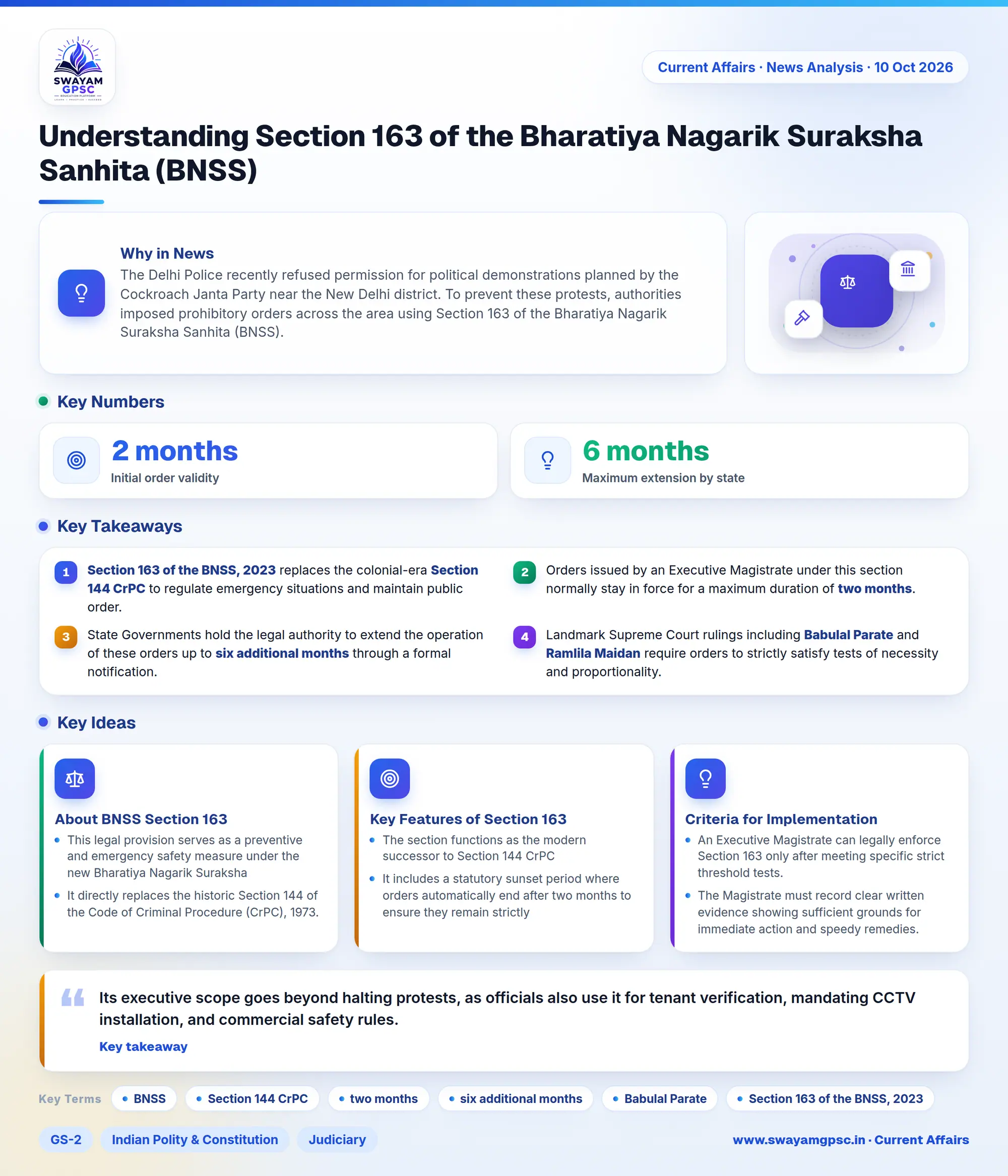
Understanding Section 163 of the Bharatiya Nagarik Suraksha Sanhita (BNSS)
#GS-2 #Indian Polity & Constitution #Judiciary #Governance & Social Justice #Current Events #National #BNSS #Preventive Law
Key takeaways
- Section 163 of the BNSS, 2023 replaces the colonial-era Section 144 CrPC to regulate emergency situations and maintain public order.
- Orders issued by an Executive Magistrate under this section normally stay in force for a maximum duration of two months.
- State Governments hold the legal authority to extend the operation of these orders up to six additional months through a formal notification.
- Landmark Supreme Court rulings including Babulal Parate and Ramlila Maidan require orders to strictly satisfy tests of necessity and proportionality.
Why in News
- The Delhi Police recently refused permission for political demonstrations planned by the Cockroach Janta Party near the New Delhi district.
- To prevent these protests, authorities imposed prohibitory orders across the area using Section 163 of the Bharatiya Nagarik Suraksha Sanhita (BNSS).
About BNSS Section 163
- This legal provision serves as a preventive and emergency safety measure under the new Bharatiya Nagarik Suraksha Sanhita.
- It directly replaces the historic Section 144 of the Code of Criminal Procedure (CrPC), 1973.
- The law gives an Executive Magistrate official power to issue written orders that ban specific actions or regulate how people use property.
Key Features of Section 163
- The section functions as the modern successor to Section 144 CrPC, allowing Executive Magistrates to stop sudden threats to public order.
- It includes a statutory sunset period where orders automatically end after two months to ensure they remain strictly temporary.
- The State Government holds the power to extend any order for up to six additional months through a formal legal notification.
- Its executive scope goes beyond halting protests, as officials also use it for tenant verification, mandating CCTV installation, and commercial safety rules.
- This wide administrative use has raised growing public concerns regarding regular overuse by civil servants.
- The Supreme Court established landmark guidelines through cases like Babulal Parate, Ramlila Maidan, and MKSS.
- These rulings mandate that executive orders must strictly follow the principles of necessity, proportionality, and protection of peaceful assembly.
Criteria for Implementation
- An Executive Magistrate can legally enforce Section 163 only after meeting specific strict threshold tests.
- The Magistrate must record clear written evidence showing sufficient grounds for immediate action and speedy remedies.
- The proposed order must directly aim to stop at least one legally defined hazard from taking place.
- One valid hazard is preventing obstruction, annoyance, or physical injury to any person who is doing their lawful work.
- Another valid hazard is stopping clear danger to human life, health, or overall public safety.
- The law also allows intervention to stop a disturbance of public peace, a riot, or an affray.
- Constitutional courts require the threat to be real, immediate, and serious rather than based on speculation or executive convenience.