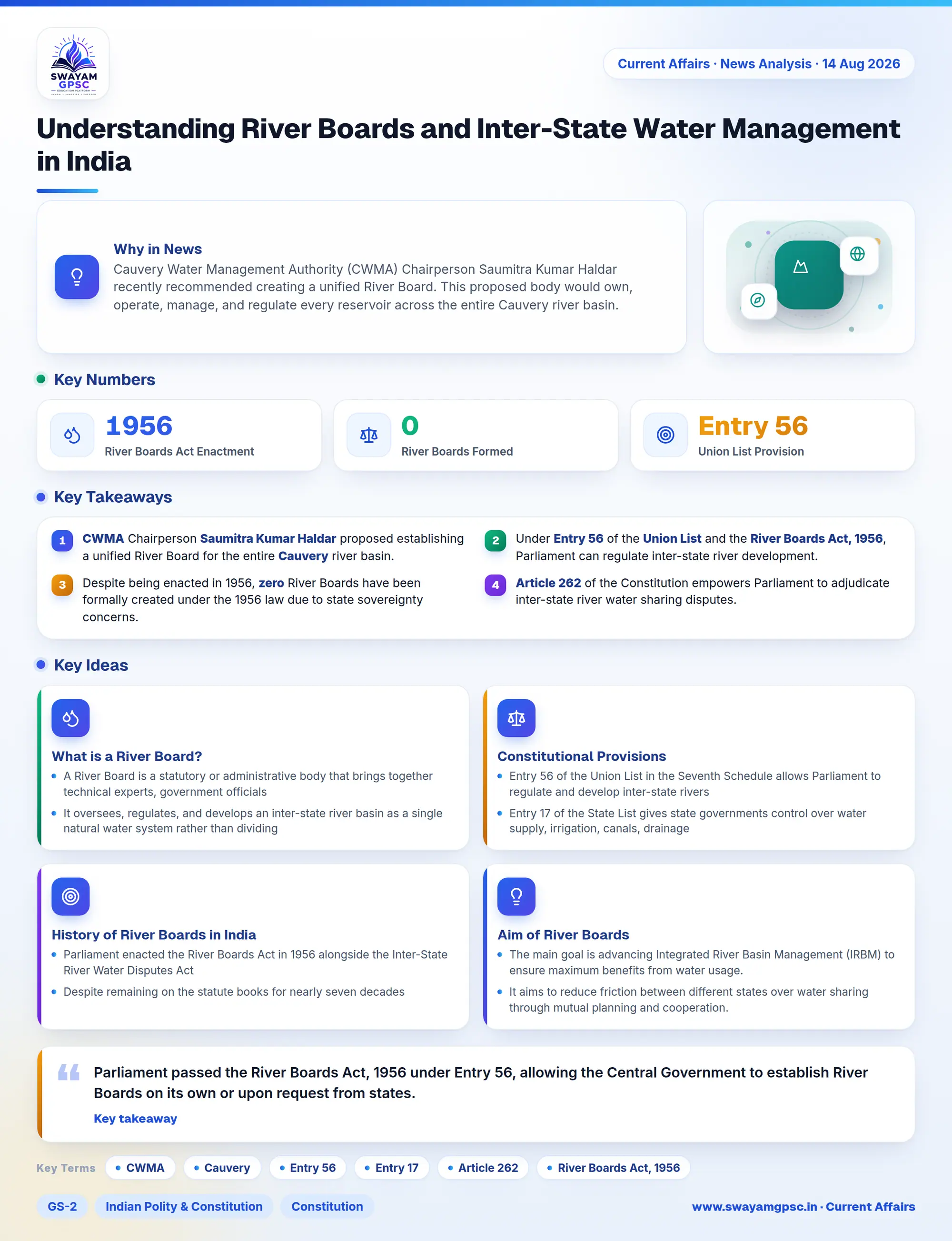
Understanding River Boards and Inter-State Water Management in India
#GS-2 #Indian Polity & Constitution #Constitution #Federalism #GS-3 #Geography #Resources #River Boards Act 1956 #Inter-State Water Disputes
Key takeaways
- CWMA Chairperson Saumitra Kumar Haldar proposed establishing a unified River Board for the entire Cauvery river basin.
- Under Entry 56 of the Union List and the River Boards Act, 1956, Parliament can regulate inter-state river development.
- Despite being enacted in 1956, zero River Boards have been formally created under the 1956 law due to state sovereignty concerns.
- Article 262 of the Constitution empowers Parliament to adjudicate inter-state river water sharing disputes.
Why in News
- Cauvery Water Management Authority (CWMA) Chairperson Saumitra Kumar Haldar recently recommended creating a unified River Board.
- This proposed body would own, operate, manage, and regulate every reservoir across the entire Cauvery river basin.
What is a River Board?
- A River Board is a statutory or administrative body that brings together technical experts, government officials, and key stakeholders.
- It oversees, regulates, and develops an inter-state river basin as a single natural water system rather than dividing management along state borders.
Constitutional Provisions and Legislative Basis
- Entry 56 of the Union List in the Seventh Schedule allows Parliament to regulate and develop inter-state rivers in the public interest.
- Entry 17 of the State List gives state governments control over water supply, irrigation, canals, drainage, embankments, and water storage.
- Article 262 empowers Parliament to enact laws for adjudicating disputes related to inter-state river waters or river valleys.
- Parliament passed the River Boards Act, 1956 under Entry 56, allowing the Central Government to establish River Boards on its own or upon request from states.
History of River Boards in India
- Parliament enacted the River Boards Act in 1956 alongside the Inter-State River Water Disputes Act, 1956 during the linguistic reorganization of states.
- Despite remaining on the statute books for nearly seven decades, authorities have created zero River Boards under the 1956 Act.
- States have historically resisted using the Act because they fear losing their sovereign control over local water resources.
- Consequently, the government created other river management bodies through separate Parliamentary Acts, executive resolutions, or tribunal awards.
Aim of River Boards
- The main goal is advancing Integrated River Basin Management (IRBM) to ensure maximum benefits from water usage.
- It aims to reduce friction between different states over water sharing through mutual planning and cooperation.
- The board also works to prevent environmental damage and ecological degradation across the river basin.
Key Functions of a River Board
- It creates master plans for conserving, controlling, and utilizing river water across all participating states.
- It manages reservoir operations and seasonal water releases to ensure fair distribution during both floods and droughts.
- The board coordinates regional flood warnings, soil conservation programs, and soil erosion controls upstream and downstream.
- It protects river ecosystems by monitoring water quality, reducing pollution, and maintaining minimum environmental water flows (Aviral Dhara).
- It offers technical guidance on joint irrigation, navigation, and power projects to resolve state grievances before they reach formal tribunals.