Understanding Pressure Groups in India: Role, Impact, and Reforms
#GS-2 #Indian Polity & Constitution #Governance & Social Justice #Constitution #Good Governance #Regulatory Bodies #Social Justice #Pressure Groups #Public Policy
Why in News
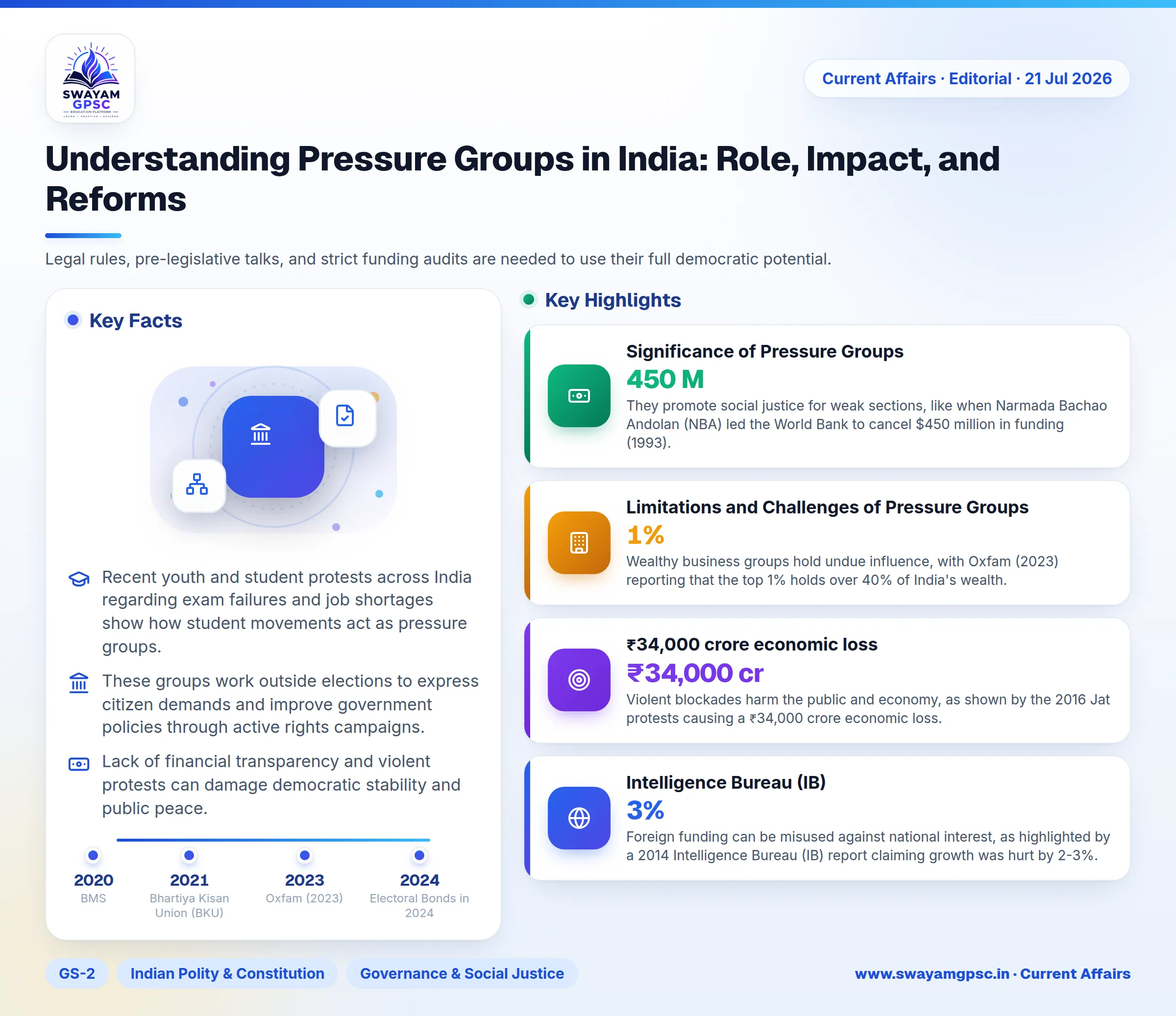
- Recent youth and student protests across India regarding exam failures and job shortages show how student movements act as pressure groups.
- These groups work outside elections to express citizen demands and improve government policies through active rights campaigns.
- Lack of financial transparency and violent protests can damage democratic stability and public peace.
- Legal rules, pre-legislative talks, and strict funding audits are needed to use their full democratic potential.
What are Pressure Groups?
- A pressure group is an organized body of people who share common goals and try to influence policy without seeking election or government office.
- They act as a key link between citizens and the state by voicing community concerns between election periods.
Key Characteristics of Pressure Groups
- They do not contest elections or seek direct political power, focusing only on influencing current decision-makers.
- They focus on specific issues like labor rights or environmental protection rather than broad election manifestos.
- They maintain political flexibility by working with whichever party is currently in power to achieve their goals.
- Their structures range from highly formal bodies like trade chambers to informal mass movements.
Classification of Pressure Groups
- Institutional pressure groups operate within existing structures like civil services, military leagues, or university staff associations.
- Anomic pressure groups are spontaneous gatherings that form suddenly during a crisis, such as sudden public protests or street rallies.
- Associational pressure groups are well-organized formal bodies created to represent specific professions, such as trade unions and medical associations.
- Non-associational pressure groups are informal bodies formed around traditional identity factors like caste, religion, or language.
Techniques Used By Pressure Groups
- Lobbying and consultations involve meeting directly with government officials to present research, policy ideas, and draft bills.
- Public opinion building uses news media, research papers, and social media campaigns to gather public support.
- Litigation involves filing class-action cases or Public Interest Litigation petitions in courts to protect public rights.
- Election action includes supporting specific candidates, funding campaigns, or releasing candidate rating reports for voters.
- Direct action involves using strikes, rallies, sit-ins, and boycotts when official communication channels fail to give results.
Categories of Pressure Groups in India
- Business groups like FICCI, CII, and ASSOCHAM are well-funded organizations that influence taxation, trade policies, and industrial regulations.
- Trade unions like AITUC, INTUC, BMS, and CITU represent industrial workers and are often linked with political parties.
- Agrarian bodies like Bhartiya Kisan Union (BKU) and All India Kisan Sabha mobilize farmers to demand subsidies and crop prices.
- Caste and tribal bodies like Karni Sena and Scheduled Castes Federation push for community reservations and social equality.
- Professional organizations like Indian Medical Association and Bar Council of India set standards and protect occupational interests.
- Student associations like ABVP, NSUI, and AISF focus on campus policies, university fees, and wider political causes.
Pressure Groups vs Political Parties
- Pressure groups attempt to influence government policy from the outside, whereas political parties seek to win elections and rule.
- Pressure groups do not field candidates in elections, while political parties regularly contest elections.
- Pressure groups concentrate on single or narrow issues, while political parties publish broad manifestos covering all national topics.
- Pressure groups answer only to their specific members, while political parties are accountable to all voters in the country.
- Pressure group members share very similar goals, while political parties must build broad alliances across diverse population groups.
- Pressure groups use persuasion, strikes, and lobbying, while political parties rely on election campaigns and legislative debates.
Significance of Pressure Groups
- They give voice to local demands, as seen when Bhartiya Kisan Union (BKU) led protests leading to the 2021 repeal of the Three Farm Laws.
- They offer expert data to government committees, with studies by PRS Legislative Research showing high reliance on inputs from FICCI and CII.
- They act as constitutional watchdogs through court cases, such as when Association for Democratic Reforms (ADR) challenged Electoral Bonds in 2024.
- They promote social justice for weak sections, like when Narmada Bachao Andolan (NBA) led the World Bank to cancel $450 million in funding (1993).
- They improve transparency in lawmaking, as shown by Mazdoor Kisan Shakti Sangathan (MKSS) driving the movement for the RTI Act, 2005.
- They encourage public participation and train leaders, with student organizations like ABVP and NSUI serving as entry pathways for political careers.
- They advocate for sustainable growth, such as when Centre for Science and Environment (CSE) successfully campaigned for CNG in Delhi's public transport (1998).
- They safeguard minority rights, with organizations like BAMCEF working to ensure correct implementation of affirmative action programs.
Limitations and Challenges of Pressure Groups
- Wealthy business groups hold undue influence, with Oxfam (2023) reporting that the top 1% holds over 40% of India's wealth.
- Powerful unions can block essential reforms, as seen when groups like BMS and CITU stalled the 2020 New Labour Codes.
- Violent blockades harm the public and economy, as shown by the 2016 Jat protests causing a ₹34,000 crore economic loss.
- Many advocacy groups lack internal governance, leading the Ministry of Home Affairs to cancel over 6,600 NGO licenses under FCRA between 2017-2021.
- Identity-based groups can deepen social divides, as seen when organizations like Karni Sena use intimidation to censor media content.
- Demands for continuous farm loan waivers place financial pressure on state budgets and harm formal banking discipline.
- Foreign funding can be misused against national interest, as highlighted by a 2014 Intelligence Bureau (IB) report claiming growth was hurt by 2-3%.
- Street movements sometimes bypass parliamentary debate, as seen during the India Against Corruption (2011) protests.
Measures to Enhance Functioning
- India should enact a statutory framework inspired by the Disclosure of Lobbying Activities Bill, 2013 to register professional lobbyists.
- The government must strictly implement the Pre-Legislative Consultation Policy (PLCP, 2014) with a mandatory 30-day public feedback window for draft bills.
- Active groups must undergo standard audits and publish funding sources, while applying Foreign Contribution Regulation Act (FCRA) rules fairly.
- Registered pressure groups must hold periodic internal elections overseen by an independent ombudsman to ensure representative leadership.
- Authorities should enforce the Prevention of Damage to Public Property Act, 1984 to make leaders financially liable for property destruction.
- State-supported policy hubs should offer free technical advice to weaker groups so policy debates depend on merits rather than money.
Conclusion
- Pressure groups serve as vital conduits of democratic pluralism in India, connecting citizens with state policy choices.
- Strengthening pre-legislative talks, lobbying rules, and financial transparency will help align these groups with constitutional governance.