Understanding the Limits of Air Power and the Need for Theatreisation
#GS-3 #Science & Technology #Defence #Governance & Social Justice #Current Events #National #Theatre Commands #Indian Air Force
Key takeaways
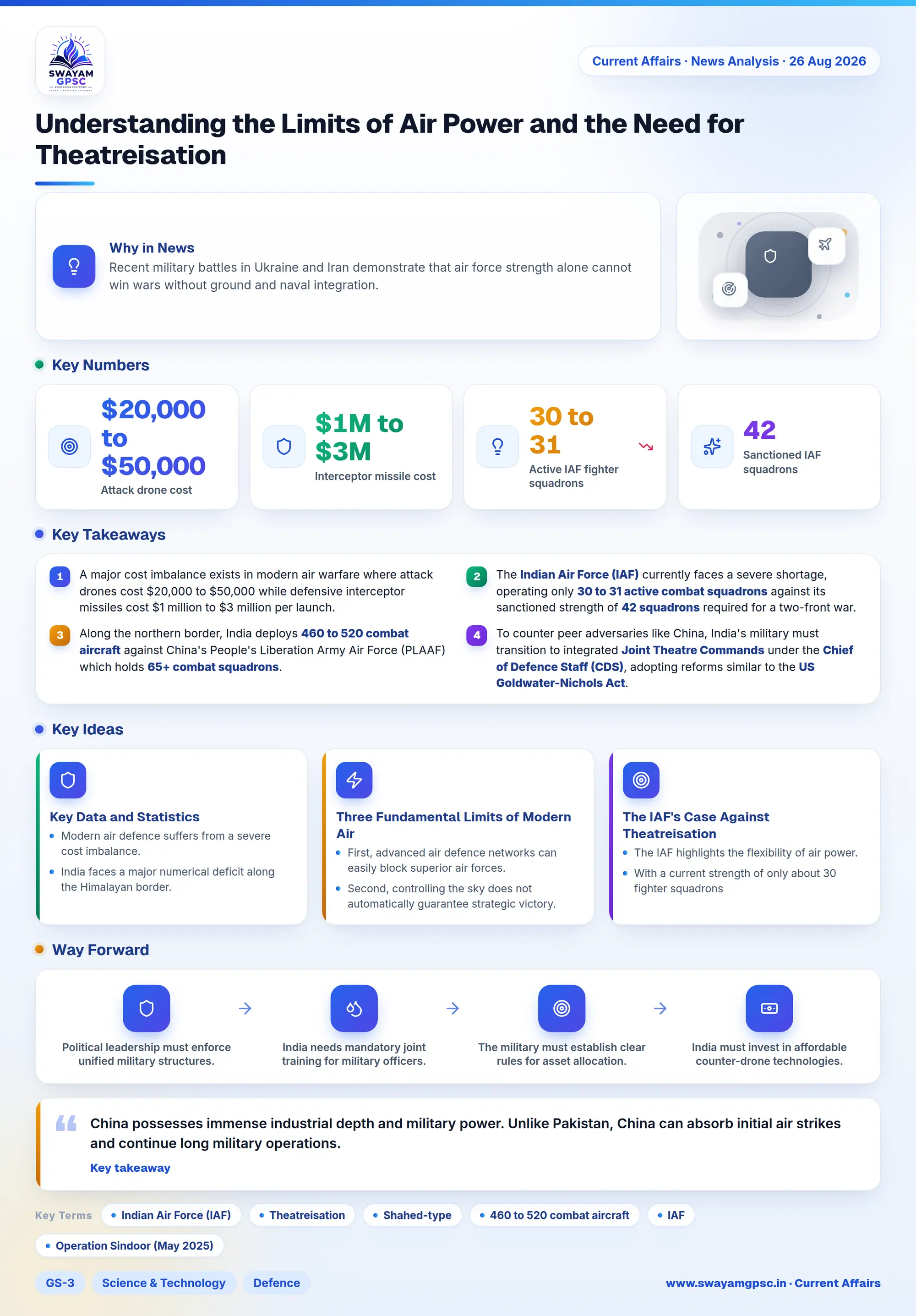
- A major cost imbalance exists in modern air warfare where attack drones cost $20,000 to $50,000 while defensive interceptor missiles cost $1 million to $3 million per launch.
- The Indian Air Force (IAF) currently faces a severe shortage, operating only 30 to 31 active combat squadrons against its sanctioned strength of 42 squadrons required for a two-front war.
- Along the northern border, India deploys 460 to 520 combat aircraft against China's People's Liberation Army Air Force (PLAAF) which holds 65+ combat squadrons.
- To counter peer adversaries like China, India's military must transition to integrated Joint Theatre Commands under the Chief of Defence Staff (CDS), adopting reforms similar to the US Goldwater-Nichols Act.
Why in News
- Recent military battles in Ukraine and Iran demonstrate that air force strength alone cannot win wars without ground and naval integration. This reality has reignited India's national debate on creating unified theatre commands versus maintaining traditional centralized control by the Indian Air Force (IAF), especially along the Line of Actual Control (LAC) with China.
- Military experts define air power as the ability to project force through air and space to hit strategic targets. However, modern combined warfare proves that air forces cannot achieve lasting results when operating alone.
- The concept of Theatreisation means combining separate Army, Navy, and Air Force commands into unified Joint Theatre Commands. Under this model, one single theatre commander manages land, sea, air, cyber, and space operations within a specific geographical area.
Key Data and Statistics
- Modern air defence suffers from a severe cost imbalance. A standard attack drone like Iran's Shahed-type costs between $20,000 and $50,000, while defensive surface-to-air missiles like Patriot, S-400, or MR-SAM cost between $1 million and $3 million per launch.
- India faces a major numerical deficit along the Himalayan border. India maintains around 460 to 520 combat aircraft on its northern front, whereas China's People's Liberation Army Air Force (PLAAF) deploys an estimated 65+ combat squadrons in high-altitude bases.
- The IAF suffers from a persistent shortfall of fighter jets. Against an authorized requirement of 42 combat squadrons needed to handle a simultaneous two-front threat, the IAF currently operates only 30 to 31 active fighter squadrons.
- The war in Ukraine showed the power of networked air defences. Dense surface-to-air missile networks stopped the larger Russian Air Force from gaining air superiority, turning the sky into contested airspace.
Three Fundamental Limits of Modern Air Power
- First, advanced air defence networks can easily block superior air forces. As seen in Ukraine, heavy air defence systems prevent large fighter fleets from controlling the skies.
- Second, controlling the sky does not automatically guarantee strategic victory. The aerial campaigns in Iran proved that air strikes can destroy visible ground structures, but deep underground bunkers and mobile forces can easily survive.
- Third, financial mathematics favors weaker attackers using cheap technology. Swarms of low-cost drones drain expensive and limited stockpiles of interceptor missiles, as demonstrated during Operation Sindoor (May 2025) and conflicts across West Asia.
The IAF's Case Against Theatreisation
- The IAF highlights the flexibility of air power. Air forces can move advanced fighters like Rafales and Su-30MKIs from the western border with Pakistan to the eastern border with China within a few hours.
- With a current strength of only about 30 fighter squadrons, locking air assets permanently into fixed geographical regions could dangerous weaken concentration at critical battle zones.
- Centralized air control has succeeded in past targeted strikes. Operations like Balakot (2019) and Operation Sindoor (2025) showed that central command can execute fast operations effectively.
- Instead of permanent joint commands, the IAF proposes setting up Joint Coordination Centers (JCC). These centers would let different services consult and coordinate during crises without placing air units under army officers.
Challenges of Centralized Air Control Against China
- China possesses immense industrial depth and military power. Unlike Pakistan, China can absorb initial air strikes and continue long military operations.
- Extreme terrain creates severe logistics bottlenecks in the Himalayas. High-altitude airbases in Ladakh and the Northeast have short runways and harsh weather, preventing quick movement of aircraft during intense war.
- Consultative coordination centers work slowly during high-pressure situations. Relying on consensus between separate service leaders during simultaneous clashes in Ladakh and Siachen causes dangerous decision delays.
- Ground units may lack direct air support during critical moments. If central headquarters manages air strike orders from far away, Integrated Battle Groups (IBGs) on the ground might not get timely air cover.
- Differences in service structures hinder smooth integration. Divergent rules on promotion, seniority rank mapping, and operational authority create bureaucratic resistance against unified joint leadership.
Way Forward
- Political leadership must enforce unified military structures. The political executive and the Chief of Defence Staff (CDS) must mandate the quick creation of joint theatre commands across all operational zones.
- India needs mandatory joint training for military officers. Following the model of the US Goldwater-Nichols Act, tri-service postings and joint staff courses should become essential criteria for military promotions.
- The military must establish clear rules for asset allocation. New operating guidelines should let the Theatre Commander control local air wings, while allowing the Air Chief to shift strategic aircraft during two-front emergencies.
- India must invest in affordable counter-drone technologies. Developing layered defence tools like Project Kusha and laser air defence systems will neutralize drone swarms without wasting costly interceptor missiles.
- The armed forces must integrate their digital networks. Creating a unified communication and radar network will connect Army ground radars, Navy patrol planes, and IAF fighters into one shared tactical map.
Conclusion
- Recent conflicts in Ukraine and Iran prove that air forces cannot win modern wars without complete integration with ground and naval forces. While the IAF's concerns about jet shortages are real, relying on temporary coordination committees creates big risks against a powerful adversary like China. Creating permanent Joint Theatre Commands will give India the speed, unity, and strength needed to win future conflicts.