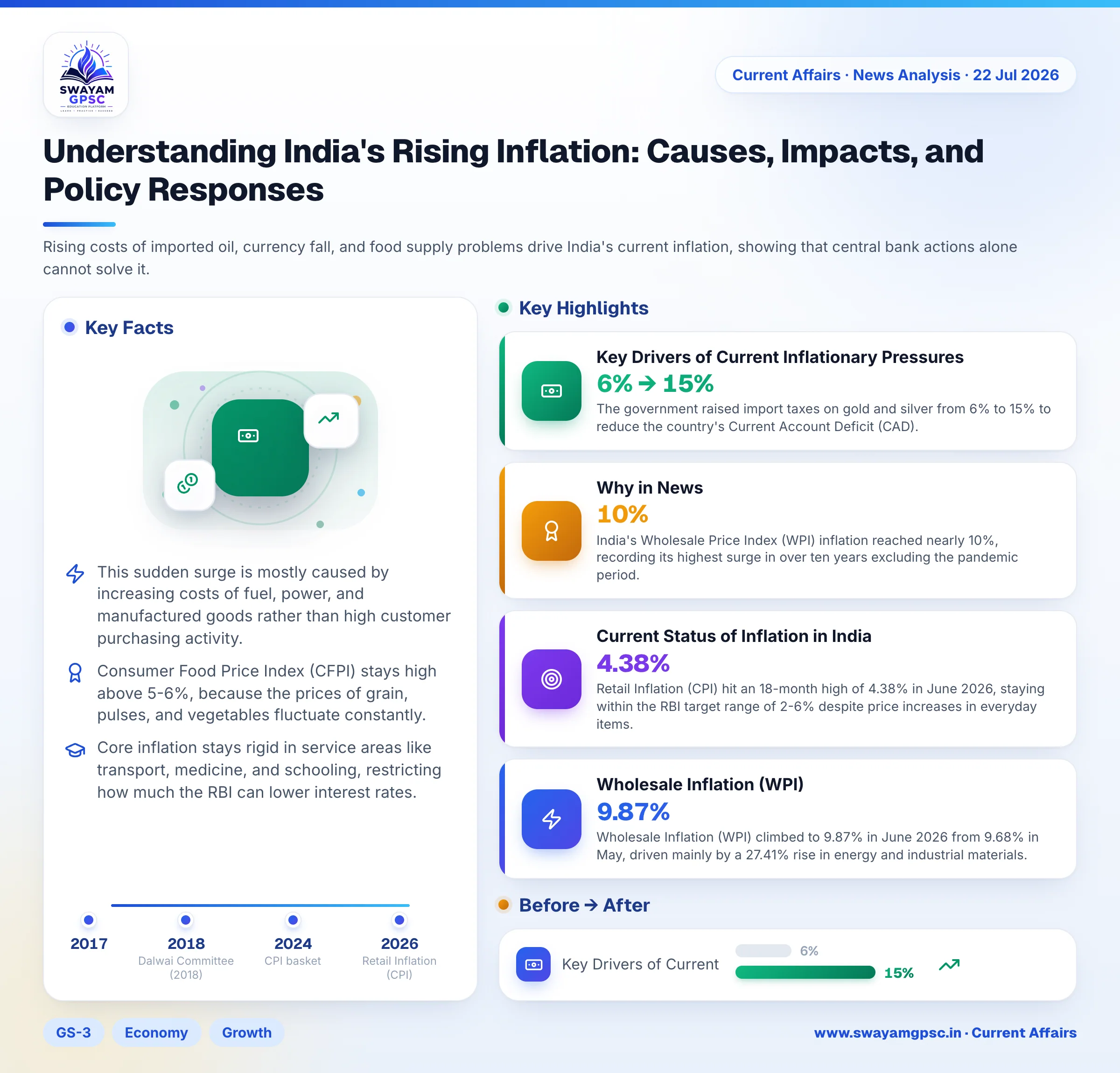
Understanding India's Rising Inflation: Causes, Impacts, and Policy Responses
#GS-3 #Economy #Growth #Taxation #Inflation #Current Events #National #Monetary Policy #Fiscal Policy
Why in News
- India's Wholesale Price Index (WPI) inflation reached nearly 10%, recording its highest surge in over ten years excluding the pandemic period.
- This sudden surge is mostly caused by increasing costs of fuel, power, and manufactured goods rather than high customer purchasing activity.
Summary
- Rising costs of imported oil, currency fall, and food supply problems drive India's current inflation, showing that central bank actions alone cannot solve it.
- Controlling this price rise needs joint effort through interest rate policy, government spending adjustments, better crop management, and renewable energy adoption.
Current Status of Inflation in India
- Retail Inflation (CPI) hit an 18-month high of 4.38% in June 2026, staying within the RBI target range of 2-6% despite price increases in everyday items.
- Wholesale Inflation (WPI) climbed to 9.87% in June 2026 from 9.68% in May, driven mainly by a 27.41% rise in energy and industrial materials.
- Consumer Food Price Index (CFPI) stays high above 5-6%, because the prices of grain, pulses, and vegetables fluctuate constantly.
- Core inflation stays rigid in service areas like transport, medicine, and schooling, restricting how much the RBI can lower interest rates.
- The shrinking gap between wholesale and retail prices shows that producers are passing their higher costs down to normal buyers.
- India faces cost-push and structural inflation right now rather than price rises caused by excessive demand from consumers.
- High fuel and energy costs increase transport expenses for factories, which eventually forces shopkeepers to charge more from everyday shoppers.
- Persistent core inflation keeps underlying price pressures high and limits how easily the RBI can adjust its monetary policies.
Key Drivers of Current Inflationary Pressures
- India buys almost 90% of its crude oil from abroad, and conflicts around the Strait of Hormuz pushed Brent crude over USD 110 per barrel.
- Higher oil import costs expanded India's monthly purchase bill to USD 70.8 billion in June 2026, raising local transport charges immediately.
- The Indian Rupee fell near Rs 95-Rs 97 against the USD, making imported goods much more expensive for local businesses.
- A weaker currency directly raises the purchase price of essential imported items like crop fertilizers, factory chemicals, and electronic parts.
- Food and drinks make up 36.75% of the CPI basket under the 2024 series, meaning crop failures quickly push up household expenses.
- Irregular monsoon rainfall across farming states reduces the total production of major summer crops.
- Higher food costs are closely connected to reduced farm output caused by El Niño weather patterns.
- This supply gap causes a cobweb phenomenon where farm prices swing sharply, keeping the CFPI consistently high.
- The government raised import taxes on gold and silver from 6% to 15% to reduce the country's Current Account Deficit (CAD).
- High public demand for precious metals meant shopkeepers passed this tax to buyers, raising personal care expenses.
- Although commercial LPG prices saw a minor price cut, high government taxes on petrol and diesel keep transport costs from coming down.
- The current situation shows the limits of the Flexible Inflation Targeting (FIT) rules introduced on the recommendation of the Urjit Patel Committee (2014).
- Increasing interest rates through the RBI curbs extra buying power but cannot fix global supply disruptions or bad weather.
Impact of Rising Inflation
- Rising prices reduce the actual purchasing value of household salaries, because wage gains in India are not keeping up with living costs.
- Since food and fuel form over 45% of household spending, inflation hits poor families, daily workers, and rural communities the hardest.
- High overall price levels force the RBI to maintain a strict interest rate policy, preventing rate cuts that could boost business growth.
- Higher loan interest rates make borrowing expensive for families and companies, slowing down factory expansion and general economic growth.
- Increasing living expenses compel the government to spend more on food and fertilizer subsidies, making budget balance under the FRBM Act, 2003 difficult.
- Higher oil import bills expand the Trade Deficit and Current Account Deficit (CAD), putting more downward pressure on the rupee.
Challenges in Curbing Rising Inflation
- Strict interest rate increases meant to control supply shocks might cause stagflation, where high prices co-exist with slow growth and job losses.
- Under the Flexible Inflation Targeting (FIT) target of 4% ± 2%, raising rates controls prices but harms business investment and new employment.
- If the central bank lowers interest rates to help growth, foreign capital leaves, weakening the rupee and making imported fuel more expensive.
- Lowering government fuel taxes could lower transport costs for citizens, but it would hurt state revenues and worsen the budget deficit.
- Heavy reliance on monsoon rain for farming is an old problem that leaves crop yields vulnerable to climate changes.
- Poor storage facilities, weak cold chains, and long supply routes turn small crop shortages into large price hikes across India.
- Because India imports 85-90% of its crude oil along with cooking oil and fertilizers, global market shocks directly impact domestic prices.
Way Forward
- Follow recommendations from the N.K. Singh (FRBM Review) Committee (2017) to adjust government spending dynamically during supply shocks while maintaining fiscal targets.
- Implement suggestions of the Shanta Kumar Committee (2015) to modernize the Food Corporation of India (FCI) and make grain distribution efficient.
- Use government tools like the Price Stabilization Fund (PSF) and Open Market Sale Scheme (OMSS) to supply crops quickly when prices rise.
- Follow the Dalwai Committee (2018) plan to double farmer incomes by investing in micro-irrigation, cold storage networks, and market connections.
- Adopt suggestions from the M.S. Swaminathan Commission to increase public funding for farm research, water supply, and rural advisory services.
- Expand clean power projects through the National Green Hydrogen Mission and National Electricity Plan to cut dependence on foreign oil.
- Secure raw materials locally under the National Critical Mineral Mission (NCMM) to protect local manufacturing from global price swings.
- Build better transport routes and warehouses using PM Gati Shakti and the National Logistics Policy to bring down movement costs.
Conclusion
- Managing inflation requires more than just interest rate changes by the central bank.
- While monetary policy keeps inflation expectations stable, lasting price stability needs government action through tax adjustments, efficient food distribution, and better farm infrastructure.
Frequently Asked Questions
- CPI tracks retail prices paid directly by consumers, whereas WPI tracks goods sold at the wholesale level before reaching retail shops.
- Current inflation is called cost-push because it stems from foreign oil costs, supply disruptions, and crop failure rather than excess customer demand.
- The Flexible Inflation Targeting (FIT) framework aims to keep CPI inflation around 4% with a ±2% margin to balance stable prices with economic expansion.
- The government uses the Price Stabilization Fund (PSF) to buy essential crops during price jumps, while FCI releases stored grain under OMSS to increase local market supply.