Swachh Vayu Sarvekshan 2026 and Progress Under NCAP
#GS-2 #Current Events #National #GS-3 #Environment #Pollution #Government Policies & Interventions
Key takeaways
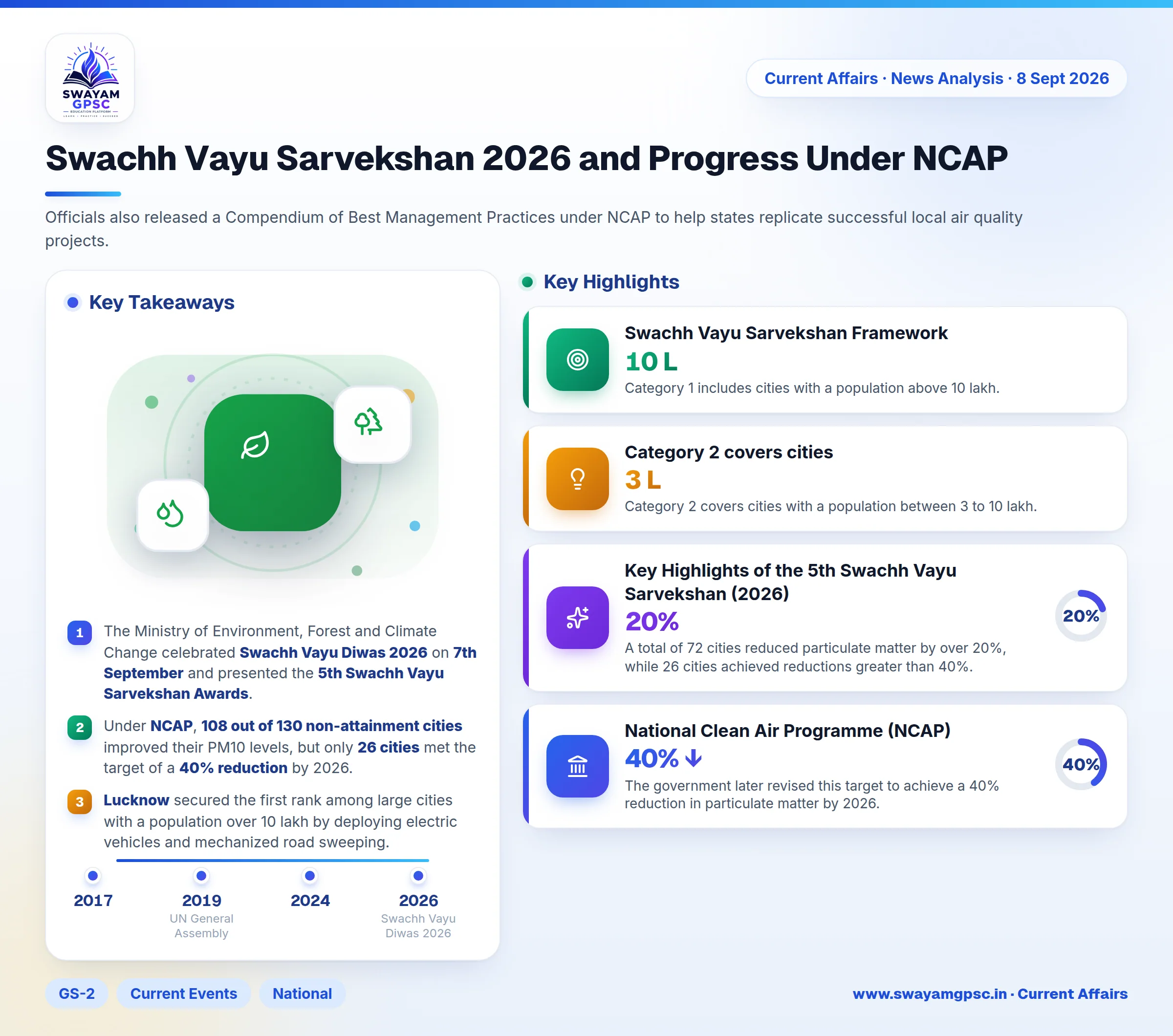
- The Ministry of Environment, Forest and Climate Change celebrated Swachh Vayu Diwas 2026 on 7th September and presented the 5th Swachh Vayu Sarvekshan Awards.
- Under NCAP, 108 out of 130 non-attainment cities improved their PM10 levels, but only 26 cities met the target of a 40% reduction by 2026.
- Lucknow secured the first rank among large cities with a population over 10 lakh by deploying electric vehicles and mechanized road sweeping.
- The government allocated a Performance-Linked Grant of Rs 16,425 crore and monitors city-level clean air plans through the digital PRANA portal.
Why in News
- The Ministry of Environment, Forest and Climate Change (MoEFCC) organized Swachh Vayu Diwas 2026 on 7th September.
- This event coincided with the International Day of Clean Air for Blue Skies.
- The government presented the 5th Swachh Vayu Sarvekshan Awards to recognize top-performing cities and wards under the National Clean Air Programme (NCAP).
- Officials also released a Compendium of Best Management Practices under NCAP to help states replicate successful local air quality projects.
International Day of Clean Air for Blue Skies
- The UN General Assembly created the International Day of Clean Air for Blue Skies in 2019 to raise global awareness about air pollution.
- India celebrates this annual observance as Swachh Vayu Diwas across the country.
- The official theme for 2026 is Clean Air for Climate Action.
Swachh Vayu Sarvekshan Framework
- The government introduced the Swachh Vayu Sarvekshan framework in 2022-23 to evaluate city-level air pollution measures.
- The assessment judges cities on road dust management, solid waste processing, vehicular and industrial emissions, construction waste, and public awareness activities.
- The evaluation covers all 130 NCAP cities, dividing them into three groups based on population.
- Category 1 includes cities with a population above 10 lakh.
- Category 2 covers cities with a population between 3 to 10 lakh.
- Category 3 comprises cities with a population below 3 lakh.
Key Highlights of the 5th Swachh Vayu Sarvekshan (2026)
- In Category 1, Lucknow won the top rank for introducing electric vehicles in municipal fleets, mechanized road sweeping, and clearing old waste dumps.
- Indore secured the second rank, while Jabalpur achieved the third position in Category 1.
- Chennai, Jamshedpur, Kota, Kolkata, and Madurai ranked among the bottom five cities, while Delhi finished in 30th spot.
- In Category 2, Rourkela in Odisha emerged as the top-performing city.
- In Category 3, Kalinganagar in Odisha took the first spot.
- The 2026 awards introduced ward-level rankings across three distinct population categories for the first time.
- For Ward Category I with a population over 30,000, Lucknow, Bhopal, and Nashik won the top three spots.
- For Ward Category II, Bhubaneswar ranked first, followed by Vijayawada and Prayagraj.
- For Ward Category III with a population under 10,000, Rourkela and Nalgonda secured the top two positions.
- Latest data from 2025-26 shows measurable progress across India compared to the 2017-18 baseline.
- Out of 130 NCAP cities, 108 cities successfully reduced their overall PM10 pollution levels.
- A total of 72 cities reduced particulate matter by over 20%, while 26 cities achieved reductions greater than 40%.
- The released compendium offers State Pollution Control Boards a practical guide for managing road dust, waste, and industrial smoke.
National Clean Air Programme (NCAP)
- The MoEFCC launched NCAP in 2019 as a long-term strategy to tackle air pollution across India.
- The programme targets 130 Non-Attainment Cities that failed to meet National Ambient Air Quality Standards (NAAQS) for five consecutive years, along with Million Plus Cities.
- NCAP operates as a multi-sector initiative but lacks statutory backing, meaning it carries no legal penalties for cities that miss targets.
- The scheme aligns with existing national programmes such as Swachh Bharat Mission (SBM), Smart Cities Mission, FAME-II, and Pradhan Mantri Ujjwala Yojana (PMUY).
- The initial target aimed for a 20% to 30% reduction in PM10 and PM2.5 levels by 2024, using 2017 as the base year.
- The government later revised this target to achieve a 40% reduction in particulate matter by 2026.
- On a national scale, India has not fully met the 2026 goal, as only 26 out of 130 cities achieved the 40% reduction mark.
NCAP Implementation and Achievements
- The government allocated a performance-linked grant of Rs 16,425 crore to fund local air quality projects.
- The PRANA portal digitally tracks both physical work and budget spending for city air action plans.
- All 130 cities must conduct Source Apportionment studies to identify specific local polluters and create emission profiles.
- A three-tier structure manages NCAP, featuring an Apex Committee at the Ministry level, a Steering Committee at the Chief Secretary level, and a Monitoring Committee at the District Magistrate level.
- By 2025-26, 108 cities improved their PM10 air quality compared to 2017-18 levels.
- Over 72 cities recorded pollution drops exceeding 20%.
- Exactly 26 cities achieved pollution cuts above 40%.
- A total of 14 cities fully satisfied the national NAAQS air quality standards.