Consensus on Defining Lethal Autonomous Weapons Systems (LAWS)
#GS-2 #GS-3 #Current Events #International #Defence #Groupings & Agreements Involving India
Key takeaways
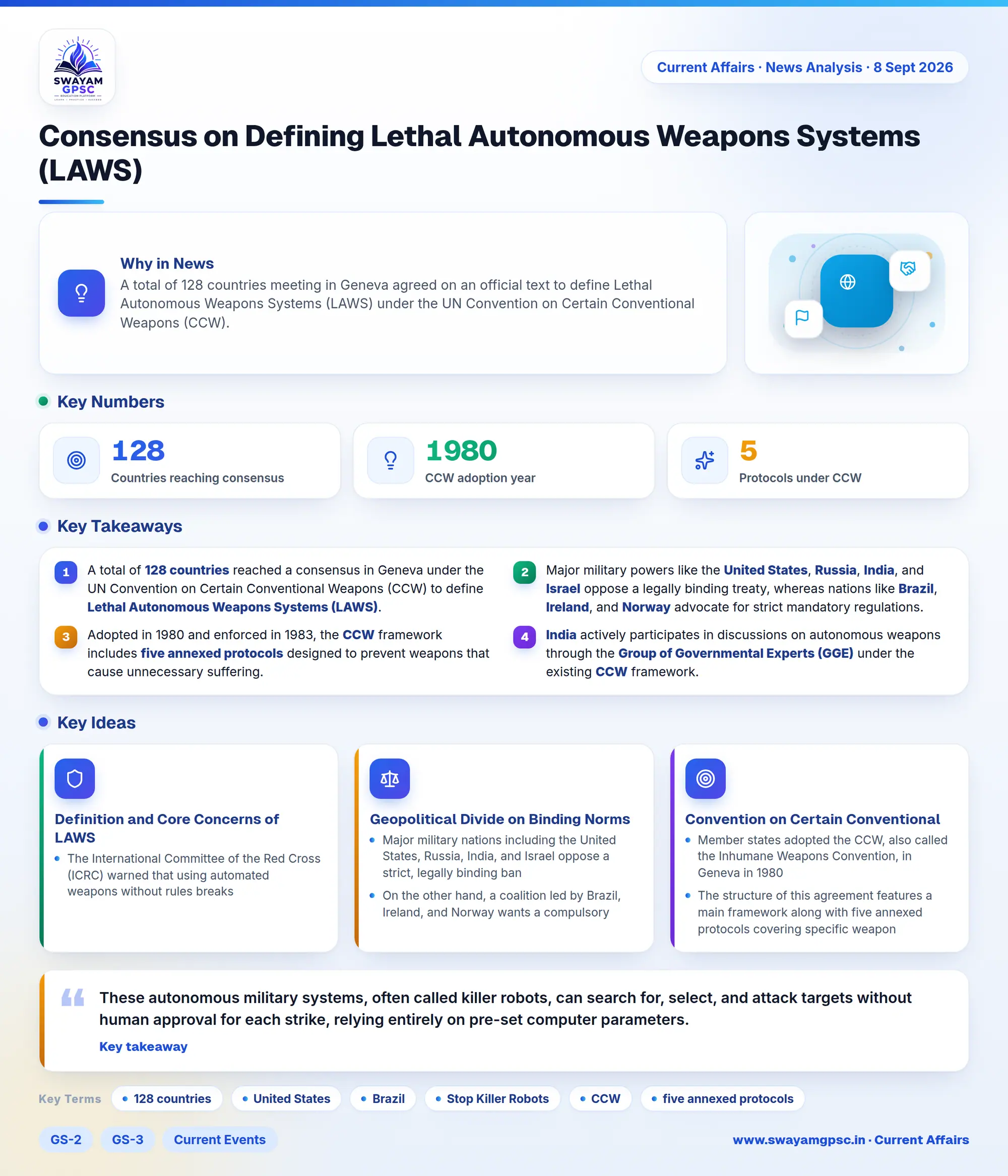
- A total of 128 countries reached a consensus in Geneva under the UN Convention on Certain Conventional Weapons (CCW) to define Lethal Autonomous Weapons Systems (LAWS).
- Major military powers like the United States, Russia, India, and Israel oppose a legally binding treaty, whereas nations like Brazil, Ireland, and Norway advocate for strict mandatory regulations.
- Adopted in 1980 and enforced in 1983, the CCW framework includes five annexed protocols designed to prevent weapons that cause unnecessary suffering.
- India actively participates in discussions on autonomous weapons through the Group of Governmental Experts (GGE) under the existing CCW framework.
Why in News
- A total of 128 countries meeting in Geneva agreed on an official text to define Lethal Autonomous Weapons Systems (LAWS) under the UN Convention on Certain Conventional Weapons (CCW). Although this agreement is non-binding, it marks an important step toward creating future international rules or treaties for autonomous weapons.
Definition and Core Concerns of LAWS
- These autonomous military systems, often called killer robots, can search for, select, and attack targets without human approval for each strike, relying entirely on pre-set computer parameters.
- The International Committee of the Red Cross (ICRC) warned that using automated weapons without rules breaks fundamental principles of International Humanitarian Law (IHL), creating serious legal, moral, and accountability problems during war.
Geopolitical Divide on Binding Norms
- Major military nations including the United States, Russia, India, and Israel oppose a strict, legally binding ban, preferring voluntary codes of conduct or existing rules of armed conflict.
- On the other hand, a coalition led by Brazil, Ireland, and Norway wants a compulsory, legally binding treaty to strictly limit automated targeting in battle.
- Human rights groups such as the Stop Killer Robots coalition criticized the agreed text for being too weak, arguing that operational limits and civilian protections were diluted to accommodate major military powers.
Convention on Certain Conventional Weapons (CCW)
- Member states adopted the CCW, also called the Inhumane Weapons Convention, in Geneva in 1980, and it took effect in 1983 to limit conventional weapons that cause unnecessary suffering to soldiers or indiscriminate harm to civilians.
- The structure of this agreement features a main framework along with five annexed protocols covering specific weapon bans, allowing new protocols to address emerging military technologies.
- India is a formal party to this agreement and actively takes part in discussions within the Group of Governmental Experts (GGE), preferring to address issues about killer robots within this existing framework rather than creating separate parallel forums.