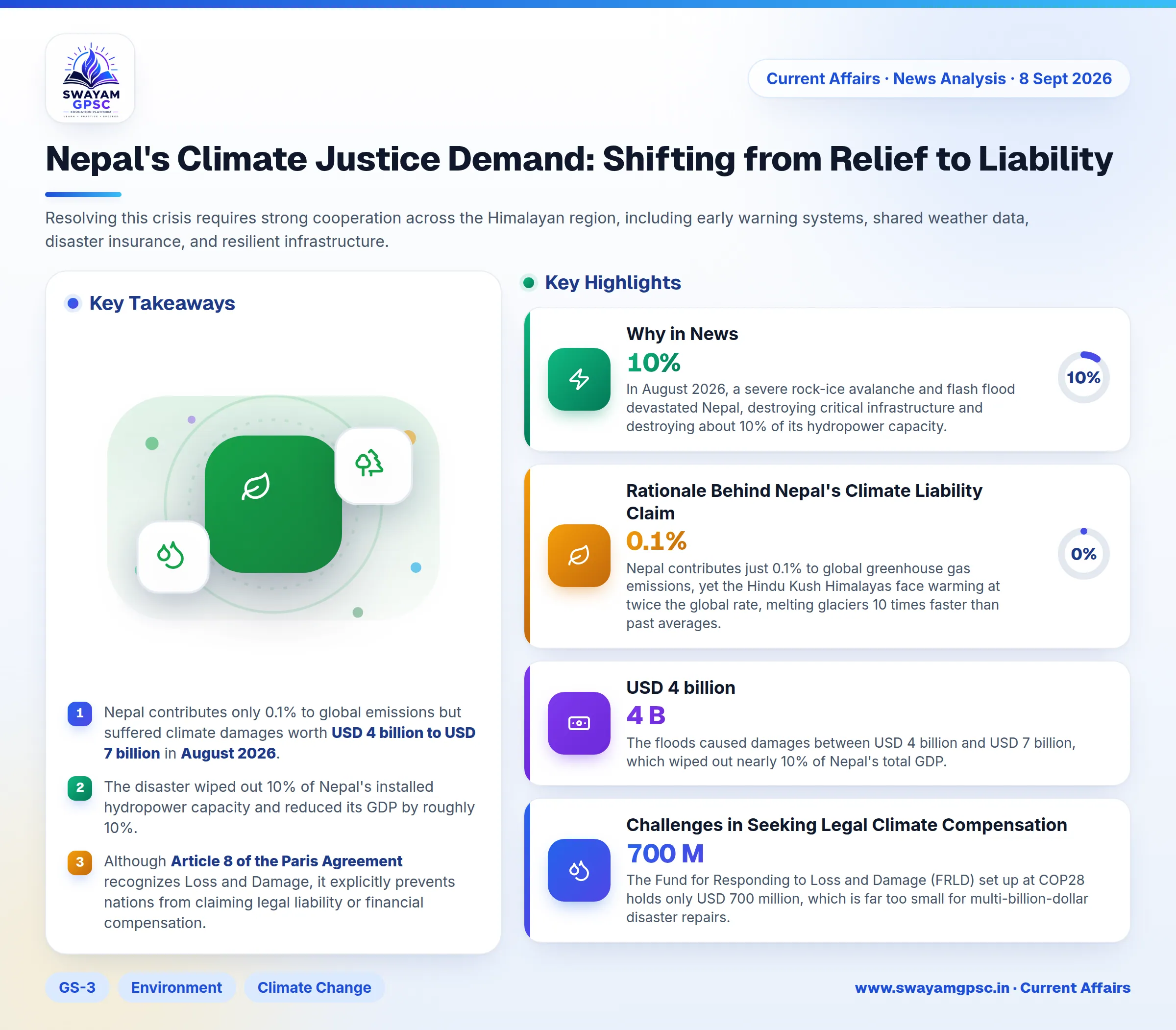
Nepal's Climate Justice Demand: Shifting from Relief to Liability
#GS-3 #Environment #Climate Change #Disaster Management #GS-2 #Current Events #International #Infrastructure
Key takeaways
- Nepal contributes only 0.1% to global emissions but suffered climate damages worth USD 4 billion to USD 7 billion in August 2026.
- The disaster wiped out 10% of Nepal's installed hydropower capacity and reduced its GDP by roughly 10%.
- Although Article 8 of the Paris Agreement recognizes Loss and Damage, it explicitly prevents nations from claiming legal liability or financial compensation.
- The global Fund for Responding to Loss and Damage (FRLD) created at COP28 holds around USD 700 million, which is insufficient for fast disaster recovery.
- To protect the region, South Asian nations must implement Target G of the Sendai Framework through open cross-border early warning networks.
Why in News
- In August 2026, a severe rock-ice avalanche and flash flood devastated Nepal, destroying critical infrastructure and destroying about 10% of its hydropower capacity.
- This massive disaster prompted Nepal's Foreign Minister to demand climate compensation from top greenhouse gas emitters like the US, China, and India.
- In response, India asked developed nations to lead carbon cuts and share green technology, citing their long historical role in global emissions.
Summary
- Nepal's demand highlights how low-emitting nations suffer severe climate damage while major emitting countries avoid legal liability under Article 8 of the Paris Agreement.
- Resolving this crisis requires strong cooperation across the Himalayan region, including early warning systems, shared weather data, disaster insurance, and resilient infrastructure.
Rationale Behind Nepal's Climate Liability Claim
- Nepal contributes just 0.1% to global greenhouse gas emissions, yet the Hindu Kush Himalayas face warming at twice the global rate, melting glaciers 10 times faster than past averages.
- The floods caused damages between USD 4 billion and USD 7 billion, which wiped out nearly 10% of Nepal's total GDP.
- Destruction of key Run-of-the-River (RoR) power plants turned Nepal from a clean electricity exporter into an importer, harming its national trade balance.
- Rebuilding destroyed projects with climate-resilient engineering increases capital costs, forcing vulnerable nations into commercial debt for a crisis they did not cause.
- Glacial instability links directly to global phenomena like Arctic warming and changing monsoon patterns, but proving direct legal cause requires complex scientific data.
- Nepal separates historical responsibility of developed nations like the US from the immediate responsibility of major regional emitters like China and India.
Understanding Climate Justice
- Climate justice focuses on protecting vulnerable communities who suffer the most from climate impacts despite causing the least pollution.
- It aims to deliver fair climate solutions by fixing environmental harms and social inequalities together.
Challenges in Seeking Legal Climate Compensation
- While Article 8 of the Paris Agreement acknowledges Loss and Damage, it explicitly blocks countries from using the UNFCCC framework to claim legal damages.
- The Fund for Responding to Loss and Damage (FRLD) set up at COP28 holds only USD 700 million, which is far too small for multi-billion-dollar disaster repairs.
- Proving in court that a specific mountain disaster occurred purely due to human-caused global warming remains scientifically difficult due to complex geological factors.
- Major world powers readily offer short-term emergency rescue aid to show diplomatic goodwill, but they strictly resist legal agreements that require financial reparations.
Implications for India and Regional Energy Politics
- India uses the CBDR-RC principle to demand funds from rich nations, but Nepal's claim turns this logic back on India as South Asia's largest economy.
- India's Cross-Border Trade in Electricity (CBET) rules block power imports from projects with Chinese funding, limiting income for damaged Nepali hydro plants.
- Geopolitical tensions continue to restrict real-time hydrological data sharing across Himalayan borders, raising risks from glacial lake outburst floods.
- Melting mountain glaciers threaten water flows into the Indo-Gangetic plain, making Himalayan stability a core national security issue for India.
Way Forward
- Countries like India, China, Nepal, and Bhutan must set up an open regional telemetry network to achieve Target G of the Sendai Framework.
- South Asia should establish a joint disaster insurance pool to provide immediate funds right after natural disasters occur.
- Regional energy frameworks like the BBIN initiative should add humanitarian clauses so disaster-hit power plants can quickly sell electricity across borders.
- The UNFCCC must create fast emergency funding channels under Loss and Damage to prevent vulnerable nations from taking on high-interest debt.
Conclusion
- Nepal's demand exposes the clear gap between climate vulnerability and global accountability.
- Building long-term Himalayan stability requires moving away from reactive relief toward automated data sharing, joint climate funds, and resilient power infrastructure.