Districts as Export Hubs Initiative for Inclusive Growth
#GS-2 #GS-3 #Governance & Social Justice #Government Policies & Interventions #Economy #Growth #Infrastructure #Employment #Current Events #National
Key takeaways
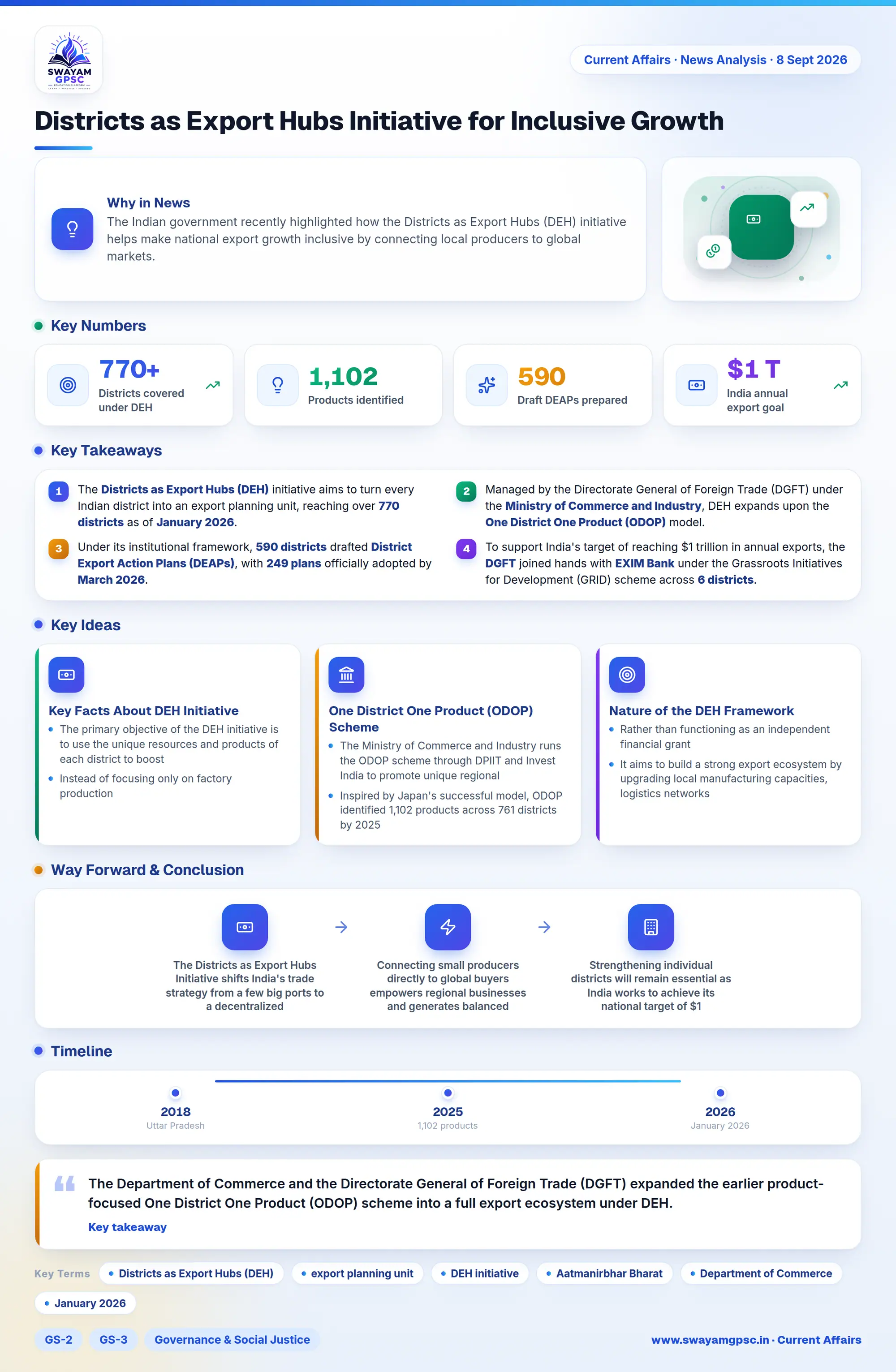
- The Districts as Export Hubs (DEH) initiative aims to turn every Indian district into an export planning unit, reaching over 770 districts as of January 2026.
- Managed by the Directorate General of Foreign Trade (DGFT) under the Ministry of Commerce and Industry, DEH expands upon the One District One Product (ODOP) model.
- Under its institutional framework, 590 districts drafted District Export Action Plans (DEAPs), with 249 plans officially adopted by March 2026.
- To support India's target of reaching $1 trillion in annual exports, the DGFT joined hands with EXIM Bank under the Grassroots Initiatives for Development (GRID) scheme across 6 districts.
Why in News
- The Indian government recently highlighted how the Districts as Export Hubs (DEH) initiative helps make national export growth inclusive by connecting local producers to global markets.
- This flagship initiative aims to convert every Indian district into a self-sustaining export planning unit by discovering local goods and services that have strong international potential.
Key Facts About DEH Initiative
- The primary objective of the DEH initiative is to use the unique resources and products of each district to boost local exports and link regional businesses with world trade.
- Instead of focusing only on factory production, this model treats each district as a distinct planning unit to boost local competitiveness and open foreign market channels.
- This initiative strengthens national goals like Aatmanirbhar Bharat and Vocal for Local by supporting small businesses and generating local employment.
- The Department of Commerce and the Directorate General of Foreign Trade (DGFT) expanded the earlier product-focused One District One Product (ODOP) scheme into a full export ecosystem under DEH.
- As of January 2026, this nationwide programme successfully covers more than 770 districts across India.
One District One Product (ODOP) Scheme
- The Ministry of Commerce and Industry runs the ODOP scheme through DPIIT and Invest India to promote unique regional products.
- Inspired by Japan's successful model, ODOP identified 1,102 products across 761 districts by 2025, spanning handicrafts, textiles, food products, and agriculture.
- The main goal is to convert traditional regional items into famous global brands while protecting India's rich cultural heritage and artisan skills.
- First launched in Uttar Pradesh in 2018 starting with Moradabad brassware, it helped revive traditional crafts like chikankari embroidery, pottery, carpets, and leather goods.
Nature of the DEH Framework
- Rather than functioning as an independent financial grant, DEH acts as a convergence mechanism that brings together existing central and state government schemes.
- It aims to build a strong export ecosystem by upgrading local manufacturing capacities, logistics networks, quality checks, and international market connections.
- By promoting regional artisans, agricultural producers, and small enterprises, this policy creates new jobs and encourages balanced economic growth.
Institutional Architecture of DEH
- The Department of Commerce sets overall policy targets, while the DGFT manages daily execution, stakeholder collaboration, and progress tracking.
- At the state level, State Export Promotion Committees (SEPCs) direct strategy and maintain coordination between various state administrative departments.
- At the local level, District Export Promotion Committees (DEPCs) identify specific export opportunities and assist exporters in resolving local administrative obstacles.
- By March 2026, authorities drafted District Export Action Plans (DEAPs) for 590 districts, with local committees formally adopting 249 plans.
- On 1st June 2026, the government launched a targeted, outcome-driven implementation strategy to speed up execution across the country.
- The initial implementation phase covers key districts across 27 States and Union Territories, supported by 24 DGFT Regional Authorities and 11 partner agencies.
- Key success metrics include registering new exporters, boosting local trade volumes, promoting GI-tagged goods, and strengthening small business clusters.
Building District-Level Export Ecosystems
- The DEH scheme maps out local products with high foreign demand, such as GI-tagged items, farm produce, handicrafts, engineering components, and toys.
- Local producers receive expert guidance on meeting international quality benchmarks, packaging standards, product testing, and mandatory global certifications.
- By partnering with major e-commerce platforms, the government helps small businesses export goods online with lower freight costs and simplified market access.
- Local postal outlets converted into Dak Ghar Niryat Kendras offer affordable shipping, easy documentation, and packaging support for small export packages.
- Regional offices of DGFT and local administration host workshops to teach small business owners about custom regulations, export rules, and packaging norm compliance.
- The DGFT collaborated with EXIM Bank under the Grassroots Initiatives for Development (GRID) scheme to provide tailored export support in select regions.
- Six pilot districts were chosen under the GRID programme: Anantapur, Raipur, Solan, Tiruppur, Kanpur, and Kolhapur.
Way Forward & Conclusion
- The Districts as Export Hubs Initiative shifts India's trade strategy from a few big ports to a decentralized, district-level export ecosystem.
- Connecting small producers directly to global buyers empowers regional businesses and generates balanced employment opportunities at the grassroots level.
- Strengthening individual districts will remain essential as India works to achieve its national target of $1 trillion in annual exports.
Frequently Asked Questions
- The DEH Initiative aims to make each district a focal point for export planning by identifying local products and linking regional businesses to world markets.
- The Directorate General of Foreign Trade (DGFT) under the Ministry of Commerce and Industry implements the DEH initiative.
- DEH is not an independent scheme with dedicated grants, but rather a convergence framework utilizing existing central and state programs.
- While ODOP focuses on promoting a single district product, DEH expands this model into an all-inclusive district export ecosystem.
- District Export Action Plans (DEAPs) are local strategies detailing potential export products, infrastructure requirements, and regulatory support for each district.