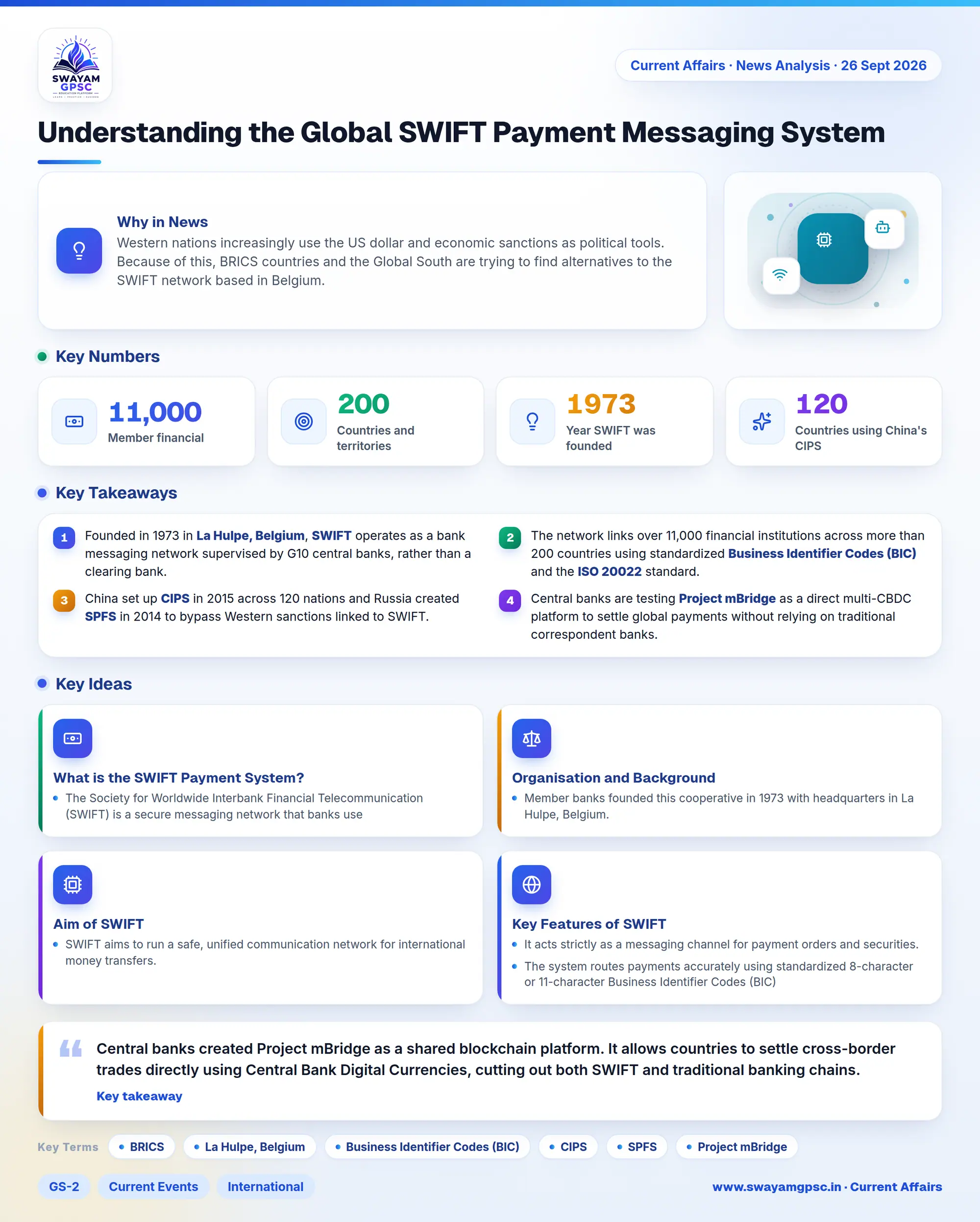
Understanding the Global SWIFT Payment Messaging System
#GS-2 #Current Events #International #GS-3 #Economy #Banking #Science & Technology #ICT #Prelims #International Relations #SWIFT #Financial Technology
Key takeaways
- Founded in 1973 in La Hulpe, Belgium, SWIFT operates as a bank messaging network supervised by G10 central banks, rather than a clearing bank.
- The network links over 11,000 financial institutions across more than 200 countries using standardized Business Identifier Codes (BIC) and the ISO 20022 standard.
- China set up CIPS in 2015 across 120 nations and Russia created SPFS in 2014 to bypass Western sanctions linked to SWIFT.
- Central banks are testing Project mBridge as a direct multi-CBDC platform to settle global payments without relying on traditional correspondent banks.
Why in News
- Western nations increasingly use the US dollar and economic sanctions as political tools. Because of this, BRICS countries and the Global South are trying to find alternatives to the SWIFT network based in Belgium.
What is the SWIFT Payment System?
- The Society for Worldwide Interbank Financial Telecommunication (SWIFT) is a secure messaging network that banks use to send financial instructions, including money transfer details, using unique codes. It only transfers information between banks; it never holds money or settles payments on its own.
Organisation and Background
- Member banks founded this cooperative in 1973 with headquarters in La Hulpe, Belgium. It works under Belgian law and the G10 central banks oversee its daily operations.
Aim of SWIFT
- SWIFT aims to run a safe, unified communication network for international money transfers. It replaced old, error-prone telex machines with automated digital messages.
Key Features of SWIFT
- It acts strictly as a messaging channel for payment orders and securities. Banks still move the real money through separate bilateral accounts known as Nostro and Vostro accounts.
- The system routes payments accurately using standardized 8-character or 11-character Business Identifier Codes (BIC) along with the ISO 20022 standard format.
- Its global reach connects more than 11,000 financial institutions across over 200 countries and territories, handling tens of millions of instructions every day.
- Belgian and European Union laws regulate the platform. Because of this legal base, SWIFT must follow and apply EU financial sanctions against targeted nations.
- The network uses strong hardware encryption, private communication lines, and multiple data centers worldwide to stop cyberattacks and prevent system failures.
Key Alternatives to SWIFT
- China launched CIPS in 2015 to promote global use of the yuan. It provides cross-border messaging, clearing, and settlement services across more than 120 countries.
- Russia set up SPFS in 2014 after facing Western sanctions. This network links Russian financial institutions with overseas partners, including Iran's SEPAM system.
- Central banks created Project mBridge as a shared blockchain platform. It allows countries to settle cross-border trades directly using Central Bank Digital Currencies, cutting out both SWIFT and traditional banking chains.