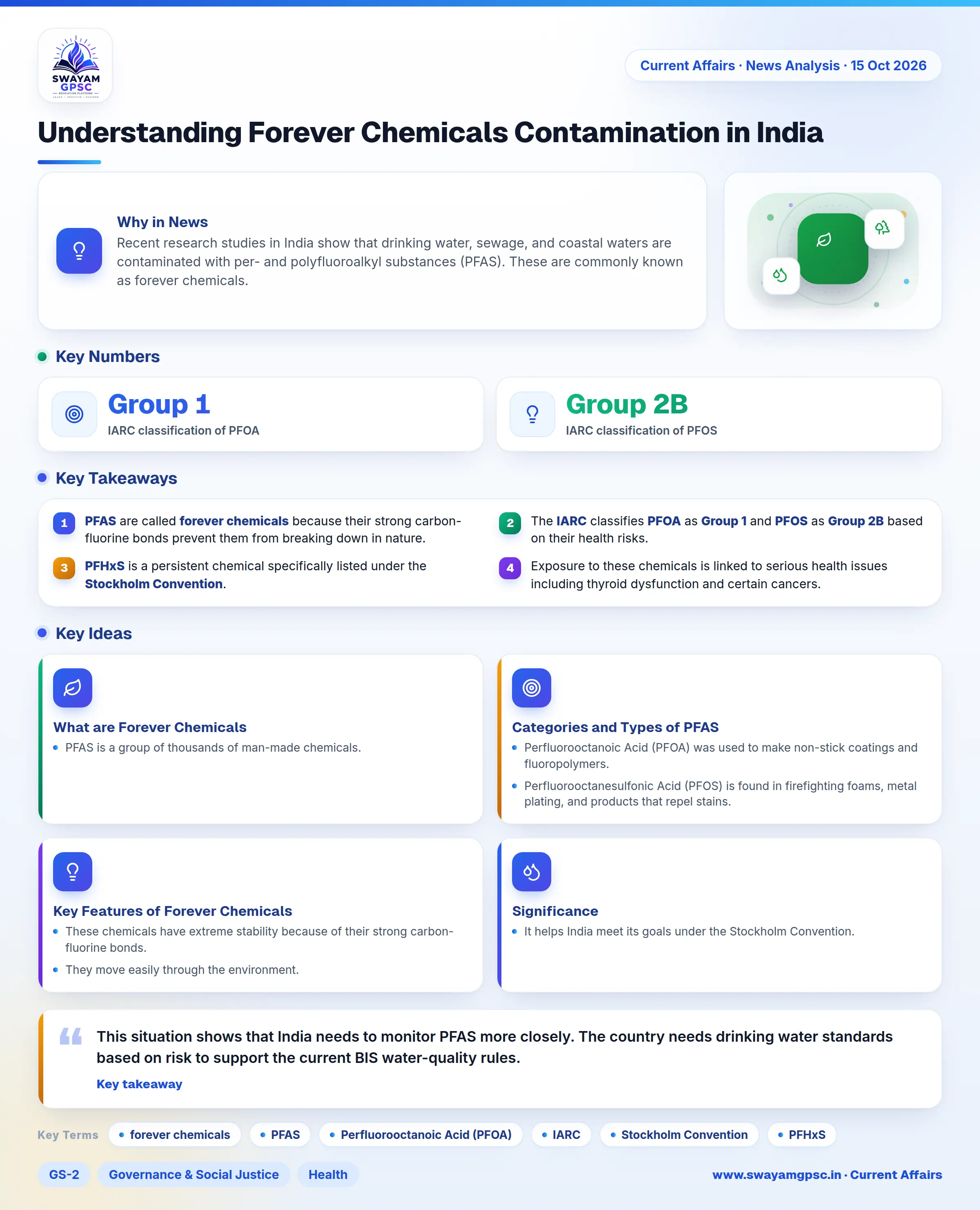
Understanding Forever Chemicals Contamination in India
#GS-2 #Governance & Social Justice #Health #GS-3 #Environment #Pollution #Sustainable Development #Current Events #National #Prelims
Key takeaways
- PFAS are called forever chemicals because their strong carbon-fluorine bonds prevent them from breaking down in nature.
- The IARC classifies PFOA as Group 1 and PFOS as Group 2B based on their health risks.
- PFHxS is a persistent chemical specifically listed under the Stockholm Convention.
- Exposure to these chemicals is linked to serious health issues including thyroid dysfunction and certain cancers.
- India needs to update its BIS water-quality standards to better monitor and manage PFAS contamination.
Why in News
- Recent research studies in India show that drinking water, sewage, and coastal waters are contaminated with per- and polyfluoroalkyl substances (PFAS). These are commonly known as forever chemicals.
What are Forever Chemicals
- PFAS is a group of thousands of man-made chemicals. They contain very strong carbon-fluorine bonds, which means they do not break down easily in nature.
Categories and Types of PFAS
- Perfluorooctanoic Acid (PFOA) was used to make non-stick coatings and fluoropolymers. The IARC has placed it in Group 1.
- Perfluorooctanesulfonic Acid (PFOS) is found in firefighting foams, metal plating, and products that repel stains. The IARC classifies it as Group 2B.
- Perfluorohexane Sulfonic Acid (PFHxS) is used in industrial surfactants and firefighting foams. The Stockholm Convention lists it as a chemical that lasts long and builds up in living organisms.
- Perfluorocarboxylic Acids and Fluorotelomers include various PFAS compounds. Some of these act as precursors that eventually turn into very persistent perfluoroalkyl acids.
Key Features of Forever Chemicals
- These chemicals have extreme stability because of their strong carbon-fluorine bonds. This makes them resistant to heat and bacteria, so they stay in the environment for a long time.
- They move easily through the environment. Some PFAS dissolve in water and travel through rivers, groundwater, and ocean currents to reach far-off ecosystems.
- Common water treatment methods do not work well against them. Standard filtration and chlorination cannot remove many PFAS, and some treatments might even turn precursors into more persistent forms.
- These chemicals build up in the body. They accumulate in the liver and blood, and their concentration increases as they move up the food chain in land and water animals.
- They pose several health risks. Exposure can lead to thyroid problems, high cholesterol, lower vaccine effectiveness, developmental issues, and certain types of cancer.
Significance
- This situation shows that India needs to monitor PFAS more closely. The country needs drinking water standards based on risk to support the current BIS water-quality rules.
- It helps India meet its goals under the Stockholm Convention. This includes limiting the use of listed PFAS and switching to safer industrial options.