Understanding the Federal Fiscal Mismatch Architecture in India
#GS-2 #Indian Polity & Constitution #Federalism #GS-3 #Economy #Taxation #Budget #Fiscal Federalism #State Development Loans
Why in News
- Economist Jayan Jose Thomas analyzed the growing debt of Indian states, showing that high debt comes from a structural gap between state responsibilities and revenue powers rather than poor management.
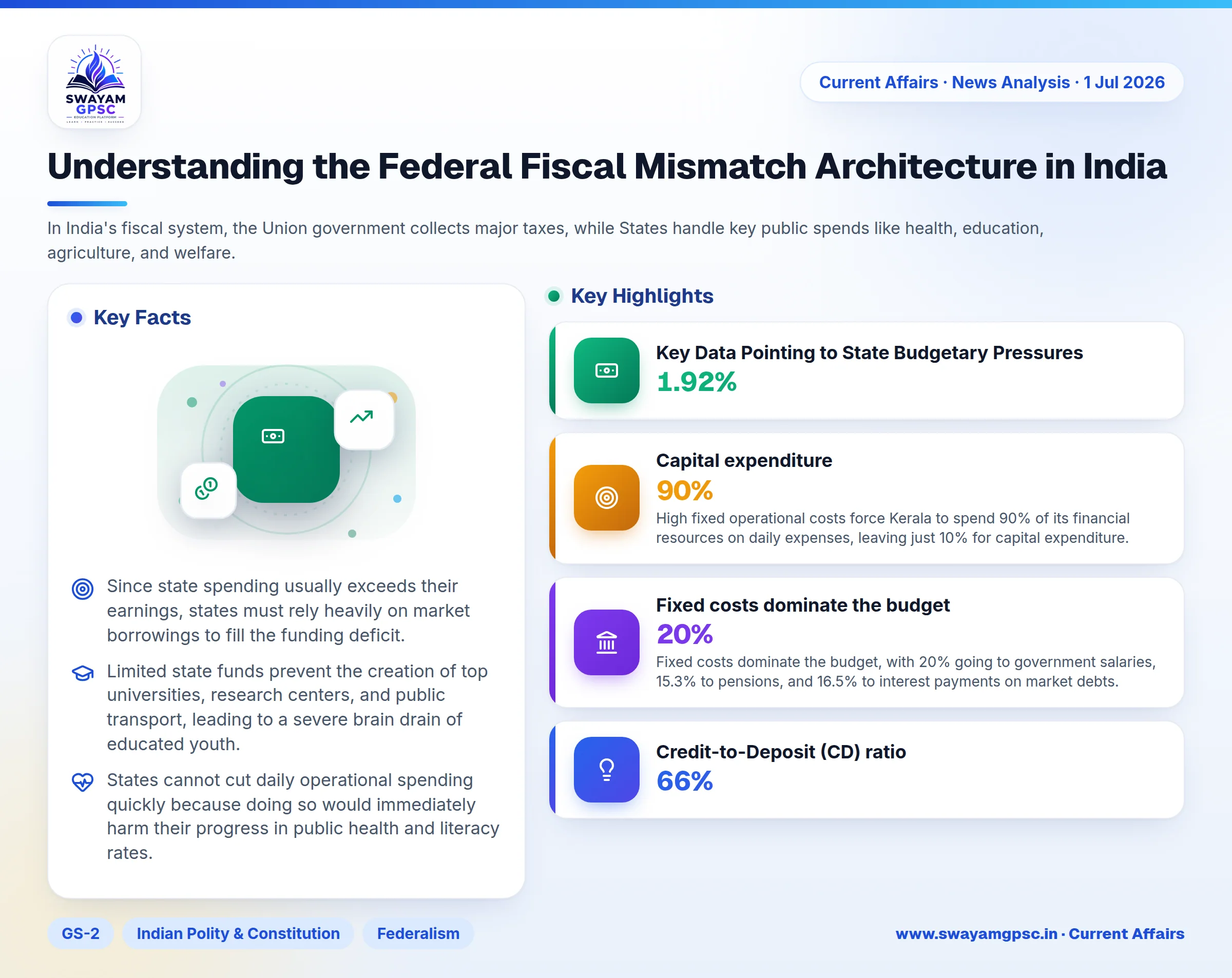
- In India's fiscal system, the Union government collects major taxes, while States handle key public spends like health, education, agriculture, and welfare.
- Since state spending usually exceeds their earnings, states must rely heavily on market borrowings to fill the funding deficit.
Key Data Pointing to State Budgetary Pressures
- In 2023-24, Kerala generated local taxes 1.5 times the national average, yet its share in Union tax devolution was capped at 1.92%, despite having 2.6% of India's population.
- High fixed operational costs force Kerala to spend 90% of its financial resources on daily expenses, leaving just 10% for capital expenditure.
- Fixed costs dominate the budget, with 20% going to government salaries, 15.3% to pensions, and 16.5% to interest payments on market debts.
- Kerala's banks have a low Credit-to-Deposit (CD) ratio of 66%, which is below the national average of 76% and far behind commercial hubs like Maharashtra and Tamil Nadu that cross 100%.
- States pay high interest rates between 6.5% and 7.5% on State Development Loans (SDLs), which is 0.25 to 0.75 percentage points higher than what the Union government pays.
Challenges
- Limited state funds prevent the creation of top universities, research centers, and public transport, leading to a severe brain drain of educated youth.
- States cannot cut daily operational spending quickly because doing so would immediately harm their progress in public health and literacy rates.
- A sharp rise in private wealth alongside poor government revenues creates a troubling contrast that widens regional socioeconomic inequality.
- High interest payments on State Development Loans (SDLs) trap states in a cycle where new loans pay off old debts instead of building productive assets.
- By comparison, local authorities in China access bank funds at a low subsidized rate of around 2%, avoiding the heavy market penalties that Indian states face.
Comparative Case Study: China's Local Government Model
- In China, local governments execute most major infrastructure projects by accessing public savings from domestic banks through central planning.
- Chinese local entities issue competitive Local Government Bonds (LGBs) directly to raise funds from investors.
- Local authorities generate substantial funding by selling commercial land rights on a large scale.
- Sub-national governments use specialized units called Local Government Financing Vehicles (LGFVs) to secure off-budget loans.
Way Forward
- India should reform its tax distribution rules to reward states that excel at raising their own local revenues.
- Financial rules must change to help states borrow unutilized local bank savings directly for building public assets.
- The Union government should offer credit guarantees for state borrowings to remove the 0.25 to 0.75 percentage point penalty on State Development Loans (SDLs).
- States need a 10-year plan to push capital spending well above the 10% limit to fund public transport and tech parks.
- Interstate agreements must ensure that healthcare, pensions, and welfare benefits move seamlessly with migrant workers across state lines.
Conclusion
- Borrowing to build universities, hospitals, and agricultural systems creates long-term value that strict spending cuts can never achieve.
- Fixing high interest rates on State Development Loans (SDLs) and utilizing local bank savings will secure social progress and spur economic growth across states.