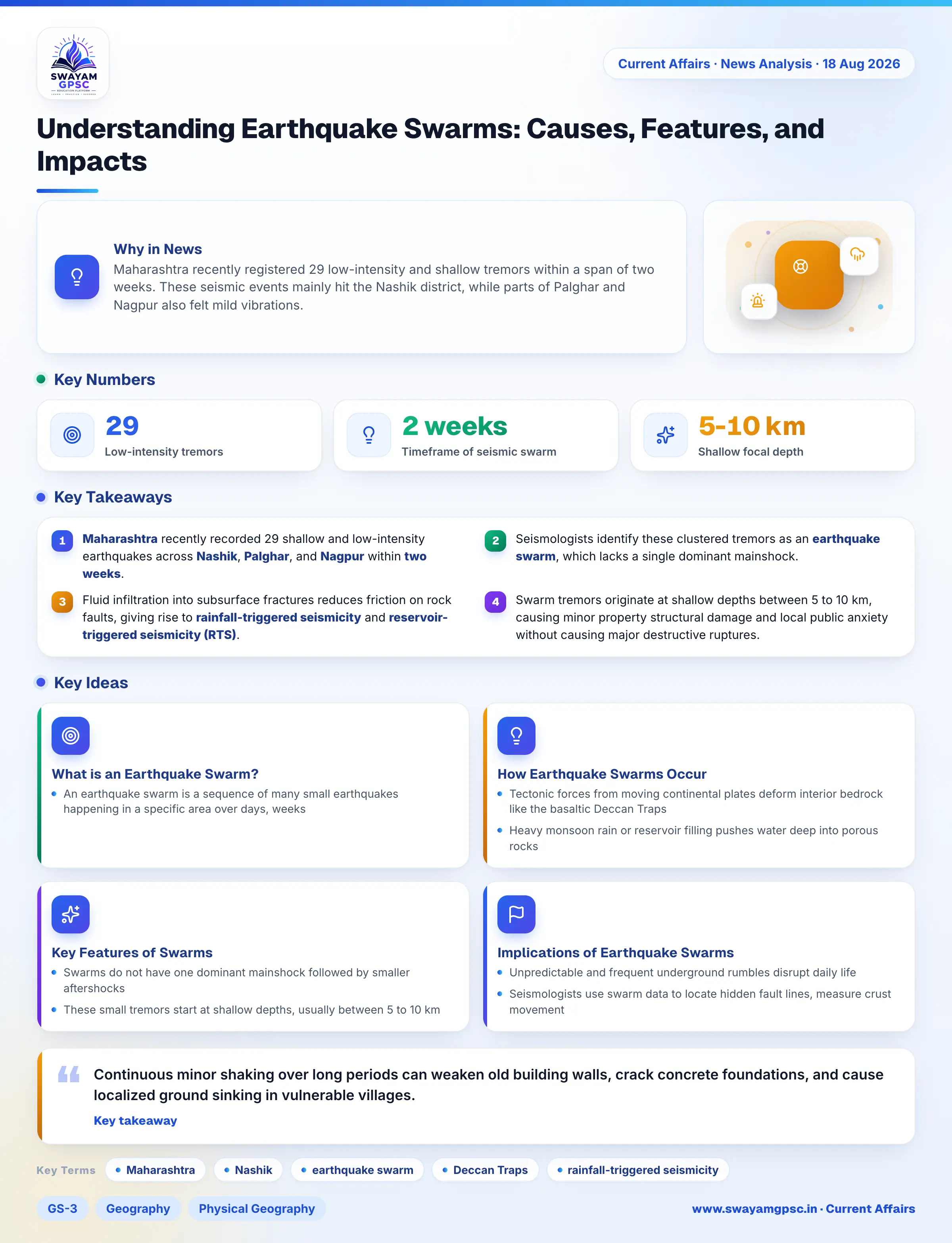
Understanding Earthquake Swarms: Causes, Features, and Impacts
#GS-3 #Geography #Physical Geography #Disaster Geography #Disaster Management #Disaster Preparedness #Current Events #National #Seismology #Earthquake Swarms
Key takeaways
- Maharashtra recently recorded 29 shallow and low-intensity earthquakes across Nashik, Palghar, and Nagpur within two weeks.
- Seismologists identify these clustered tremors as an earthquake swarm, which lacks a single dominant mainshock.
- Fluid infiltration into subsurface fractures reduces friction on rock faults, giving rise to rainfall-triggered seismicity and reservoir-triggered seismicity (RTS).
- Swarm tremors originate at shallow depths between 5 to 10 km, causing minor property structural damage and local public anxiety without causing major destructive ruptures.
Why in News
- Maharashtra recently registered 29 low-intensity and shallow tremors within a span of two weeks.
- These seismic events mainly hit the Nashik district, while parts of Palghar and Nagpur also felt mild vibrations.
- Seismologists have officially classified this closely clustered group of tremors as an earthquake swarm.
What is an Earthquake Swarm?
- An earthquake swarm is a sequence of many small earthquakes happening in a specific area over days, weeks, or months without a single major mainshock or a typical mainshock-aftershock pattern.
How Earthquake Swarms Occur
- Tectonic forces from moving continental plates deform interior bedrock like the basaltic Deccan Traps, concentrating stress along hidden fault zones and old rock cracks.
- Heavy monsoon rain or reservoir filling pushes water deep into porous rocks, which sharply increases pore-fluid pressure inside the subterranean fractures.
- Higher water pressure lowers rock friction, causing geological faults to slip repeatedly in brief bursts of mild tremors instead of breaking in one huge earthquake.
Key Features of Swarms
- Swarms do not have one dominant mainshock followed by smaller aftershocks, but rather feature multiple tremors of similar strength that go up and down over time.
- These small tremors start at shallow depths, usually between 5 to 10 km, making local residents hear loud underground rumbles and feel noticeable vibrations.
- Hydro-geological conditions often trigger swarms, leading to rainfall-triggered seismicity after rains or reservoir-triggered seismicity (RTS) like in the Koyna-Warna region.
- This seismic activity can continue for weeks, months, or even years without ever producing a destructive large earthquake.
Implications of Earthquake Swarms
- Continuous minor shaking over long periods can weaken old building walls, crack concrete foundations, and cause localized ground sinking in vulnerable villages.
- Unpredictable and frequent underground rumbles disrupt daily life, creating ongoing panic among locals that requires continuous awareness programs by disaster relief teams.
- Seismologists use swarm data to locate hidden fault lines, measure crust movement, and establish strict safety checks for large dams and public buildings.