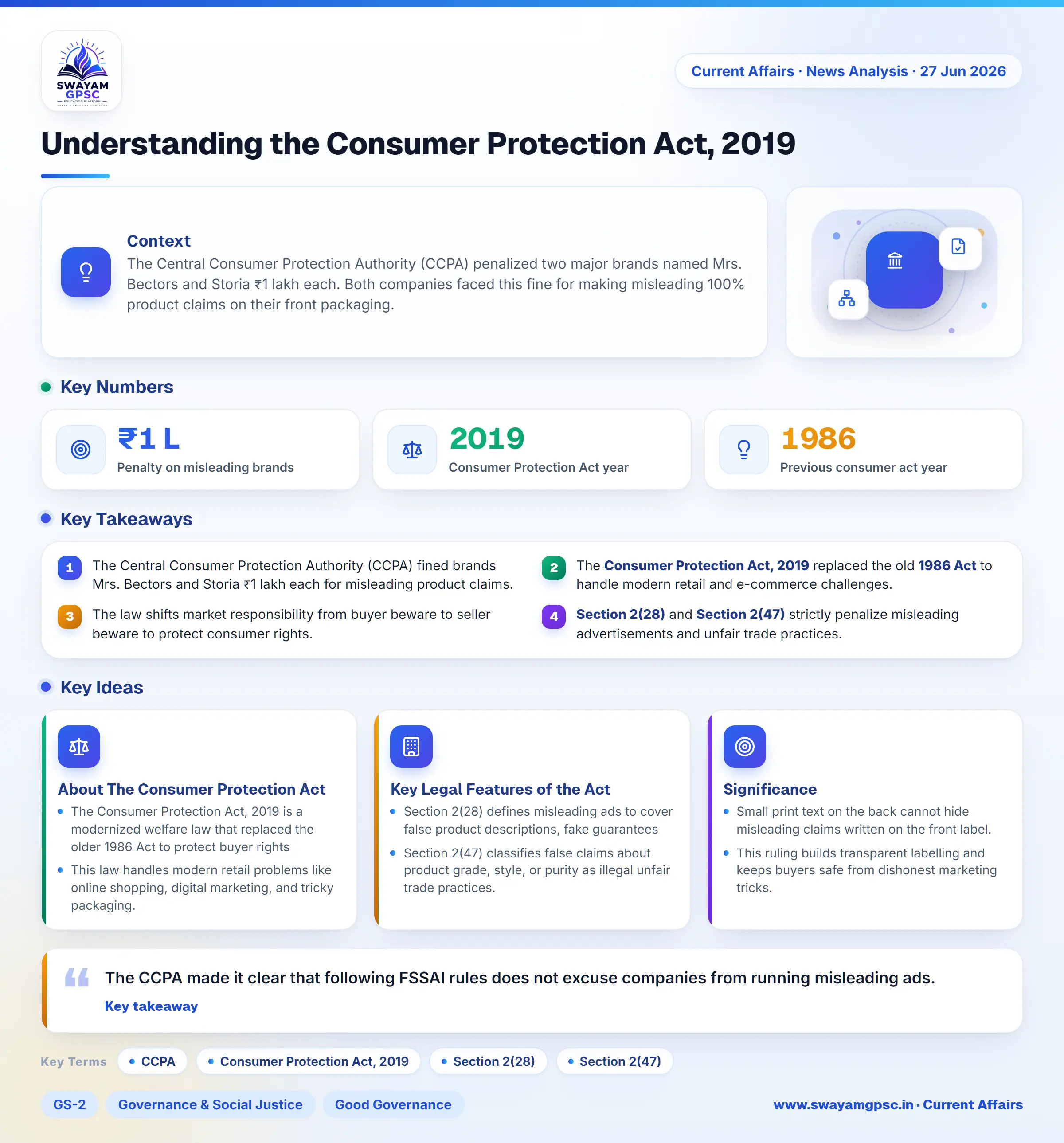
Understanding the Consumer Protection Act, 2019
#GS-2 #Governance & Social Justice #Good Governance #Consumer Rights #Economy
Key takeaways
- The Central Consumer Protection Authority (CCPA) fined brands Mrs. Bectors and Storia ₹1 lakh each for misleading product claims.
- The Consumer Protection Act, 2019 replaced the old 1986 Act to handle modern retail and e-commerce challenges.
- The law shifts market responsibility from buyer beware to seller beware to protect consumer rights.
- Section 2(28) and Section 2(47) strictly penalize misleading advertisements and unfair trade practices.
Context
- The Central Consumer Protection Authority (CCPA) penalized two major brands named Mrs. Bectors and Storia ₹1 lakh each.
- Both companies faced this fine for making misleading 100% product claims on their front packaging.
About The Consumer Protection Act, 2019
- The Consumer Protection Act, 2019 is a modernized welfare law that replaced the older 1986 Act to protect buyer rights in India.
- This law handles modern retail problems like online shopping, digital marketing, and tricky packaging.
- The Ministry of Consumer Affairs, Food and Public Distribution runs and manages this law in India.
- The law created the Central Consumer Protection Authority (CCPA) as a strong watchdog to check consumer rights violations.
- The main goal is to shift the market rule from buyer beware to seller beware.
- It stops false ads and unfair practices that lie about product quality or purity.
- It makes solving consumer problems easier by setting up dispute commissions at district, state, and national levels.
Key Legal Features of the Act
- Section 2(28) defines misleading ads to cover false product descriptions, fake guarantees, and hidden important details.
- Section 2(47) classifies false claims about product grade, style, or purity as illegal unfair trade practices.
- The CCPA can take suo-motu action on its own without needing any formal complaint from a buyer.
- The law allows authorities to charge heavy fines, like the ₹1 lakh penalty on food brands, and stop fake labels.
- It covers online shops and stops manipulative tricks, hidden charges, and fake reviews.
Significance
- The CCPA made it clear that following FSSAI rules does not excuse companies from running misleading ads.
- Small print text on the back cannot hide misleading claims written on the front label.
- This ruling builds transparent labelling and keeps buyers safe from dishonest marketing tricks.