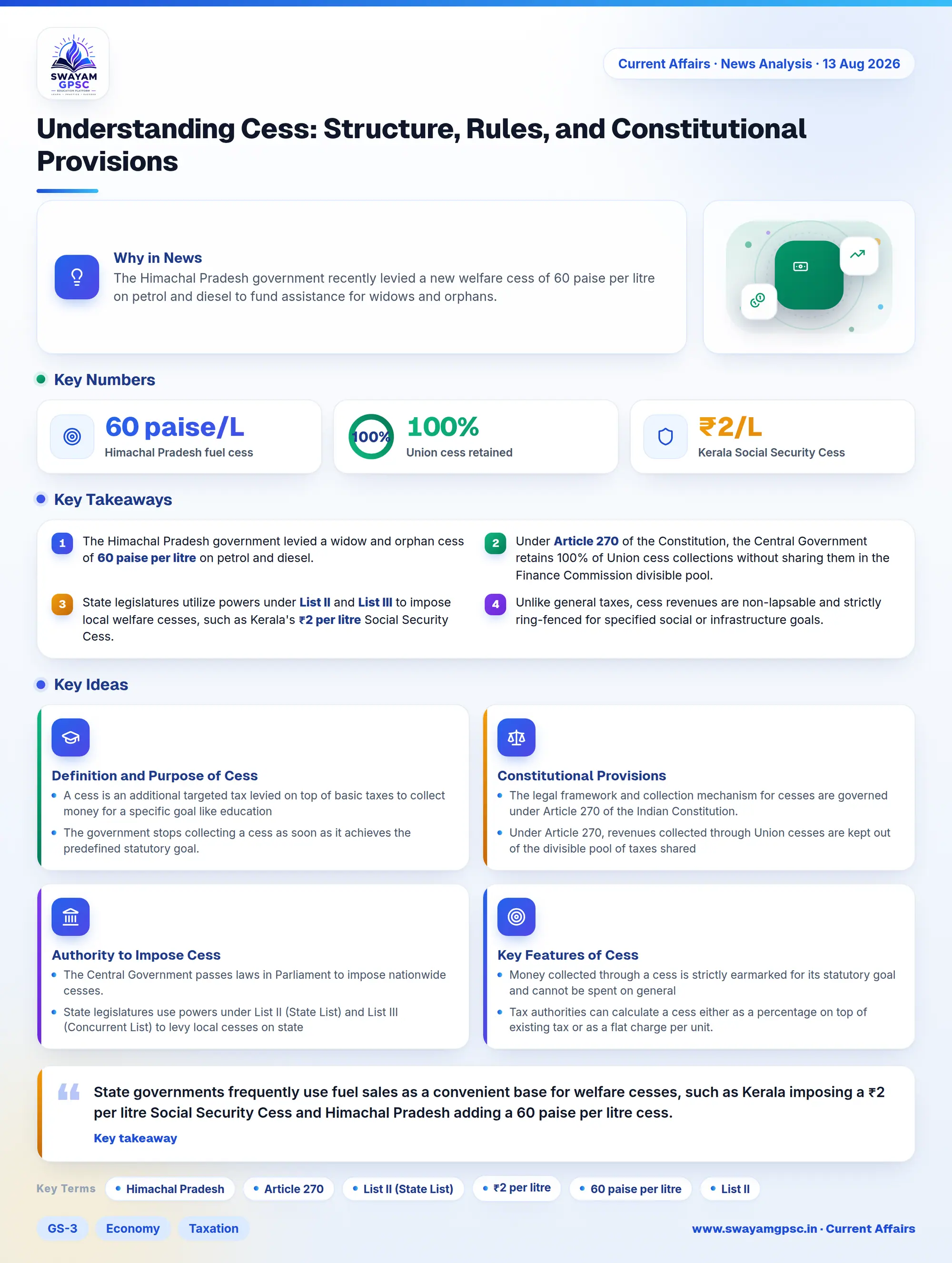
Understanding Cess: Structure, Rules, and Constitutional Provisions
#GS-3 #Economy #Taxation #Constitutional Provisions #Fiscal Federalism
Key takeaways
- The Himachal Pradesh government levied a widow and orphan cess of 60 paise per litre on petrol and diesel.
- Under Article 270 of the Constitution, the Central Government retains 100% of Union cess collections without sharing them in the Finance Commission divisible pool.
- State legislatures utilize powers under List II and List III to impose local welfare cesses, such as Kerala's ₹2 per litre Social Security Cess.
- Unlike general taxes, cess revenues are non-lapsable and strictly ring-fenced for specified social or infrastructure goals.
Why in News
- The Himachal Pradesh government recently levied a new welfare cess of 60 paise per litre on petrol and diesel to fund assistance for widows and orphans.
Definition and Purpose of Cess
- A cess is an additional targeted tax levied on top of basic taxes to collect money for a specific goal like education or road development.
- The government stops collecting a cess as soon as it achieves the predefined statutory goal.
- The core purpose of a cess is to build a dedicated fund for critical social priorities without relying on standard annual budget allocations.
Constitutional Provisions and Devolution
- The legal framework and collection mechanism for cesses are governed under Article 270 of the Indian Constitution.
- Under Article 270, revenues collected through Union cesses are kept out of the divisible pool of taxes shared with state governments.
- The Central Government retains 100% of its collected cess revenue and does not distribute any part of it through Finance Commission recommendations.
Authority to Impose Cess
- The Central Government passes laws in Parliament to impose nationwide cesses.
- State legislatures use powers under List II (State List) and List III (Concurrent List) to levy local cesses on state subjects like fuel, land, and infrastructure.
Key Features of Cess
- Money collected through a cess is strictly earmarked for its statutory goal and cannot be spent on general administration or routine government expenditures.
- Tax authorities can calculate a cess either as a percentage on top of existing tax or as a flat charge per unit.
- Unused funds in a cess account do not lapse at the end of the financial year and carry forward in dedicated statutory funds.
- State governments frequently use fuel sales as a convenient base for welfare cesses, such as Kerala imposing a ₹2 per litre Social Security Cess and Himachal Pradesh adding a 60 paise per litre cess.
Comparison Between General Tax and Cess
- General tax revenue enters the Consolidated Fund for general expenses like administration and defense, whereas cess revenue stays strictly reserved for its specific statutory purpose.
- Central general tax collections are shared with state governments through the Finance Commission divisible pool, while Union cesses are retained entirely by the Central Government.
- A general tax serves as a permanent and continuous source of public revenue, whereas a cess is temporary in principle and ends when its target is achieved.
- General taxes apply directly to income, profits, or goods, while a cess is charged on top of base taxes as a tax on tax or flat surcharge.