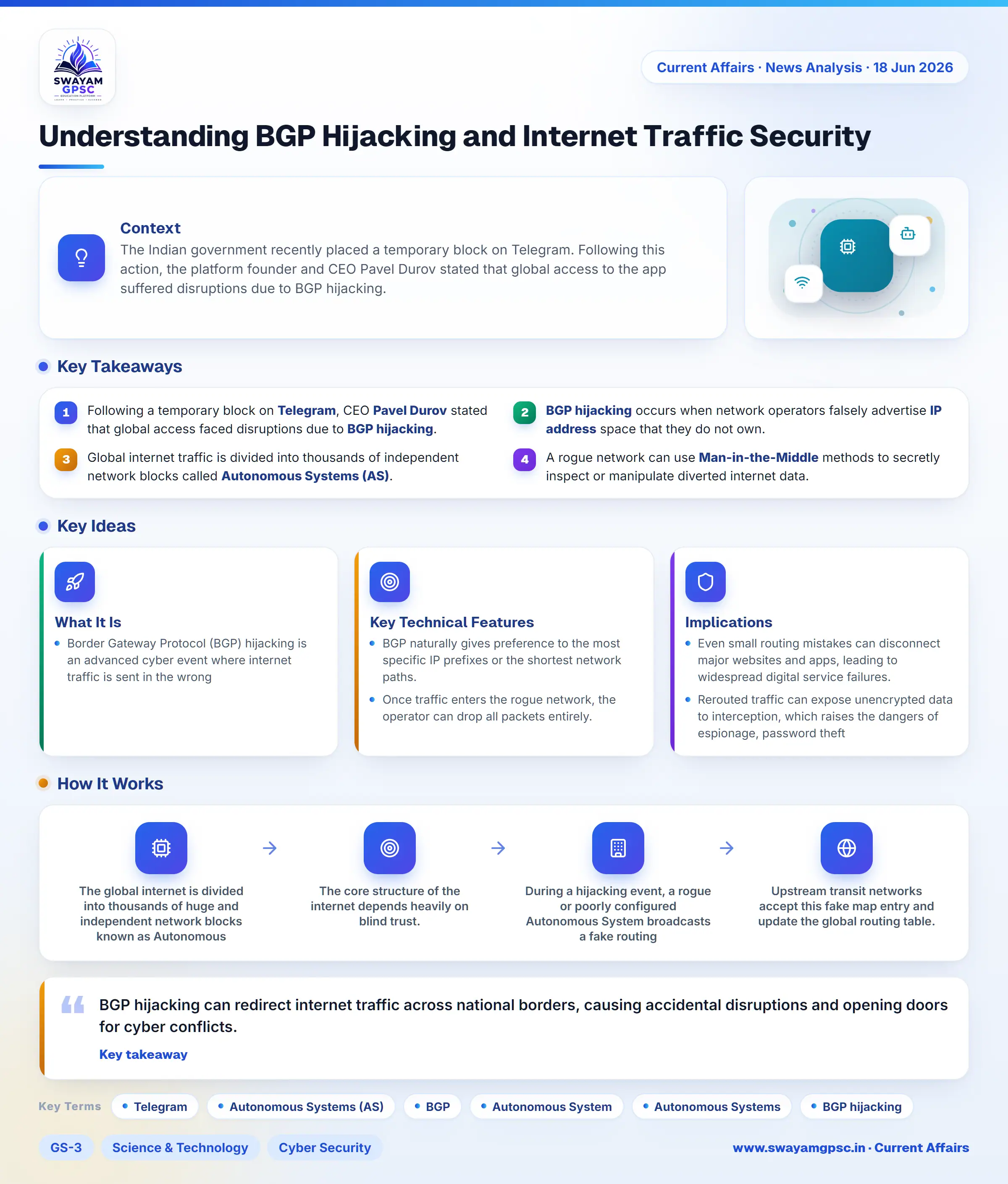
Understanding BGP Hijacking and Internet Traffic Security
#GS-3 #Science & Technology #Cyber Security #Economy #Infrastructure
Key takeaways
- Following a temporary block on Telegram, CEO Pavel Durov stated that global access faced disruptions due to BGP hijacking.
- BGP hijacking occurs when network operators falsely advertise IP address space that they do not own.
- Global internet traffic is divided into thousands of independent network blocks called Autonomous Systems (AS).
- A rogue network can use Man-in-the-Middle methods to secretly inspect or manipulate diverted internet data.
Context
- The Indian government recently placed a temporary block on Telegram. Following this action, the platform founder and CEO Pavel Durov stated that global access to the app suffered disruptions due to BGP hijacking.
What It Is
- Border Gateway Protocol (BGP) hijacking is an advanced cyber event where internet traffic is sent in the wrong direction either maliciously or by accident. This occurs when a network operator falsely advertises IP address space that does not belong to them, which confuses the global routing directory of the internet.
How It Works
- The global internet is divided into thousands of huge and independent network blocks known as Autonomous Systems (AS) which are operated by telecom companies, ISPs, and cloud providers. Every AS uses BGP to announce which IP addresses it can successfully reach.
- The core structure of the internet depends heavily on blind trust. Networks generally accept these BGP routing paths as accurate reflections of the best available map routes.
- During a hijacking event, a rogue or poorly configured Autonomous System broadcasts a fake routing announcement. It claims falsely that it holds the shortest and most efficient path to the IP addresses of a target service.
- Upstream transit networks accept this fake map entry and update the global routing table. As a result, traffic intended for the legitimate service gets pulled away and channeled into the rogue network instead.
Key Technical Features
- BGP naturally gives preference to the most specific IP prefixes or the shortest network paths. Attackers use this behavior by making specific fake announcements that force external networks to choose their rogue route over genuine options.
- Once traffic enters the rogue network, the operator can drop all packets entirely. This drops the data into a void and causes an immediate denial of service for users.
- Instead of destroying the diverted traffic, a malicious operator can secretly inspect, log, or change the data before passing it to the real destination. This allows them to carry out silent surveillance.
- Because Autonomous Systems constantly share routing tables with one another, a single fake entry made in one region can spread across global carrier networks within minutes and disrupt users everywhere.
Implications
- BGP hijacking can redirect internet traffic across national borders, causing accidental disruptions and opening doors for cyber conflicts.
- Even small routing mistakes can disconnect major websites and apps, leading to widespread digital service failures.
- Rerouted traffic can expose unencrypted data to interception, which raises the dangers of espionage, password theft, and privacy breaches.