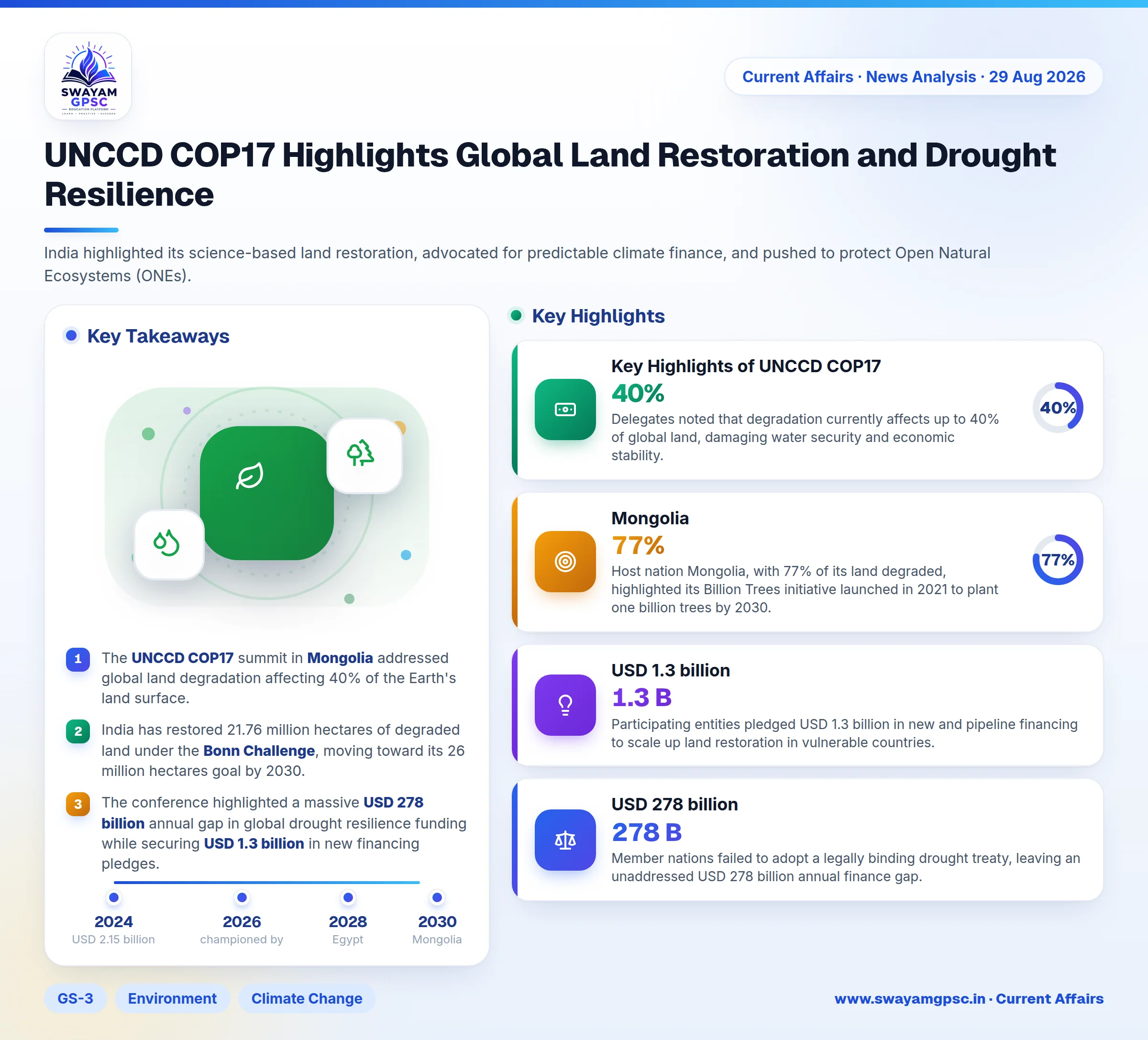
UNCCD COP17 Highlights Global Land Restoration and Drought Resilience
#GS-3 #Environment #Climate Change #Sustainable Development #GS-2 #Current Events #International #Conservation
Key takeaways
- The UNCCD COP17 summit in Mongolia addressed global land degradation affecting 40% of the Earth's land surface.
- India has restored 21.76 million hectares of degraded land under the Bonn Challenge, moving toward its 26 million hectares goal by 2030.
- The conference highlighted a massive USD 278 billion annual gap in global drought resilience funding while securing USD 1.3 billion in new financing pledges.
- According to UNCCD data, 40-45% of global rangelands are degraded, while India's grassland area shrank from 18 million hectares in 2005 to 12 million hectares in 2015.
Why in News
- The 17th session of the Conference of the Parties (COP17) to the United Nations Convention to Combat Desertification (UNCCD) recently concluded in Ulaanbaatar, Mongolia.
- Delegates gathered to tackle desertification, land degradation, and drought, while setting Egypt as host for COP18 in 2028.
Summary of COP17 Outcomes
- The UNCCD COP17 focused on managing rangelands, aiding pastoral communities, expanding nature-based solutions, and raising innovative finance.
- India highlighted its science-based land restoration, advocated for predictable climate finance, and pushed to protect Open Natural Ecosystems (ONEs).
Key Highlights of UNCCD COP17
- The conference adopted the theme Restoring Land. Restoring Hope. to show that land restoration boosts food security and stops forced migration.
- The event aligned with the United Nations International Year of Rangelands and Pastoralists (IYRP 2026) championed by Mongolia.
- Delegates noted that degradation currently affects up to 40% of global land, damaging water security and economic stability.
- Host nation Mongolia, with 77% of its land degraded, highlighted its Billion Trees initiative launched in 2021 to plant one billion trees by 2030.
- The summit pushed Ecosystem-based Adaptation (EbA) to embed nature-based mechanisms into national infrastructure plans.
- Organizers launched the Drought Resilience Index (DRI) as the first AI tool to assess how countries prepare for and adapt to droughts.
- The UNCCD and Luxembourg created the Drought Resilience Investment Facility (DRIF) to use public capital to attract private investments.
- Participating entities pledged USD 1.3 billion in new and pipeline financing to scale up land restoration in vulnerable countries.
- Member nations failed to adopt a legally binding drought treaty, leaving an unaddressed USD 278 billion annual finance gap.
- A future framework would require national drought plans along with shared early-warning systems for rainfall, soil moisture, and risk.
- The framework will also establish dedicated funding mechanisms for land recovery and drought mitigation.
- The conference made drought a permanent standalone agenda item for all future meetings starting from COP18.
India's Stance at UNCCD COP17
- India published its first Guide to Grasslands and Other Open Natural Ecosystems (ONEs).
- This guide seeks to conserve savannas, ravines, and deserts like Thar, Banni, and Deccan, challenging the old practice of calling them wastelands.
- Under the Bonn Challenge, India has restored 21.76 million hectares of degraded land toward its target of 26 million hectares by 2030.
- Indian representatives demanded predictable funding from international sources while highlighting domestic instruments like Sovereign Green Bonds and the Green Credit Programme.
- India urged delegates to empower pastoralists and merge traditional knowledge with modern science, pointing to community-managed Orans of Rajasthan.
Overview of UNCCD
- Adopted in 1994, the United Nations Convention to Combat Desertification (UNCCD) is one of three Rio Conventions alongside UNFCCC and UNCBD.
- It stands as the only legally binding international treaty that connects sustainable land management with environmental preservation.
- The core focus of the convention is reaching Land Degradation Neutrality (LDN) under SDG Target 15.3.
- The Conference of the Parties (COP) serves as the main decision-making body that reviews implementation reports and updates treaty terms.
- The convention includes 197 Parties, comprising 196 countries and the European Union.
- India hosted UNCCD COP14 in New Delhi in 2019, where members signed the New Delhi Declaration.
- At COP16 in Riyadh in 2024, partners launched the Riyadh Global Drought Resilience Partnership with USD 2.15 billion for 80 vulnerable countries.
- The Business4Land Initiative acts as the primary tool to involve private companies in sustainable land and water management.
Ecological and Landscape-Level Challenges
- Unplanned tree planting, loss of soil organic matter, and rising salt levels present serious ecological challenges.
- Classifying Open Natural Ecosystems (ONEs) as wasteland leads to improper tree plantations that damage native wildlife, underground water, and grazing lands.
- Over-farming and excess fertilizer usage deplete Soil Organic Carbon (SOC), while poor irrigation increases soil salinity and lowers crop yields.
- The 2024 UNCCD report reveals that 40-45% of global rangelands are degraded, putting one-sixth of food production at risk, while India protects under 5% of its 1.21 million sq. km of rangelands.
Agrarian and Market Vulnerabilities
- Agricultural subsidies encourage farmers to grow water-heavy crops like paddy and sugarcane in dry regions, depleting groundwater rapidly.
- Encroachments on Common Property Resources (CPRs) like Gochars and Orans reduce open grazing areas and degrade land.
- Uncertain land ownership rights leave women farmers without easy access to bank loans, crop insurance, government subsidies, and training.
Institutional and Governance Gaps
- Divided responsibilities among forestry, agriculture, water, and rural development departments hamper unified landscape planning.
- Disaster management systems focus mostly on short-term relief after a drought occurs rather than building early resilience.
- Remote sensing tracks plant stress well, but a shortage of ground-level soil moisture sensors delays accurate drought assessments.
Global Finance and Climate Challenges
- Global funding for drought and land restoration remains far lower than funding allocated for climate change and biodiversity.
- Private companies hesitate to invest in land projects because of long wait times, complex property rights, and weak carbon verification tools.
- Climate change causes unpredictable rain patterns, leading to heavy soil erosion, fast water runoff, and heavy silt accumulation in reservoirs.
India’s Initiatives to Combat Desertification
- The government introduced the National Action Plan to Combat Desertification (NAPCD) in 2001 and updated it in 2023 to align land restoration schemes.
- The PMKSY & Watershed Development program improves rainwater harvesting, protects soil moisture, and restores native plants.
- The Green India Mission (GIM) under the NAPCC focuses on expanding forest cover and storing more atmospheric carbon.
- The Soil Health Card Scheme provides custom fertilizer guidelines to farmers to preserve soil nutrients and stop land degradation.
- The ISRO Desertification and Land Degradation Atlas of India uses satellite imagery to locate degraded land for targeted restoration.
- Mission Amrit Sarovar rejuvenates local water bodies to lift groundwater levels and protect villages against dry spells.
- The Aravalli Green Wall Initiative works to restore degraded land across the Aravalli mountain range to block desert expansion.
Measures Needed to Strengthen Land Restoration
- Governments should adopt Agro-Ecological Zoning (AEZ) to link crop subsidies and MSP with suitable local crops instead of water-intensive varieties.
- Authorities need to move toward anticipatory funding using satellite data to distribute money before drought conditions worsen.
- Districts should adopt Ridge-to-Valley planning to pool funds across agriculture, forestry, water, and rural development agencies.
- Planners must treat grasslands and scrublands as distinct natural habitats and focus on removing invasive species.
- Farmers should adopt regenerative farming, biochar, and soil carbon practices to improve water retention and soil health.
- States should build circular economy models using crop waste to produce bio-CNG and pellets, reducing stubble burning.
- Agencies should combine satellite data, ground sensors, and AI warning systems for precision irrigation and seasonal crop planning.
- Financial institutions need blended finance tools to lower risks and draw private investments into agroforestry and land recovery.
Conclusion
- UNCCD COP17 proved that restoring degraded land is essential for environmental stability, economic growth, and human welfare.
- India's focus on science-backed restoration and its target of Land Degradation Neutrality (LDN) highlight the urgency of international cooperation and climate finance.
Frequently Asked Questions
- The UNCCD is a legally binding global agreement formed in 1994 to stop desertification, restore land, and mitigate drought.
- Land Degradation Neutrality (LDN) means maintaining or increasing healthy land resources to support nature under SDG Target 15.3.
- The Drought Resilience Index (DRI) uses AI analytics to evaluate how prepared a country is to face severe droughts.
- The Drought Resilience Investment Facility (DRIF) uses public money to reduce risk and attract private capital for water and land projects.
- At COP17, India advocated for pastoral rights, protected Open Natural Ecosystems, and reported restoring 21.76 million hectares of degraded land.