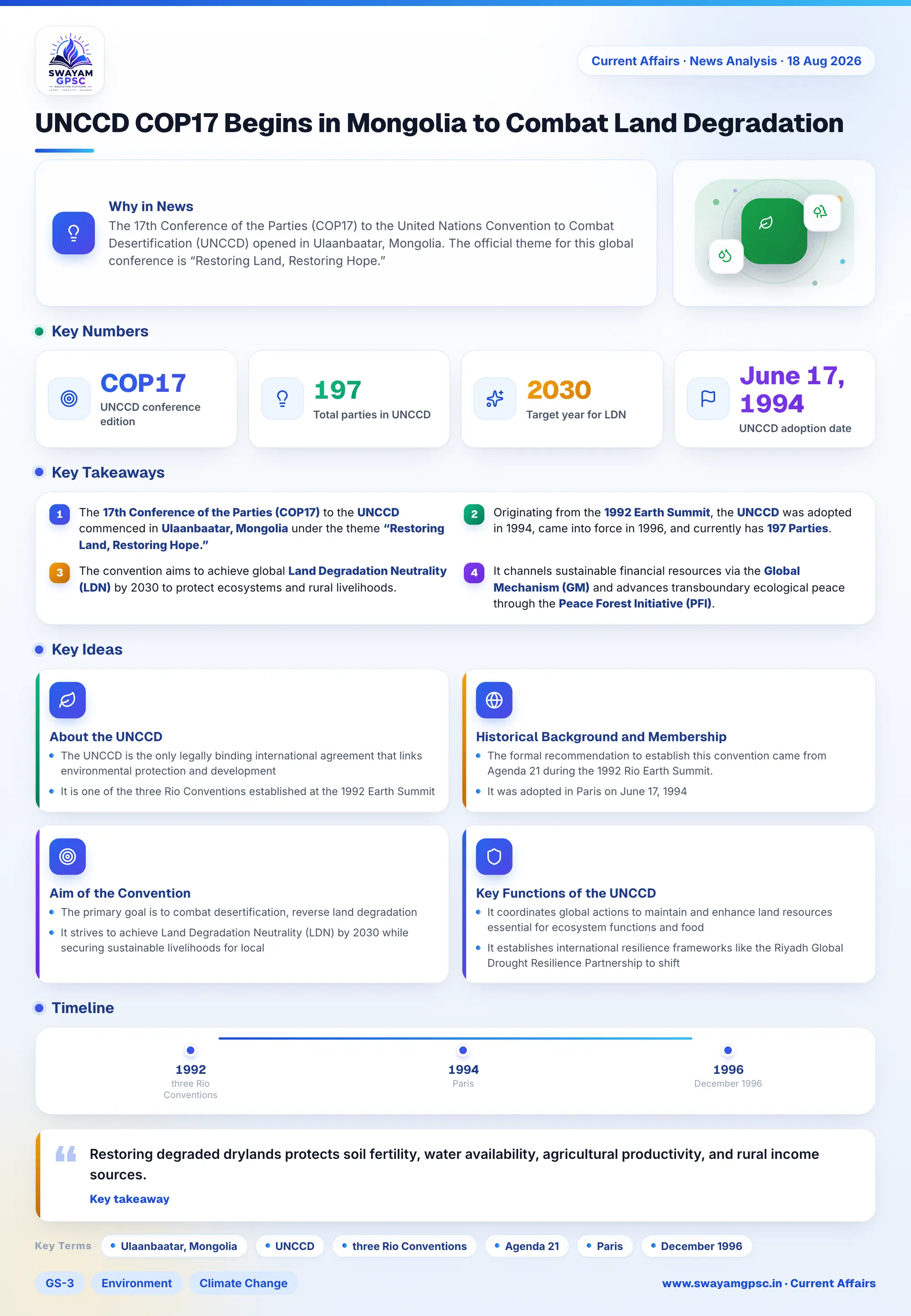
UNCCD COP17 Begins in Mongolia to Combat Land Degradation
#GS-3 #Environment #Climate Change #Sustainable Development #GS-2 #Current Events #International #UNCCD #Land Degradation
Key takeaways
- The 17th Conference of the Parties (COP17) to the UNCCD commenced in Ulaanbaatar, Mongolia under the theme “Restoring Land, Restoring Hope.”
- Originating from the 1992 Earth Summit, the UNCCD was adopted in 1994, came into force in 1996, and currently has 197 Parties.
- The convention aims to achieve global Land Degradation Neutrality (LDN) by 2030 to protect ecosystems and rural livelihoods.
- It channels sustainable financial resources via the Global Mechanism (GM) and advances transboundary ecological peace through the Peace Forest Initiative (PFI).
Why in News
- The 17th Conference of the Parties (COP17) to the United Nations Convention to Combat Desertification (UNCCD) opened in Ulaanbaatar, Mongolia.
- The official theme for this global conference is “Restoring Land, Restoring Hope.”
About the UNCCD
- The UNCCD is the only legally binding international agreement that links environmental protection and development directly to sustainable land management.
- It is one of the three Rio Conventions established at the 1992 Earth Summit, alongside the UNFCCC for climate change and the CBD for biodiversity.
Historical Background and Membership
- The formal recommendation to establish this convention came from Agenda 21 during the 1992 Rio Earth Summit.
- It was adopted in Paris on June 17, 1994, which is now observed globally as the World Day to Combat Desertification and Drought.
- The treaty formally entered into force in December 1996.
- The convention has achieved near-universal participation with 197 Parties, comprising 196 countries and the European Union.
Aim of the Convention
- The primary goal is to combat desertification, reverse land degradation, and lessen drought impacts in dry and semi-arid regions.
- It strives to achieve Land Degradation Neutrality (LDN) by 2030 while securing sustainable livelihoods for local populations.
Key Functions of the UNCCD
- It coordinates global actions to maintain and enhance land resources essential for ecosystem functions and food security.
- It establishes international resilience frameworks like the Riyadh Global Drought Resilience Partnership to shift nations toward proactive drought preparedness.
- It mandates a bottom-up approach where National Action Programmes (NAPs) are built with local farmers, pastoralists, indigenous groups, and women.
- It manages the Global Mechanism (GM) to help developing nations direct public, private, and international funds toward land management.
- It leads international peace efforts like the Peace Forest Initiative (PFI) to promote ecological restoration across conflict-affected borders.
Significance of the UNCCD
- Restoring degraded drylands protects soil fertility, water availability, agricultural productivity, and rural income sources.
- Healthy restored soils act as vital carbon sinks and preserve plant and animal habitats, helping achieve broader climate and biodiversity targets.