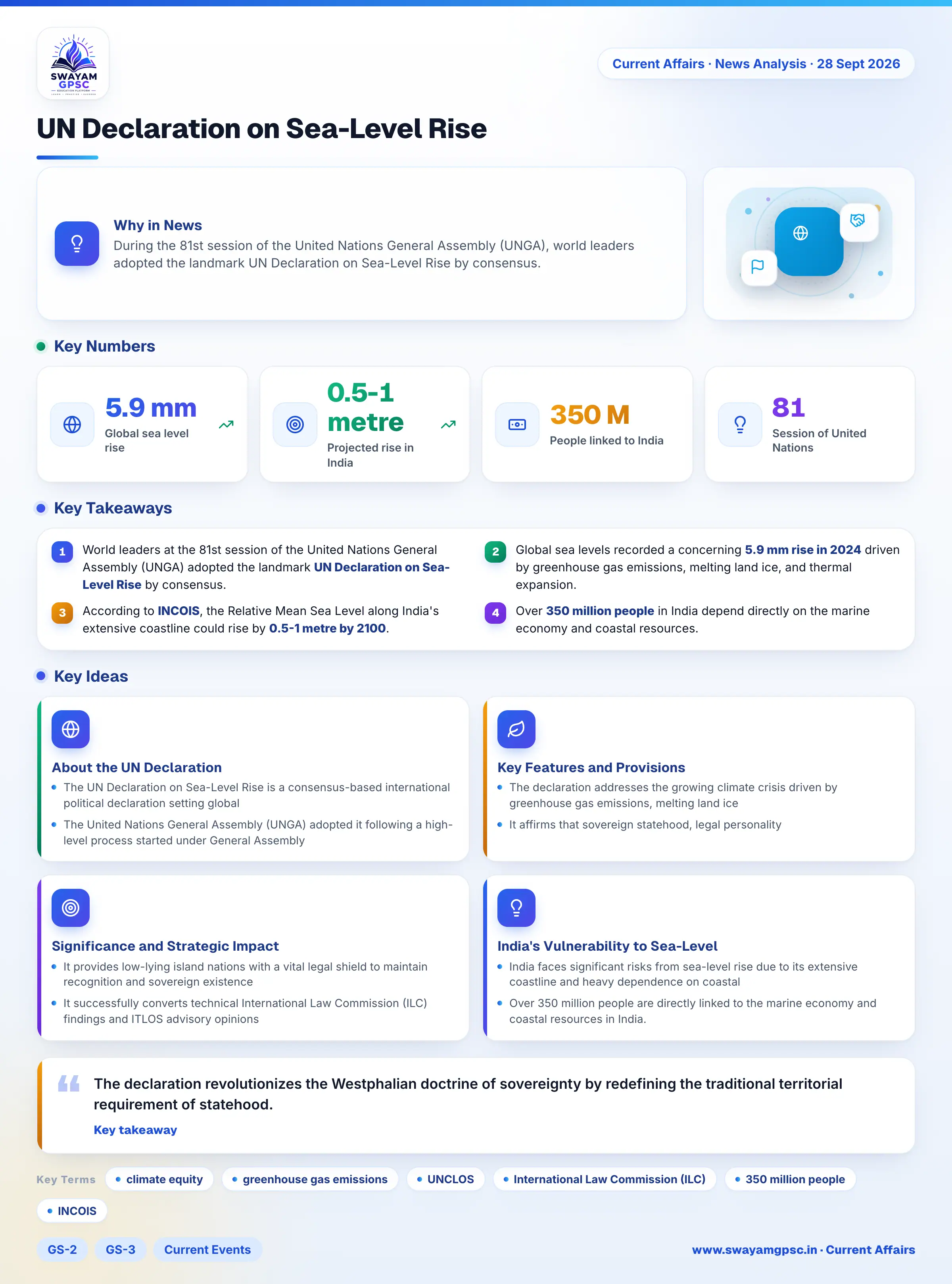
UN Declaration on Sea-Level Rise
#GS-2 #GS-3 #Current Events #International #Environment #Climate Change #Important International Institutions #International Treaties & Agreements #Environmental Pollution & Degradation
Key takeaways
- World leaders at the 81st session of the United Nations General Assembly (UNGA) adopted the landmark UN Declaration on Sea-Level Rise by consensus.
- Global sea levels recorded a concerning 5.9 mm rise in 2024 driven by greenhouse gas emissions, melting land ice, and thermal expansion.
- According to INCOIS, the Relative Mean Sea Level along India's extensive coastline could rise by 0.5-1 metre by 2100.
- Over 350 million people in India depend directly on the marine economy and coastal resources.
- The declaration ensures that vulnerable Small Island Developing States (SIDS) retain their sovereignty, statehood, and maritime zones established under UNCLOS even if physical territory is lost.
Why in News
- During the 81st session of the United Nations General Assembly (UNGA), world leaders adopted the landmark UN Declaration on Sea-Level Rise by consensus.
- India welcomed this adoption, reinforcing its strong dedication to climate equity, maritime stability, and developmental assistance for vulnerable countries.
- This global pact directly targets pressing threats to the sovereignty, legal rights, and basic survival of low-lying coastal nations and Small Island Developing States (SIDS).
About the UN Declaration
- The UN Declaration on Sea-Level Rise is a consensus-based international political declaration setting global principles to protect vulnerable nations facing land inundation.
- The United Nations General Assembly (UNGA) adopted it following a high-level process started under General Assembly Decision 78/558, which Australia and Cabo Verde co-facilitated.
- Its primary goal is providing legal certainty and international stability against territorial submergence driven by climate change.
- It also works to ensure predictability under the law of the sea, scale up climate adaptation and loss-and-damage financing, and protect displaced populations while preserving their cultural identities.
Key Features and Provisions
- The declaration addresses the growing climate crisis driven by greenhouse gas emissions, melting land ice, and thermal expansion of seawater, with global sea levels recording a 5.9 mm rise in 2024.
- It affirms that sovereign statehood, legal personality, and UN membership remain fully intact even if a nation's physical territory is completely submerged by rising sea levels.
- It establishes that lawfully deposited UNCLOS maritime boundaries remain fixed and permanent, removing any requirement to revise or retract limits as coastlines retreat.
- It guarantees that populations displaced across borders retain protections under international human rights law, preserving their nationality, dignity, and right to self-determination.
- It urges predictable, simplified climate adaptation funds for vulnerable island nations, closing the deficit between current flows and projected needs.
- It pledges oceanic data sharing, coastal risk mapping, and multi-hazard early warning systems to curb high-risk developments in vulnerable low-lying zones.
- The declaration highlights sea-level rise as a serious human-rights and displacement challenge threatening housing, freshwater, food security, and cultural identity.
- It calls for stronger climate adaptation, resilient infrastructure, early-warning systems, and increased adaptation finance for developing countries.
Significance and Strategic Impact
- The declaration revolutionizes the Westphalian doctrine of sovereignty by redefining the traditional territorial requirement of statehood.
- It provides low-lying island nations with a vital legal shield to maintain recognition and sovereign existence despite territorial loss.
- It successfully converts technical International Law Commission (ILC) findings and ITLOS advisory opinions into a multilateral consensus.
- This framework actively averts future geopolitical disputes over offshore rights and maritime entitlements.
- India stressed the non-negotiable application of equity and the principle of Common But Differentiated Responsibilities and Respective Capabilities (CBDR-RC) in global climate adaptation efforts.
India's Vulnerability to Sea-Level Rise
- India faces significant risks from sea-level rise due to its extensive coastline and heavy dependence on coastal ecosystems.
- Over 350 million people are directly linked to the marine economy and coastal resources in India.
- According to INCOIS, the Relative Mean Sea Level (RMSL) along India's coast could rise by 0.5-1 metre by 2100.
- This rise will drastically increase the frequency and intensity of storm surges, high tides, and coastal flooding.
- Low-lying areas such as Mumbai, Chennai, Kolkata, the Sundarbans, Lakshadweep, and the Andaman & Nicobar Islands face severe risks of permanent inundation, coastal erosion, and saltwater intrusion.