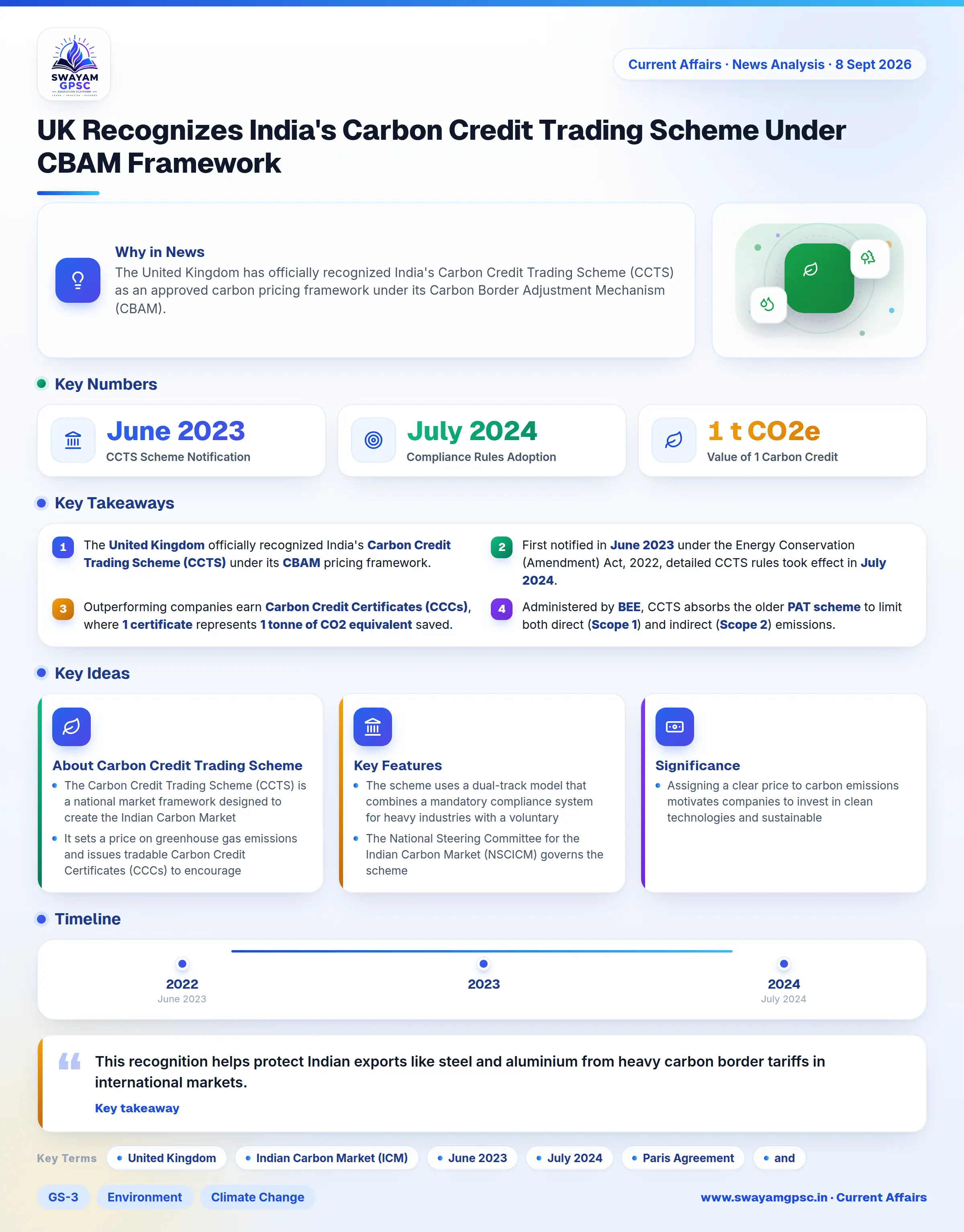
UK Recognizes India's Carbon Credit Trading Scheme Under CBAM Framework
#GS-3 #Environment #Climate Change #Sustainable Development #Economy #Carbon Trading #CCTS #CBAM
Key takeaways
- The United Kingdom officially recognized India's Carbon Credit Trading Scheme (CCTS) under its CBAM pricing framework.
- First notified in June 2023 under the Energy Conservation (Amendment) Act, 2022, detailed CCTS rules took effect in July 2024.
- Outperforming companies earn Carbon Credit Certificates (CCCs), where 1 certificate represents 1 tonne of CO2 equivalent saved.
- Administered by BEE, CCTS absorbs the older PAT scheme to limit both direct (Scope 1) and indirect (Scope 2) emissions.
Why in News
- The United Kingdom has officially recognized India's Carbon Credit Trading Scheme (CCTS) as an approved carbon pricing framework under its Carbon Border Adjustment Mechanism (CBAM).
About Carbon Credit Trading Scheme
- The Carbon Credit Trading Scheme (CCTS) is a national market framework designed to create the Indian Carbon Market (ICM).
- It sets a price on greenhouse gas emissions and issues tradable Carbon Credit Certificates (CCCs) to encourage industrial decarbonization.
- The government notified this scheme in June 2023 using powers under the Energy Conservation (Amendment) Act, 2022.
- It later introduced detailed compliance rules in July 2024 to operationalize the framework.
- The main objective is to accelerate economic decarbonization and help India meet its Nationally Determined Contributions (NDCs) under the Paris Agreement through a transparent market.
Key Features
- The scheme uses a dual-track model that combines a mandatory compliance system for heavy industries with a voluntary offset mechanism for other entities.
- The National Steering Committee for the Indian Carbon Market (NSCICM) governs the scheme, co-chaired by the Ministry of Power and MoEFCC.
- The Bureau of Energy Efficiency (BEE) serves as the primary administrative authority managing day-to-day operations.
- CCTS will absorb and replace the older Perform, Achieve, and Trade (PAT) energy efficiency program.
- It moves industrial units away from simple energy consumption goals toward strict carbon emission intensity benchmarks.
- Facilities that cut emissions below their set target receive Carbon Credit Certificates (CCCs), where 1 certificate equals 1 tonne of CO2 equivalent.
- Entities that fail to achieve their target must buy certificates from the market to meet their regulatory compliance.
- The scope follows a gate-to-gate method covering direct operational emissions (Scope 1) and indirect electricity emissions (Scope 2).
- The mechanism focuses on reducing CO2 and perfluorocarbons (PFCs) in its initial implementation phase.
Significance
- This recognition helps protect Indian exports like steel and aluminium from heavy carbon border tariffs in international markets.
- Assigning a clear price to carbon emissions motivates companies to invest in clean technologies and sustainable production methods.