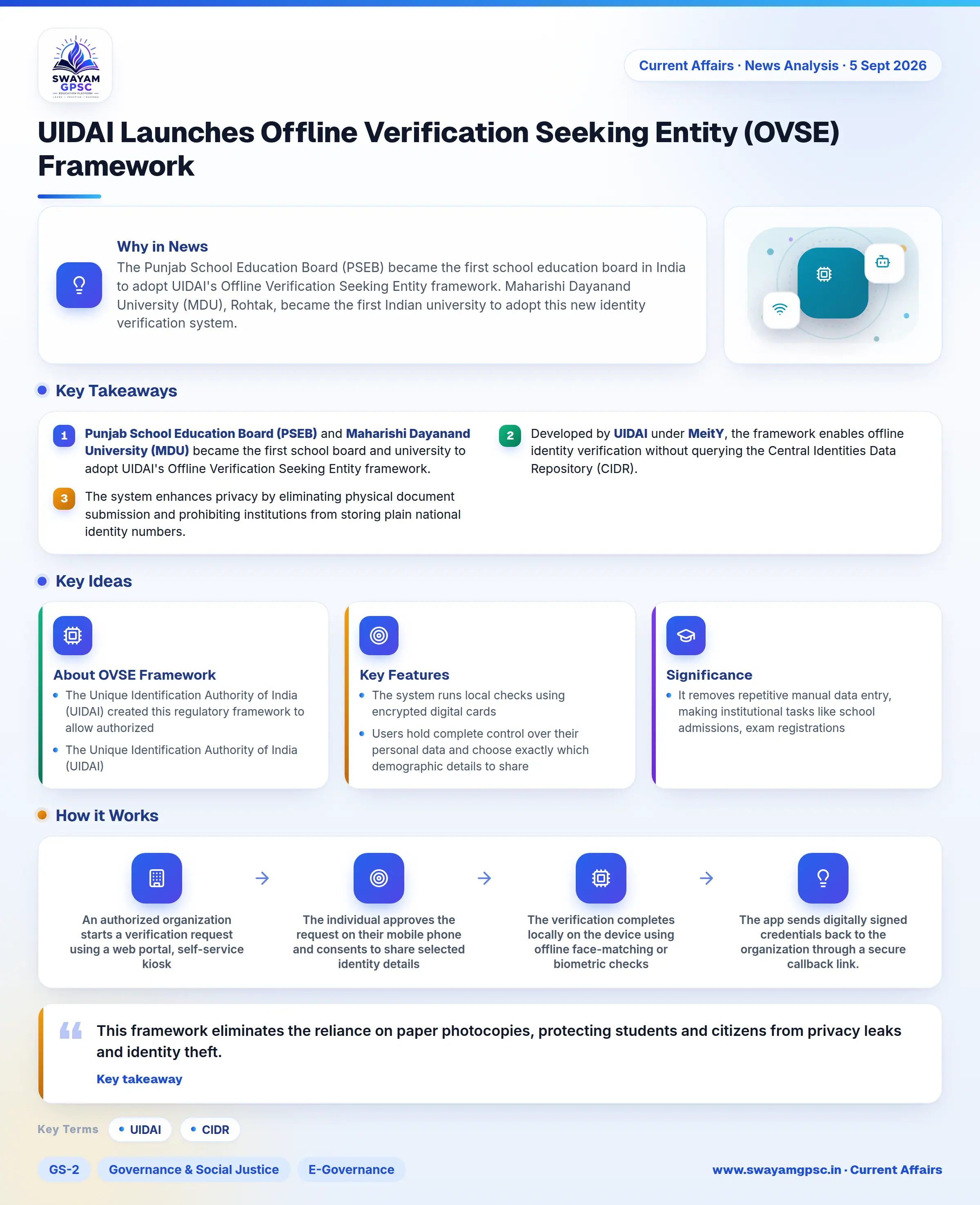
UIDAI Launches Offline Verification Seeking Entity (OVSE) Framework
#GS-2 #Governance & Social Justice #E-Governance #Regulatory Bodies #Current Events #National #GS-3 #Science & Technology #ICT #Cyber Security #OVSE Framework #UIDAI
Key takeaways
- Punjab School Education Board (PSEB) and Maharishi Dayanand University (MDU) became the first school board and university to adopt UIDAI's Offline Verification Seeking Entity framework.
- Developed by UIDAI under MeitY, the framework enables offline identity verification without querying the Central Identities Data Repository (CIDR).
- The system enhances privacy by eliminating physical document submission and prohibiting institutions from storing plain national identity numbers.
Why in News
- The Punjab School Education Board (PSEB) became the first school education board in India to adopt UIDAI's Offline Verification Seeking Entity framework.
- Maharishi Dayanand University (MDU), Rohtak, became the first Indian university to adopt this new identity verification system.
About OVSE Framework
- The Unique Identification Authority of India (UIDAI) created this regulatory framework to allow authorized organizations to verify identity offline using digital credentials instead of searching central databases.
- The Unique Identification Authority of India (UIDAI), working under the Ministry of Electronics and Information Technology (MeitY), manages this initiative.
- This system aims to create a secure, paperless verification method that cuts operational costs, removes physical documents, and prevents identity fraud.
How it Works
- An authorized organization starts a verification request using a web portal, self-service kiosk, or QR code scan.
- The individual approves the request on their mobile phone and consents to share selected identity details through the official app.
- The verification completes locally on the device using offline face-matching or biometric checks without connecting to UIDAI's Central Identities Data Repository (CIDR).
- The app sends digitally signed credentials back to the organization through a secure callback link.
Key Features
- The system runs local checks using encrypted digital cards, so it does not query central servers or create heavy system traffic.
- Users hold complete control over their personal data and choose exactly which demographic details to share with the organization.
- Verifying organizations cannot save plain national identity numbers, as mandatory data masking lowers data leakage risks.
- The framework connects seamlessly with mobile applications, enterprise systems, and service counters using standard software interfaces.
- It uses on-device face matching and digital signatures to confirm physical presence without transferring raw biometric data across the network.
Significance
- This framework eliminates the reliance on paper photocopies, protecting students and citizens from privacy leaks and identity theft.
- It removes repetitive manual data entry, making institutional tasks like school admissions, exam registrations, and certificate issuance much faster.