The U.S.-Iran Preliminary Peace Accord 2026
#GS-2 #International Relations #Current Events #Economy #Energy #Infrastructure #National
Key takeaways
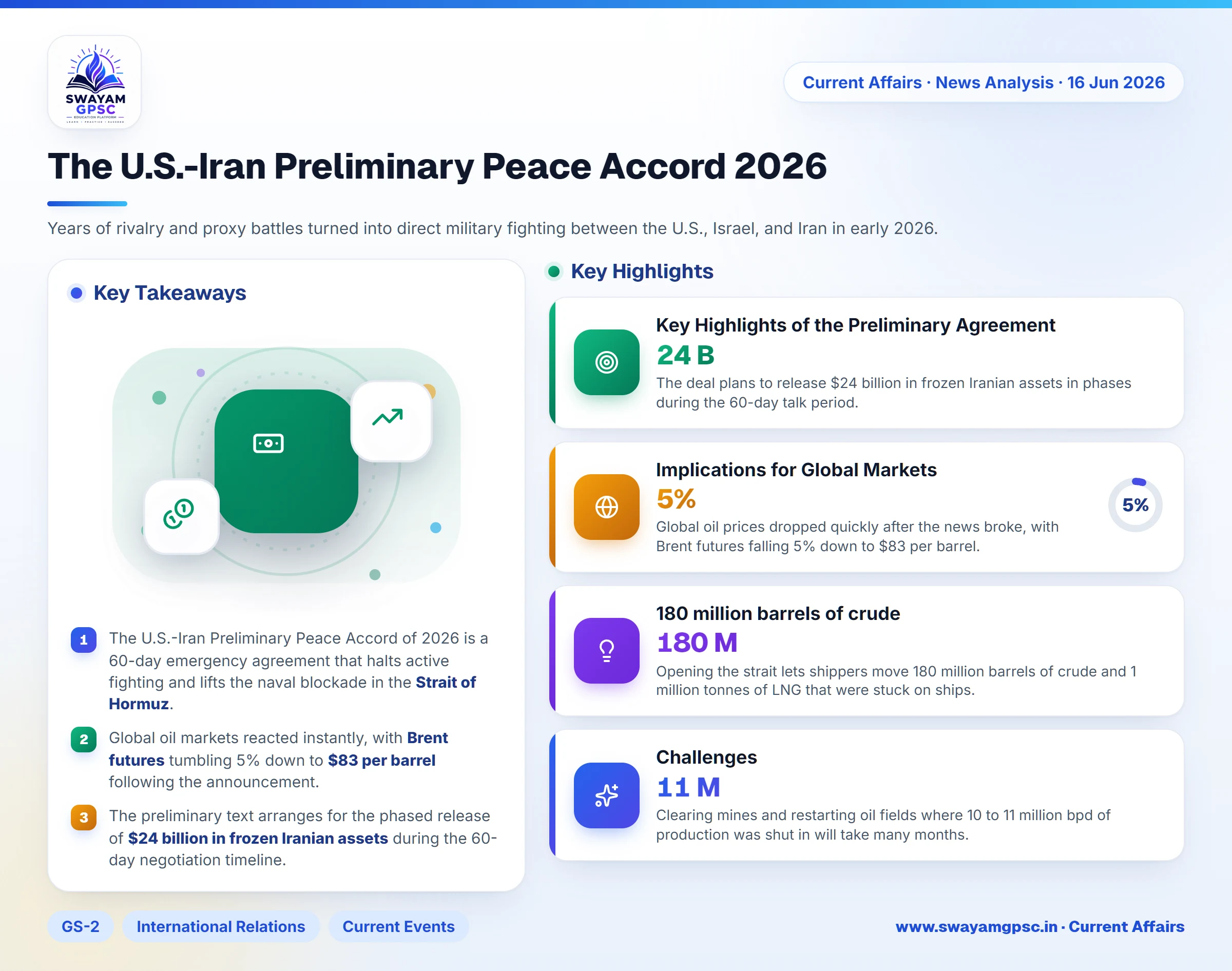
- The U.S.-Iran Preliminary Peace Accord of 2026 is a 60-day emergency agreement that halts active fighting and lifts the naval blockade in the Strait of Hormuz.
- Global oil markets reacted instantly, with Brent futures tumbling 5% down to $83 per barrel following the announcement.
- The preliminary text arranges for the phased release of $24 billion in frozen Iranian assets during the 60-day negotiation timeline.
- Re-opening the strait allows shippers to move 180 million barrels of crude and 1 million tonnes of LNG previously stuck on vessels.
- The agreement aims to restart production from oil fields where 10 to 11 million bpd of production was shut in during the conflict.
Context and Overview
- The United States and Iran recently announced a major preliminary peace agreement. This pact stops active military fighting and lifts the naval blockade in the Strait of Hormuz and the Gulf of Oman.
- The U.S.-Iran Preliminary Peace Accord of 2026 is an emergency political agreement meant to stop a hot war and prevent a global energy crisis. This agreement serves as a 60-day pause to lower tensions rather than a permanent final treaty.
Historical Background to the Conflict
- The 2015 JCPOA agreement limited Iran's nuclear work in exchange for lifting sanctions. Its collapse brought back deep regional distrust.
- Years of rivalry and proxy battles turned into direct military fighting between the U.S., Israel, and Iran in early 2026.
- Iran controlled the Strait of Hormuz, which put vital global oil and LNG transport routes at high risk.
- The U.S. launched a naval blockade to isolate Iran economically and cut off its maritime trade.
- This long standoff disrupted energy supplies and caused sudden spikes in global oil prices and economic worry.
Key Highlights of the Preliminary Agreement
- The agreement orders a permanent stop to all direct and proxy military actions, including active fighting in Lebanon.
- The U.S. ends its naval blockade in the Gulf of Oman, while Iran allows safe and toll-free international shipping through the Strait of Hormuz along with immediate mine removal.
- Diplomats have a strict 60-day window to hold peace talks on Iran's nuclear work and long-term Western sanctions while the ceasefire holds.
- The deal plans to release $24 billion in frozen Iranian assets in phases during the 60-day talk period.
- Washington promised to create a financial system to pay war damages to Tehran for losses during the 2025-2026 conflicts.
- Iran cannot charge transit tolls, but it keeps the legal right to collect standard fees for marine services, environmental care, and vessel safety inside the strait.
Implications for the Middle East
- The permanent ceasefire stops active fighting in Lebanon and Syria, giving local communities a chance to rebuild and stabilize.
- Washington is shifting its policy away from forcing regime change in Tehran, which changes how Israel handles its own security.
- Major Gulf nations like Saudi Arabia and the UAE can focus on internal economic growth now that cross-border attack risks are lower.
Implications for Global Markets
- Global oil prices dropped quickly after the news broke, with Brent futures falling 5% down to $83 per barrel.
- Opening the strait lets shippers move 180 million barrels of crude and 1 million tonnes of LNG that were stuck on ships.
- The high cost of this conflict has pushed the U.S. to rethink its long-term military role in West Asian conflicts.
Challenges
- The deal faces a big risk because Tehran wants half its frozen money released before nuclear talks start, while the U.S. wants no cash paid out right at signing.
- Local proxy groups in Lebanon or Yemen that neither Washington nor Tehran fully control can easily break the ceasefire.
- Clearing mines and restarting oil fields where 10 to 11 million bpd of production was shut in will take many months.
- Political opposition groups in both capitals and deep doubt from Israel create strong domestic pushback against the deal.
- Because the U.S. pulled out of the old 2015 JCPOA, building enough trust to turn a short pause into a lasting treaty is very difficult.
Direct Implications on India's Interests
- Cheaper crude oil cuts India's import bill and controls inflation, which helps the current account and fiscal health.
- A peaceful Strait of Hormuz ensures safer trade movement and cuts down expensive war insurance costs.
- Lifting sanctions could let India buy cheaper Iranian oil again, which lowers transport costs and boosts supply options.
- Steady gas supplies from West Asia mean factories do not need fuel rationing, keeping industrial production smooth.
Way Forward
- India should work closely with Gulf nations to keep its large worker population safe and secure.
- India can take a bigger role in regional peace by using groups like I2U2 and other strategic partnerships.
- Lower oil prices give a good chance to refill national strategic oil reserves against future shocks.
- Projects like IMEC can help reduce reliance on risky sea routes and build long-term trade safety.
Conclusion
- The 2026 peace efforts bring short-term relief by lowering oil prices, but long-term peace is still unsure.
- India must use this quiet time to build up reserves, protect economic goals, and back regional peace through smart diplomacy.