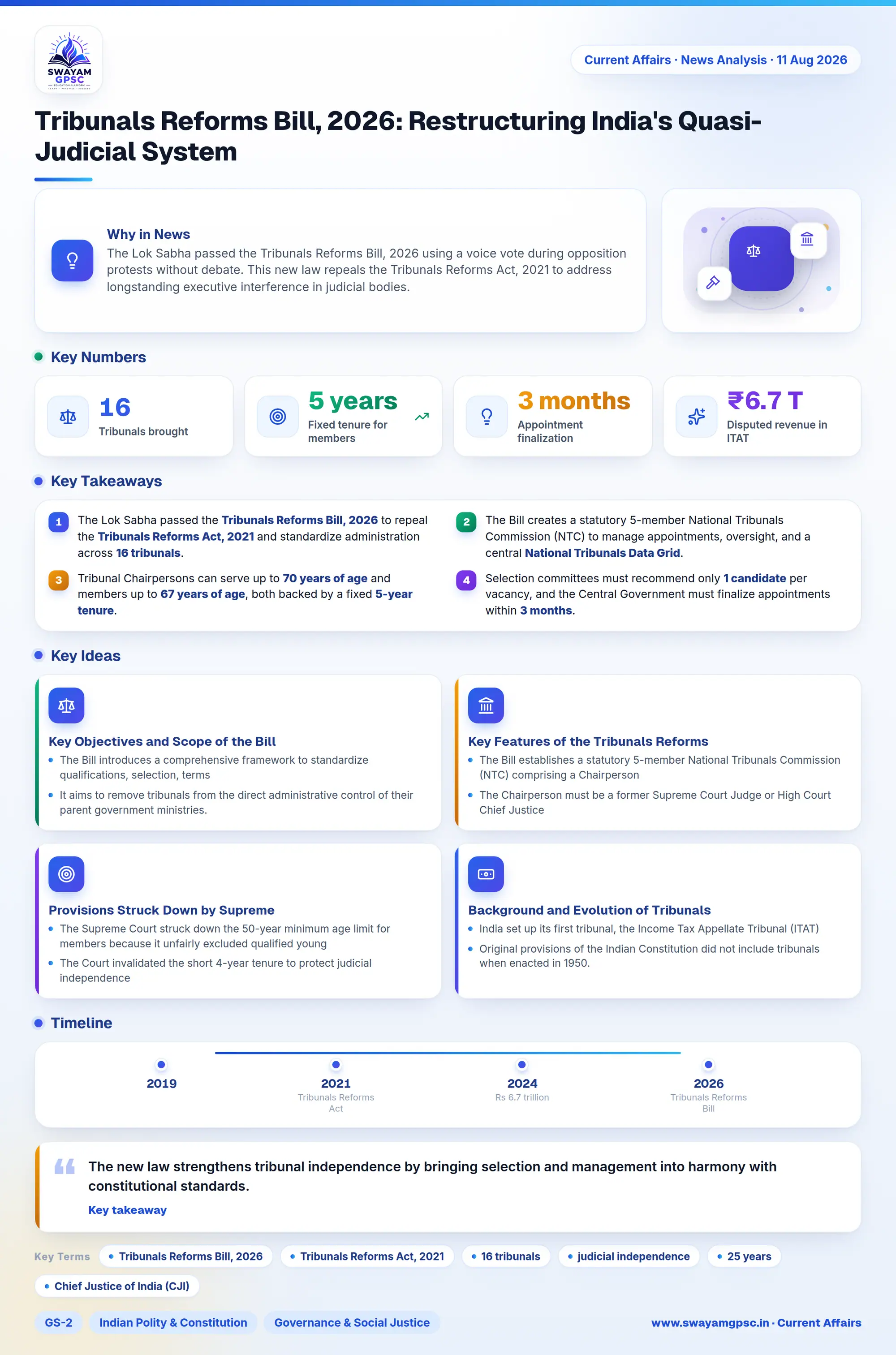
Tribunals Reforms Bill, 2026: Restructuring India's Quasi-Judicial System
#GS-2 #Indian Polity & Constitution #Governance & Social Justice #Judiciary #Tribunals #Constitutional Bodies #National
Key takeaways
- The Lok Sabha passed the Tribunals Reforms Bill, 2026 to repeal the Tribunals Reforms Act, 2021 and standardize administration across 16 tribunals.
- The Bill creates a statutory 5-member National Tribunals Commission (NTC) to manage appointments, oversight, and a central National Tribunals Data Grid.
- Tribunal Chairpersons can serve up to 70 years of age and members up to 67 years of age, both backed by a fixed 5-year tenure.
- Selection committees must recommend only 1 candidate per vacancy, and the Central Government must finalize appointments within 3 months.
- As of 2024, chronic vacancies left Rs 6.7 trillion stuck in tax disputes at the Income Tax Appellate Tribunal.
Why in News
- The Lok Sabha passed the Tribunals Reforms Bill, 2026 using a voice vote during opposition protests without debate.
- This new law repeals the Tribunals Reforms Act, 2021 to address longstanding executive interference in judicial bodies.
- The legislation sets up the National Tribunals Commission (NTC) to handle appointments and service rules for tribunals.
- This reform follows directives from the Supreme Court in the landmark Madras Bar Association v. Union of India rulings.
Key Objectives and Scope of the Bill
- The Bill introduces a comprehensive framework to standardize qualifications, selection, terms, and working conditions across 16 tribunals.
- It aims to remove tribunals from the direct administrative control of their parent government ministries.
- The law seeks to protect judicial independence and the separation of powers as mandated by constitutional principles.
- It addresses chronic problems like heavy case backlogs, unfilled vacancies, short tenures, and financial dependence on the executive.
Key Features of the Tribunals Reforms Bill, 2026
- The Bill establishes a statutory 5-member National Tribunals Commission (NTC) comprising a Chairperson, two Judicial Members, and two Technical Members.
- The Chairperson must be a former Supreme Court Judge or High Court Chief Justice, while Technical Members need at least 25 years of relevant expertise.
- Central Government appointments for the NTC Chairperson and Judicial Members require mandatory consultation with the Chief Justice of India (CJI).
- A Central Government Secretary will lead the administrative secretariat of the National Tribunals Commission.
- Specialized search-cum-selection committees will process every vacancy by recommending 1 main candidate and 1 waiting list candidate.
- The Central Government must issue final appointment orders within 3 months of receiving recommendations from the selection committee.
- Chairpersons will serve a 5-year term up to a maximum age of 70 years, while members serve up to 67 years of age.
- Members can seek reappointment through structured performance reviews and consultation with the respective Tribunal Chairperson.
- Strict removal rules apply for insolvency, conviction of moral turpitude, proven incompetence, conflict of interest, or taking paid outside jobs.
- The Central Government will issue formal Rules covering salaries, allowances, resignations, and general service conditions.
- The law mandates the creation of the National Tribunals Data Grid to track live case records, pendency rates, and tribunal output metrics online.
Provisions Struck Down by Supreme Court in 2021 Act
- The Supreme Court struck down the 50-year minimum age limit for members because it unfairly excluded qualified young advocates with 10 years of practice.
- The Court invalidated the short 4-year tenure to protect judicial independence, restoring a minimum 5-year tenure for tribunal members.
- The directive forcing selection committees to submit two names per vacancy was cancelled because it gave excessive discretion to the executive.
- The apex court affirmed that Parliament cannot re-enact invalidated clauses without fixing constitutional defects, as judicial review is part of the Basic Structure.
Background and Evolution of Tribunals in India
- India set up its first tribunal, the Income Tax Appellate Tribunal (ITAT), in 1941 to lower court burdens and build domain expertise.
- Original provisions of the Indian Constitution did not include tribunals when enacted in 1950.
- The Swaran Singh Committee (1976) recommended creating specialized tribunals to clear huge backlogs of service cases in High Courts.
- Parliament added Part XIV-A with Article 323A and Article 323B through the 42nd Constitutional Amendment Act, 1976.
- Article 323A allows Parliament to set up Administrative Tribunals for public service employment disputes.
- Article 323B permits Parliament and State Legislatures to create tribunals for taxation, land reforms, labor, and foreign exchange matters.
- Parliament merged several sector-specific tribunals based on shared functions under the Finance Act, 2017.
- In 2010, the Supreme Court clarified that legislatures can create tribunals for any subject under the Seventh Schedule.
- The Supreme Court ruled in the S.P. Sampath Kumar Case (1986) that tribunals can act as court alternatives if they match High Court efficacy.
- The landmark L. Chandra Kumar Case (1997) established that tribunal decisions remain subject to writ jurisdiction of High Courts under Article 226 and Article 227.
Major Issues Plaguing the Tribunal System
- Executive dominance persists because government departments control appointments, salaries, and funding despite being the largest litigant in tribunals.
- In the Rojer Mathew v. South Indian Bank (2019) ruling, the Supreme Court demanded greater judicial control over tribunal member selection.
- Widespread vacancies lead to massive case backlogs across tribunals, slowing down justice delivery significantly.
- For instance, disputes involving Rs 6.7 trillion remained locked in the Income Tax Appellate Tribunal as of 2024.
- Short tenures prevent members from gaining deep adjudicatory experience, while reappointment hopes create dependency on government favor.
- Reliance on parent ministries for office space, budgets, and staff severely harms the functional autonomy of tribunals.
- Allowing appeals to High Courts under the L. Chandra Kumar precedent creates extra layers of litigation, delaying final decisions.
- Most tribunals suffer from outdated computer systems, inadequate physical space, short staffing, and non-uniform operating procedures.
Reforms to Strengthen Tribunal Independence and Efficiency
- Government ministries must transfer administrative and financial control of tribunals to an independent body with separate budget lines.
- High Courts should form specialized Tribunal Appellate Benches to resolve tribunal appeals quickly and reduce delays.
- India can adopt a two-tier model similar to the UK Tribunal System, using First-tier and Upper Tribunals with subject-specific chambers.
- Authorities should conduct a mandatory Judicial Impact Assessment before expanding tribunal powers to estimate required budgets and staff.
- The National Judicial Academy must offer cross-training, giving domain experts judicial skills and judges subject-matter knowledge.
- The system should require pre-institution mediation for applicable tribunal cases to filter out minor or frivolous disputes early.
- Independent agencies must conduct annual performance audits on disposal rates and judicial quality, publishing the findings publicly.
Significance of the Reform Bill
- The new law strengthens tribunal independence by bringing selection and management into harmony with constitutional standards.
- It boosts operational speed by enforcing fixed timelines, performance tracking, and digital data management through the National Tribunals Data Grid.
- The Bill enhances accountability by establishing a dedicated central commission to manage complaints and structural reforms.
Conclusion
- Statutory changes can fix structural rules, but real progress depends on changing administrative habits and institutional culture.
- The executive branch must release its control over daily operations and provide true financial independence to these judicial bodies.
- Modernizing case management will help tribunals achieve their core purpose of delivering fast and specialized justice.