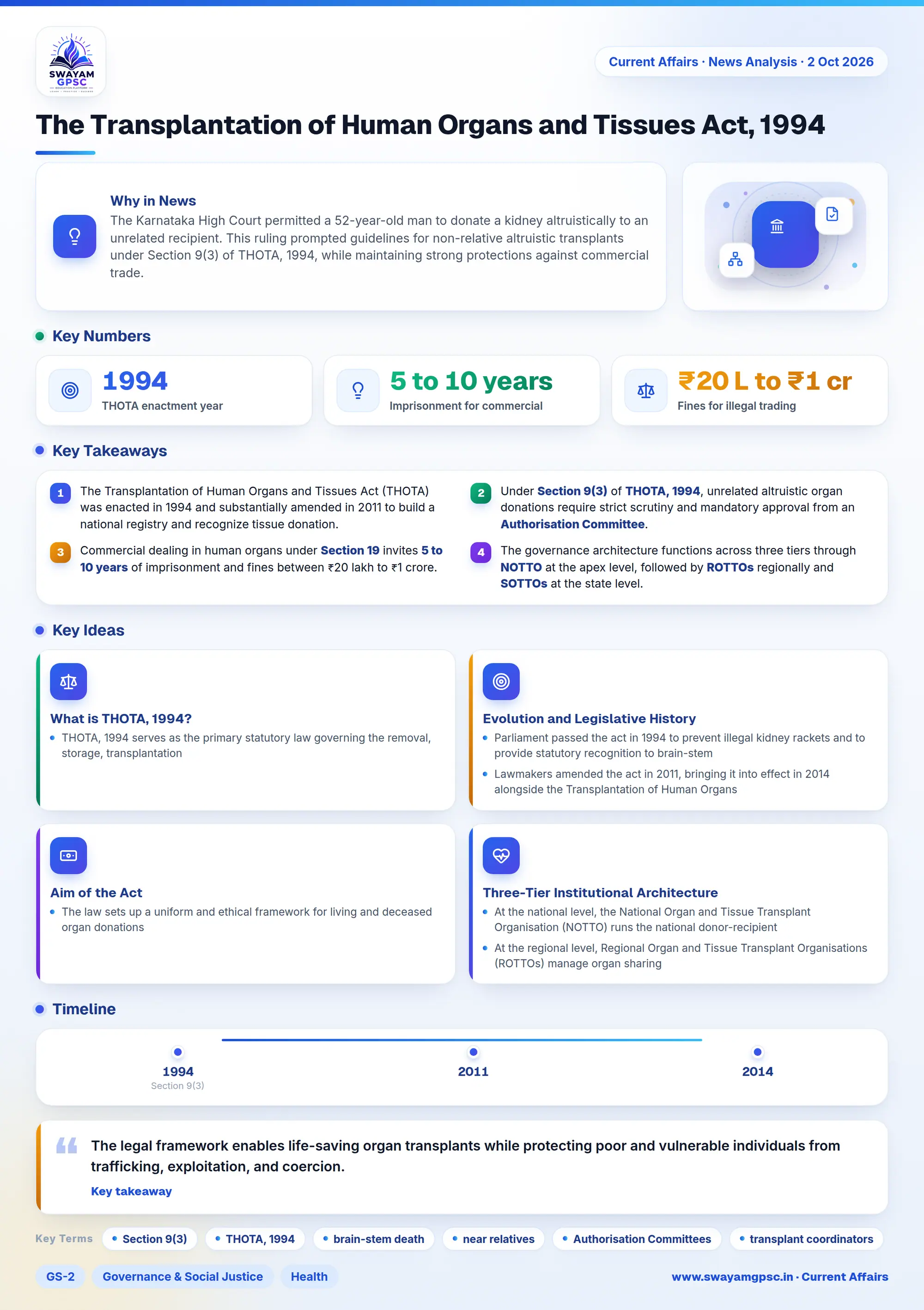
The Transplantation of Human Organs and Tissues Act, 1994
#GS-2 #Governance & Social Justice #Health #Regulatory Bodies #Current Events #National #Polity #Prelims
Key takeaways
- The Transplantation of Human Organs and Tissues Act (THOTA) was enacted in 1994 and substantially amended in 2011 to build a national registry and recognize tissue donation.
- Under Section 9(3) of THOTA, 1994, unrelated altruistic organ donations require strict scrutiny and mandatory approval from an Authorisation Committee.
- Commercial dealing in human organs under Section 19 invites 5 to 10 years of imprisonment and fines between ₹20 lakh to ₹1 crore.
- The governance architecture functions across three tiers through NOTTO at the apex level, followed by ROTTOs regionally and SOTTOs at the state level.
Why in News
- The Karnataka High Court permitted a 52-year-old man to donate a kidney altruistically to an unrelated recipient.
- This ruling prompted guidelines for non-relative altruistic transplants under Section 9(3) of THOTA, 1994, while maintaining strong protections against commercial trade.
What is THOTA, 1994?
- THOTA, 1994 serves as the primary statutory law governing the removal, storage, transplantation, and allocation of human organs and tissues for therapeutic purposes across India, while strictly banning commercial exploitation and organ trafficking.
Evolution and Legislative History
- Parliament passed the act in 1994 to prevent illegal kidney rackets and to provide statutory recognition to brain-stem death.
- Lawmakers amended the act in 2011, bringing it into effect in 2014 alongside the Transplantation of Human Organs and Tissues Rules, 2014 to include tissues, establish a national organ registry, mandate required request protocols in intensive care units, and increase criminal penalties.
Aim of the Act
- The law sets up a uniform and ethical framework for living and deceased organ donations, protects vulnerable groups from financial coercion, guarantees fair organ distribution, and completely bans commercial trade in human body parts.
Three-Tier Institutional Architecture
- At the national level, the National Organ and Tissue Transplant Organisation (NOTTO) runs the national donor-recipient registry and executes the National Organ Transplant Programme (NOTP) under the Ministry of Health and Family Welfare.
- At the regional level, Regional Organ and Tissue Transplant Organisations (ROTTOs) manage organ sharing, inter-state transit, and regional waiting lists across designated states and union territories.
- At the state level, State Organ and Tissue Transplant Organisations (SOTTOs) coordinate organ procurement, hospital networks, public awareness drives, and state transplant registries.
Key Features of the Regulatory Framework
- The law identifies spouses, children, grandchildren, siblings, parents, and grandparents as near relatives, permitting donations after standard hospital-level verification and approval.
- Under Section 9(3), unrelated individuals may donate organs due to affection, attachment, or special reasons only after formal scrutiny and clearance by a statutory Authorisation Committee.
- Statutory Authorisation Committees interview unrelated and foreign donor-recipient pairs, review documents, and run background checks to rule out commercial transactions, coercion, or financial inducements.
- The statute legally recognizes brain-stem death and mandates certification by a panel of medical experts using specified clinical protocols.
- Hospitals with intensive care units must appoint dedicated transplant coordinators, and medical teams must request organ donation from families once brain-stem death is formally certified.
- Under Section 19, commercial trade in organs carries strict punishments, including imprisonment of 5 to 10 years and fines ranging from ₹20 lakh to ₹1 crore.
- Removing human organs without proper authorization can lead to up to 10 years in prison, heavy financial penalties, and cancellation of the offending doctor's medical license.
Significance
- The legal framework enables life-saving organ transplants while protecting poor and vulnerable individuals from trafficking, exploitation, and coercion.
- It aligns domestic practices with WHO principles that endorse voluntary, unpaid organ donation while building robust barriers against illegal and cross-border organ commerce.