GOBARdhan Scheme for Compressed Biogas Sector
#GS-3 #Economy #Environment #Infrastructure #Energy #Sustainable Development #GOBARdhan Scheme #Compressed Biogas
Key takeaways
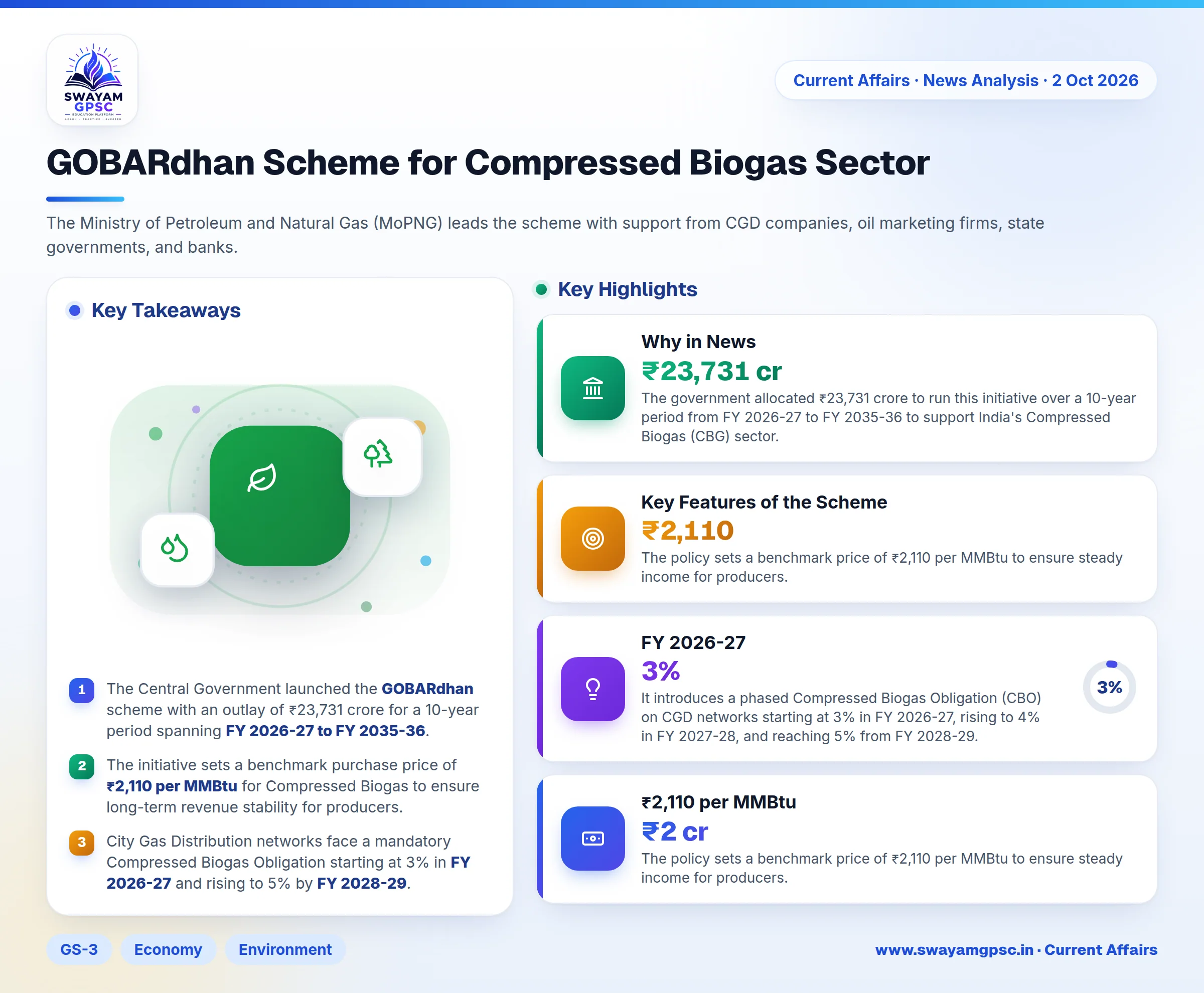
- The Central Government launched the GOBARdhan scheme with an outlay of ₹23,731 crore for a 10-year period spanning FY 2026-27 to FY 2035-36.
- The initiative sets a benchmark purchase price of ₹2,110 per MMBtu for Compressed Biogas to ensure long-term revenue stability for producers.
- City Gas Distribution networks face a mandatory Compressed Biogas Obligation starting at 3% in FY 2026-27 and rising to 5% by FY 2028-29.
- Eligible new projects can receive capital subsidies up to ₹2 crore per TPD of capacity along with pipeline funding up to 80% of capex.
- Expanding domestic biogas production is projected to save over ₹40,000 crore in foreign exchange and create around 5 lakh jobs.
Why in News
- The Union Minister of Petroleum and Natural Gas introduced the GOBARdhan Central Sector Scheme.
- The government allocated ₹23,731 crore to run this initiative over a 10-year period from FY 2026-27 to FY 2035-36 to support India's Compressed Biogas (CBG) sector.
About The GOBARdhan Scheme
- This integrated long-term Central Sector Scheme merges smaller programs into a unified national policy.
- It combines guaranteed buying, fixed pricing, capital subsidies, pipeline grid connection, and loan guarantees to boost commercial CBG manufacturing.
- The Ministry of Petroleum and Natural Gas (MoPNG) leads the scheme with support from CGD companies, oil marketing firms, state governments, and banks.
- The program aims to increase local CBG production, cut down LNG imports, prevent crop burning, and turn farm waste and cow dung into green fuel and organic fertilizer.
Key Features of the Scheme
- The policy sets a benchmark price of ₹2,110 per MMBtu to ensure steady income for producers.
- It introduces a phased Compressed Biogas Obligation (CBO) on CGD networks starting at 3% in FY 2026-27, rising to 4% in FY 2027-28, and reaching 5% from FY 2028-29.
- New CBG plants receive financial help up to ₹2 crore per TPD of capacity to cover equipment, waste collection tools, and organic fertilizer processing units.
- The government funds pipeline construction by covering up to 80% of costs for connecting major CBG hubs to national gas networks and up to 50% for individual plants linking to local city gas grids.
- A credit guarantee program covers up to 85% of loan default risk, offering coverage limits of ₹20 crore for small businesses and ₹25 crore for women-led businesses.
- The initiative sets up an innovation fund for research and district-level waste mapping, managed through the central Unified GOBARdhan Portal.
Significance of the Initiative
- Boosting CBG production cuts foreign gas dependency and can save over ₹40,000 crore in foreign currency while reducing carbon emissions.
- The scheme will generate nearly 5 lakh jobs and produce organic fertilizer, which improves soil quality and brings extra revenue to rural households.