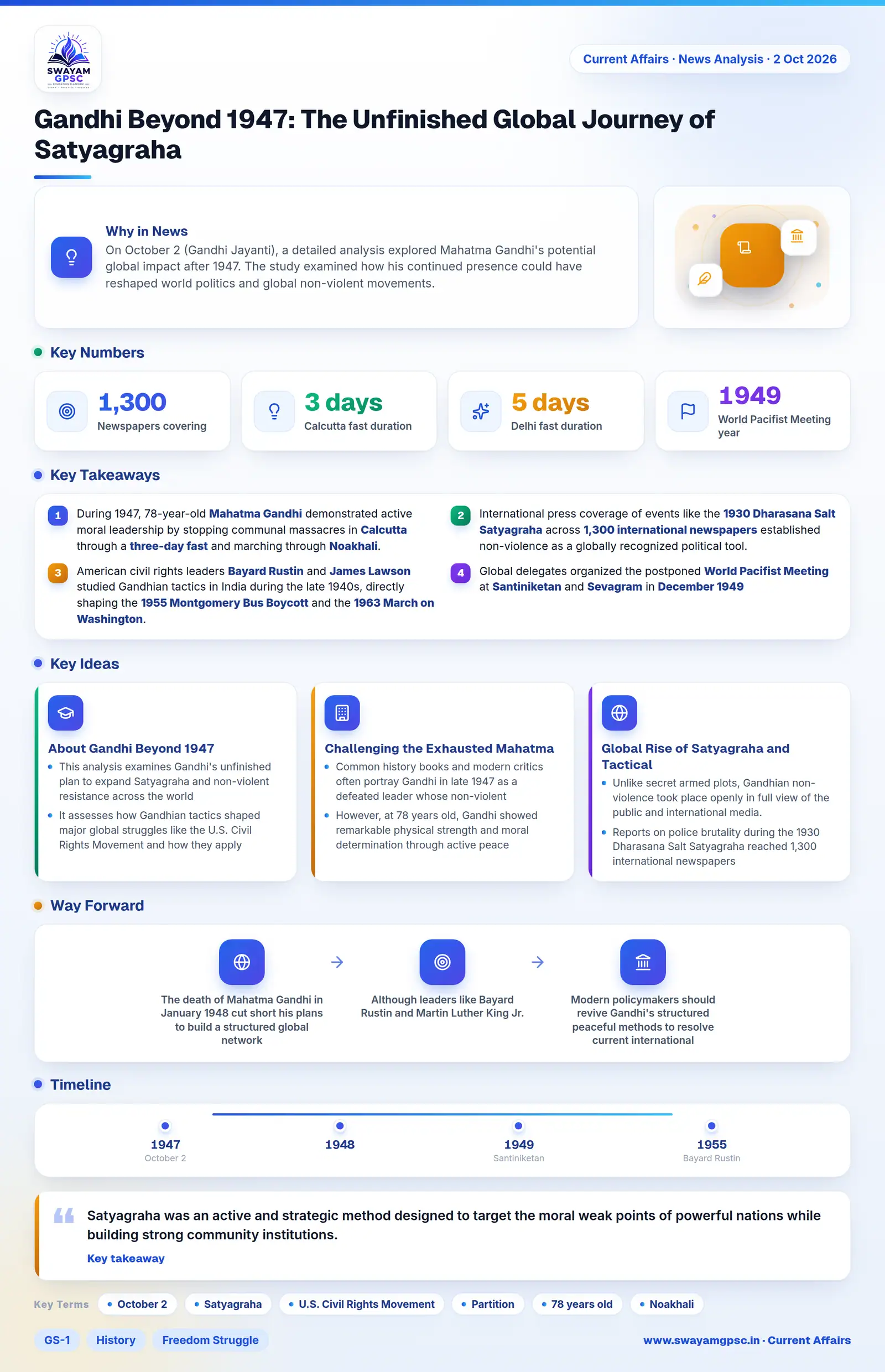
Gandhi Beyond 1947: The Unfinished Global Journey of Satyagraha
#GS-1 #History #Freedom Struggle #Gandhian Thought #Current Events #International #Satyagraha #Non-Violence #Civil Rights Movement
Key takeaways
- During 1947, 78-year-old Mahatma Gandhi demonstrated active moral leadership by stopping communal massacres in Calcutta through a three-day fast and marching through Noakhali.
- International press coverage of events like the 1930 Dharasana Salt Satyagraha across 1,300 international newspapers established non-violence as a globally recognized political tool.
- American civil rights leaders Bayard Rustin and James Lawson studied Gandhian tactics in India during the late 1940s, directly shaping the 1955 Montgomery Bus Boycott and the 1963 March on Washington.
- Global delegates organized the postponed World Pacifist Meeting at Santiniketan and Sevagram in December 1949, but the movement struggled to function as an operational global force without Gandhi's personal leadership.
- Historical examples like the 1987 First Intifada and the Baltic Singing Revolutions demonstrate that organized civil resistance often achieved better political outcomes than armed conflicts.
Why in News
- On October 2 (Gandhi Jayanti), a detailed analysis explored Mahatma Gandhi's potential global impact after 1947.
- The study examined how his continued presence could have reshaped world politics and global non-violent movements.
About Gandhi Beyond 1947
- This analysis examines Gandhi's unfinished plan to expand Satyagraha and non-violent resistance across the world after Indian independence.
- It assesses how Gandhian tactics shaped major global struggles like the U.S. Civil Rights Movement and how they apply to modern conflicts.
Challenging the Exhausted Mahatma Narrative
- Common history books and modern critics often portray Gandhi in late 1947 as a defeated leader whose non-violent philosophy failed during Partition.
- However, at 78 years old, Gandhi showed remarkable physical strength and moral determination through active peace efforts.
- He walked from village to village on an arduous peace march through riot-torn Noakhali in present-day Bangladesh.
- His three-day fast in Calcutta successfully stopped mass violence, leading Lord Mountbatten to call him a one-man boundary force.
- He undertook a five-day fast in Delhi to protect Muslims and pressure the Indian government to release Partition funds to Pakistan.
- He also proposed a fast-unto-death to stop anti-Muslim riots in Bihar, proving his moral power remained fully active.
Global Rise of Satyagraha and Tactical Emulation
- Unlike secret armed plots, Gandhian non-violence took place openly in full view of the public and international media.
- Reports on police brutality during the 1930 Dharasana Salt Satyagraha reached 1,300 international newspapers, creating a powerful global visual story.
- African-American leaders actively integrated Gandhian methods into the U.S. Civil Rights Movement rather than just admiring the philosophy from afar.
- Activists set up tactical ashrams in Harlem and non-violent experimental farms in Ohio to train campaigners.
- Bayard Rustin, who organized the 1963 March on Washington, visited India in the late 1940s and later guided Martin Luther King Jr. during the 1955 Montgomery Bus Boycott.
- Rustin convinced King to give up armed guards and led peaceful surrenders to flood city jails, breaking the segregationist legal system.
- James Lawson studied Satyagraha in India and established training workshops in Nashville that prepared the Freedom Riders.
- Gandhi transformed local passive resistance, previously seen in small labor strikes or the 1905 St. Petersburg march, into a organized system capable of challenging empires.
The Unfinished Global Agenda from 1947 to 1949
- Archival records show that during the 1931 Second Round Table Conference in London, Gandhi told Horace Alexander about his goal to build a global non-violence movement after independence.
- In August 1947, Gandhi held active discussions with international leaders to plan a World Pacifist Meeting.
- Delegates finally held this global conference in Santiniketan and Sevagram in December 1949, nearly two years after his assassination.
- American activist A.J. Muste and international representatives tried to create a permanent global training center in India, but without Gandhi, the movement lacked operational direction.
The Untested Frontiers of Asymmetric Conflicts
- Post-World War II history showed that armed rebellions against heavily equipped governments caused long destruction, whereas organized civil resistance changed world opinion successfully, as seen in East Timor and the Baltic Singing Revolutions.
- The First Intifada in 1987 showed the highest potential for Palestinian self-determination through non-violent means like strikes and boycotts.
- These non-violent actions put greater moral pressure on Israel and international observers than armed attacks, leading directly to peace talks in Madrid and Oslo.
- Had Gandhi lived to address the Middle East crisis after 1948, he might have used his moral influence to challenge Israel regarding its treatment of displaced Palestinians.
Core Takeaways for Modern Geopolitics
- Satyagraha was an active and strategic method designed to target the moral weak points of powerful nations while building strong community institutions.
- The decline of global peace efforts after 1949 shows that mass non-violent campaigns depended heavily on Gandhi's personal leadership and timing.
- In today's world of major power rivalries and global conflicts, Gandhian tools like economic boycotts and peaceful resistance offer a practical alternative to military force.
Way Forward
- The death of Mahatma Gandhi in January 1948 cut short his plans to build a structured global network for non-violent action.
- Although leaders like Bayard Rustin and Martin Luther King Jr. successfully used his strategies, world non-violence largely remained an ethical idea rather than an organized system.
- Modern policymakers should revive Gandhi's structured peaceful methods to resolve current international conflicts without turning to violent warfare.