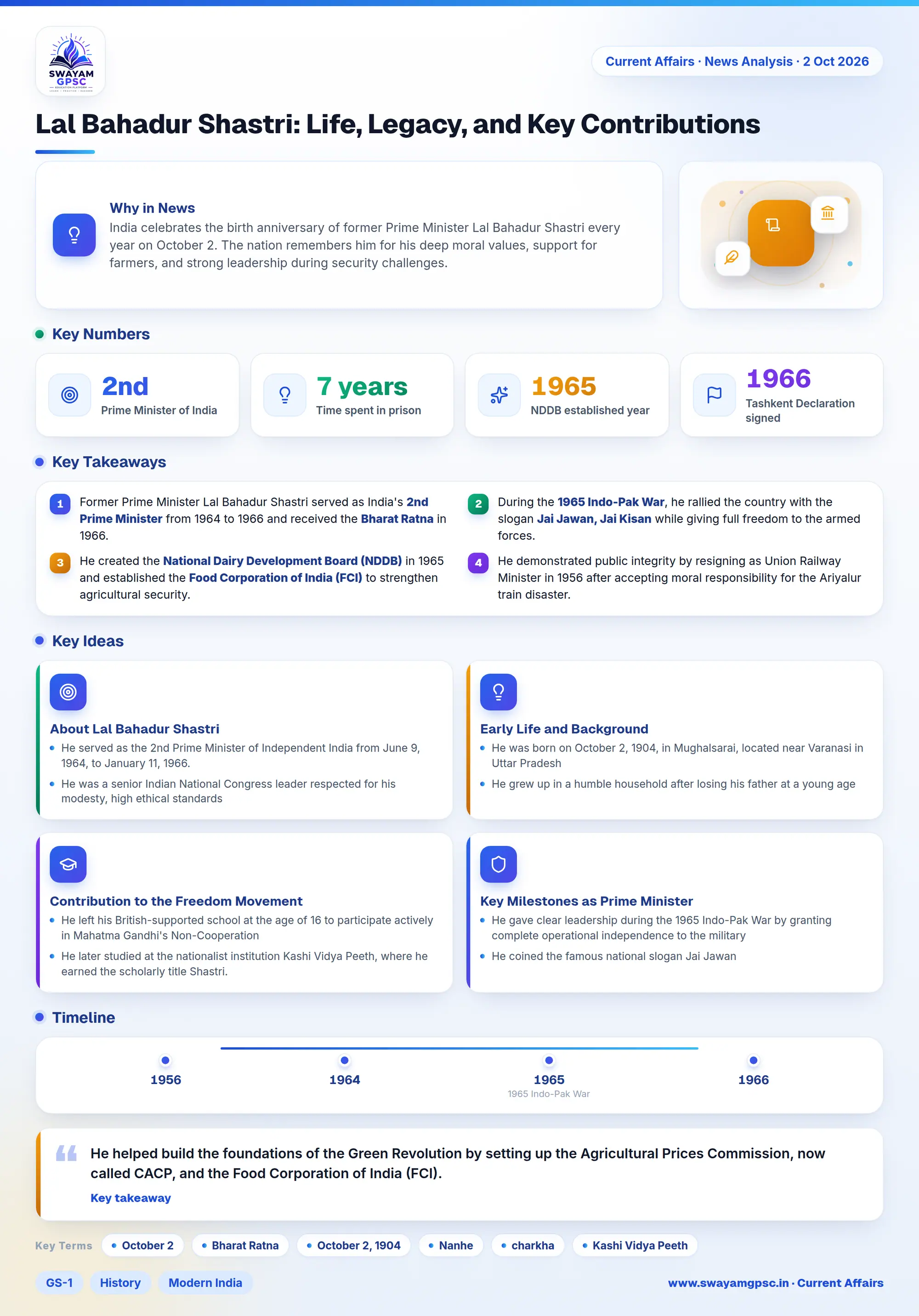
Lal Bahadur Shastri: Life, Legacy, and Key Contributions
#GS-1 #History #Modern India #Freedom Struggle #GS-2 #Current Events #National #Lal Bahadur Shastri #White Revolution #Green Revolution
Key takeaways
- Former Prime Minister Lal Bahadur Shastri served as India's 2nd Prime Minister from 1964 to 1966 and received the Bharat Ratna in 1966.
- During the 1965 Indo-Pak War, he rallied the country with the slogan Jai Jawan, Jai Kisan while giving full freedom to the armed forces.
- He created the National Dairy Development Board (NDDB) in 1965 and established the Food Corporation of India (FCI) to strengthen agricultural security.
- He demonstrated public integrity by resigning as Union Railway Minister in 1956 after accepting moral responsibility for the Ariyalur train disaster.
- He signed the Tashkent Declaration on January 10, 1966, and passed away hours later, leaving a legacy remembered at Vijay Ghat.
Why in News
- India celebrates the birth anniversary of former Prime Minister Lal Bahadur Shastri every year on October 2.
- The nation remembers him for his deep moral values, support for farmers, and strong leadership during security challenges.
About Lal Bahadur Shastri
- He served as the 2nd Prime Minister of Independent India from June 9, 1964, to January 11, 1966.
- He was a senior Indian National Congress leader respected for his modesty, high ethical standards, and firm decision-making.
- The government posthumously awarded him India's highest civilian honor, the Bharat Ratna, in 1966.
Early Life and Background
- He was born on October 2, 1904, in Mughalsarai, located near Varanasi in Uttar Pradesh, to Sharada Prasad Srivastava and Ramdulari Devi.
- He grew up in a humble household after losing his father at a young age, earning the affectionate childhood nickname Nanhe.
- He showed strong determination early in life by walking miles barefoot to reach his school in Varanasi.
- He married Lalita Devi in 1927 and refused any lavish dowry, taking only a spinning wheel (charkha) and a few yards of handspun khadi.
Contribution to the Freedom Movement
- He left his British-supported school at the age of 16 to participate actively in Mahatma Gandhi's Non-Cooperation Movement in 1921.
- He later studied at the nationalist institution Kashi Vidya Peeth, where he earned the scholarly title Shastri.
- He actively joined major national movements, including the Salt Satyagraha in 1930, Individual Satyagraha in 1940, and the Quit India Movement in 1942.
- He spent a total of seven years in British gaols, using that time to develop strong political and administrative organization skills for the Congress party.
Key Milestones as Prime Minister
- He gave clear leadership during the 1965 Indo-Pak War by granting complete operational independence to the military forces.
- He coined the famous national slogan Jai Jawan, Jai Kisan to honor both soldiers protecting borders and farmers feeding the country.
- He supported Dr. Verghese Kurien to boost the dairy sector, establishing the National Dairy Development Board (NDDB) in 1965 to launch the White Revolution.
- He helped build the foundations of the Green Revolution by setting up the Agricultural Prices Commission, now called CACP, and the Food Corporation of India (FCI).
- He set a high standard of moral political accountability by resigning as Union Railway Minister in 1956 after the tragic Ariyalur train accident.
Key Associations and Institutional Roles
- He joined the Servants of the People Society (Lok Sevak Mandal) under the mentorship of Lala Lajpat Rai, eventually serving as its President.
- He remained deeply connected to Kashi Vidya Peeth, where Gandhian ideals shaped his core philosophical beliefs.
- He served as Uttar Pradesh's Minister for Police and Transport, where he hired female conductors and replaced police wooden batons with water jets.
- He handled major portfolios in the Union Cabinet before becoming Prime Minister, including Railways, Transport, Commerce & Industry, and Home Affairs.
Final Days and Tashkent Agreement
- He traveled to Tashkent in the Soviet Union to negotiate a peaceful resolution to end the 1965 conflict with Pakistan.
- He signed the famous Tashkent Declaration alongside Pakistani President Ayub Khan on January 10, 1966.
- He passed away suddenly in Tashkent from a cardiac arrest on January 11, 1966, only hours after signing the peace agreement.
- His official memorial in New Delhi is named Vijay Ghat to honor his leadership and service to the country.