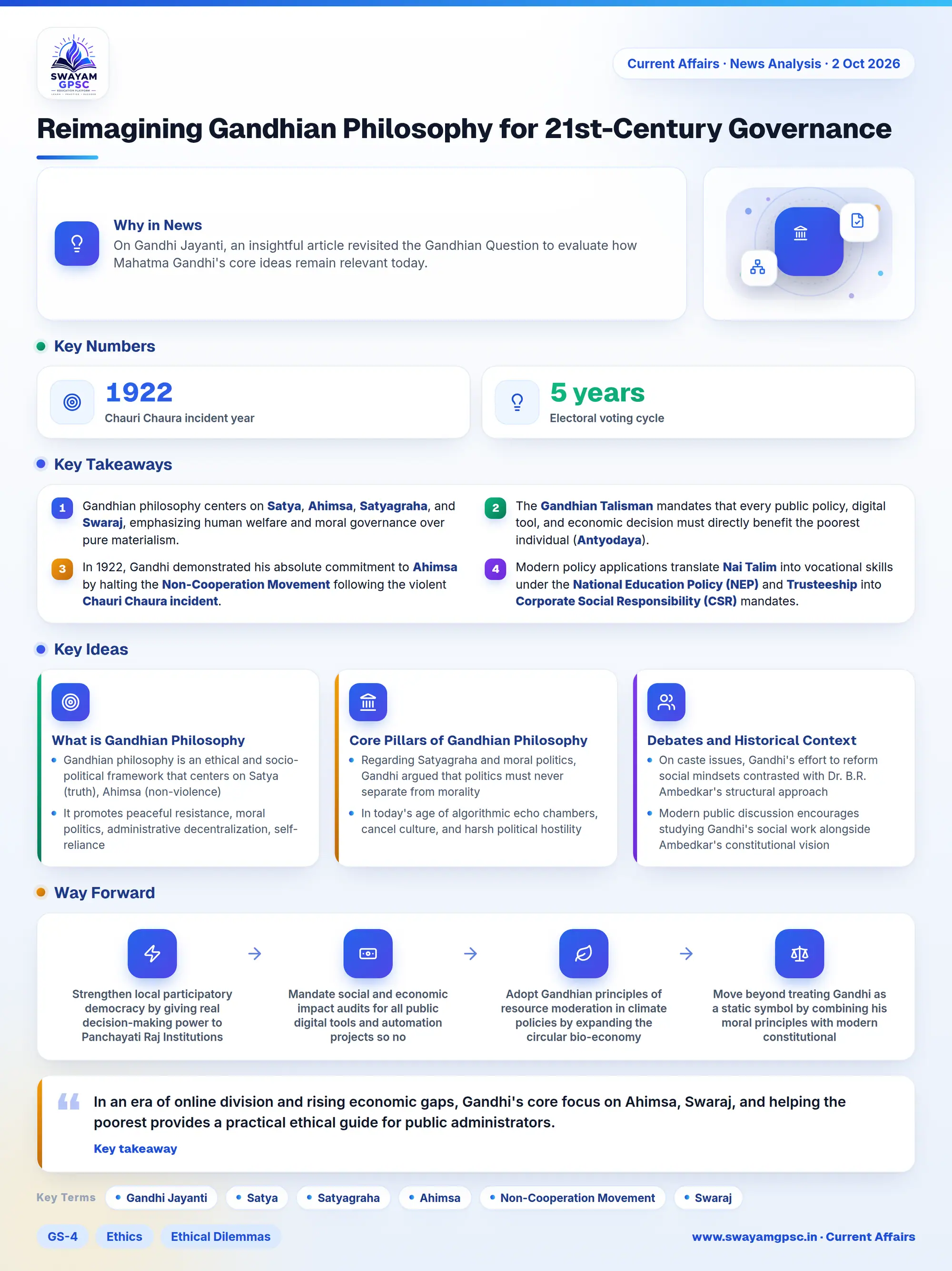
Reimagining Gandhian Philosophy for 21st-Century Governance
#GS-4 #Ethics #Ethical Dilemmas #GS-2 #Governance & Social Justice #Good Governance #GS-1 #History #Freedom Struggle
Key takeaways
- Gandhian philosophy centers on Satya, Ahimsa, Satyagraha, and Swaraj, emphasizing human welfare and moral governance over pure materialism.
- The Gandhian Talisman mandates that every public policy, digital tool, and economic decision must directly benefit the poorest individual (Antyodaya).
- In 1922, Gandhi demonstrated his absolute commitment to Ahimsa by halting the Non-Cooperation Movement following the violent Chauri Chaura incident.
- Modern policy applications translate Nai Talim into vocational skills under the National Education Policy (NEP) and Trusteeship into Corporate Social Responsibility (CSR) mandates.
- Addressing modern challenges requires empowering Panchayati Raj Institutions and evaluating modern technology through human dignity and social equity.
Why in News
- On Gandhi Jayanti, an insightful article revisited the Gandhian Question to evaluate how Mahatma Gandhi's core ideas remain relevant today.
- The analysis examines his philosophy in the context of modern challenges like digital polarization, hyper-nationalism, growing economic inequality, and rapid technological disruption.
What is Gandhian Philosophy
- Gandhian philosophy is an ethical and socio-political framework that centers on Satya (truth), Ahimsa (non-violence), Satyagraha, and Swaraj (self-rule).
- It promotes peaceful resistance, moral politics, administrative decentralization, self-reliance, and the dignity of physical labor by placing human welfare above material wealth.
Core Pillars of Gandhian Philosophy in Contemporary Governance
- Regarding Satyagraha and moral politics, Gandhi argued that politics must never separate from morality, treating truth as an active rule for public life.
- In today's age of algorithmic echo chambers, cancel culture, and harsh political hostility, Satyagraha offers a way to fight injustice without stripping opponents of their human dignity.
- On Ahimsa, Gandhi viewed non-violence not as weakness, but as a practice requiring deep moral courage, strict discipline, and organization.
- He famously proved this commitment by suspending the Non-Cooperation Movement after the violent Chauri Chaura incident in 1922.
- Today, violence also occurs digitally through hate speech, targeted disinformation, online abuse, and social division, making his call for emotional restraint vital for social harmony.
- Regarding Swaraj, Gandhi made a clear distinction between simple political independence and true self-rule built on internal moral restraint and strong civic duty.
- He believed true democracy requires active citizen participation, tolerance for different views, respect for institutions, and balancing rights with responsibilities, rather than just voting every 5 years.
- Under the Gandhian Talisman, governments must test every policy, digital platform, artificial intelligence tool, and economic reform by its concrete benefit to the poorest person, known as Antyodaya.
- Through Trusteeship, Gandhi suggested that while private business is necessary, wealth carries a moral duty, meaning corporations and wealthy individuals should act as trustees for society.
- Regarding Swadeshi, Gandhi advocated for local self-reliance and respecting manual labor rather than promoting complete economic isolation.
- His famous warning that the Earth provides enough for human need but not human greed serves as an important lesson for environmental protection during current climate crises.
Debates and Historical Context
- On caste issues, Gandhi's effort to reform social mindsets contrasted with Dr. B.R. Ambedkar's structural approach aimed at completely ending the caste system.
- Modern public discussion encourages studying Gandhi's social work alongside Ambedkar's constitutional vision without uncritical worship.
- On technology, Gandhi's early doubt about large machinery cannot replace modern industrial planning, but his ideas help us judge if modern automation and AI protect human labor dignity.
- Regarding communal harmony, Gandhi firmly maintained during the Partition violence that a nation's identity must not depend on a single religion.
- His vision directly supports equal, rights-based citizenship for all religions in a democratic India.
Key Dimensions for Indian Public Policy
- For Satyagraha, the traditional method was civil disobedience against colonial rulers, while the modern application is constructive public debate over digital hostility.
- For Ahimsa, traditional non-violent action transforms into fighting cyber-bullying, online hate speech, and administrative intimidation.
- For The Talisman, an individual ethical test becomes policy auditing of AI systems, welfare schemes, and infrastructure to ensure they reach marginalized groups.
- For Swadeshi, hand-spun khadi expands into building domestic manufacturing, strengthening rural supply chains, and supporting MSMEs.
- For Trusteeship, moral ownership of personal wealth evolves into formal Corporate Social Responsibility (CSR) and environmental reporting.
- For Nai Talim, craft-centered basic learning translates into skill development and civic ethics under the National Education Policy (NEP).
Way Forward
- Strengthen local participatory democracy by giving real decision-making power to Panchayati Raj Institutions and Urban Local Bodies.
- Mandate social and economic impact audits for all public digital tools and automation projects so no vulnerable citizen gets left behind.
- Adopt Gandhian principles of resource moderation in climate policies by expanding the circular bio-economy and cutting single-use waste.
- Move beyond treating Gandhi as a static symbol by combining his moral principles with modern constitutional thinking to solve governance challenges.
Conclusion
- In an era of online division and rising economic gaps, Gandhi's core focus on Ahimsa, Swaraj, and helping the poorest provides a practical ethical guide for public administrators.
- Protecting India's constitutional democracy requires grounding state power in truth, civic responsibility, and human dignity.