Transparency Concerns over Collegium System of Judicial Appointments
#GS-2 #Indian Polity & Constitution #Judiciary #Constitution #Governance & Social Justice #Good Governance #Current Events #National
Key takeaways
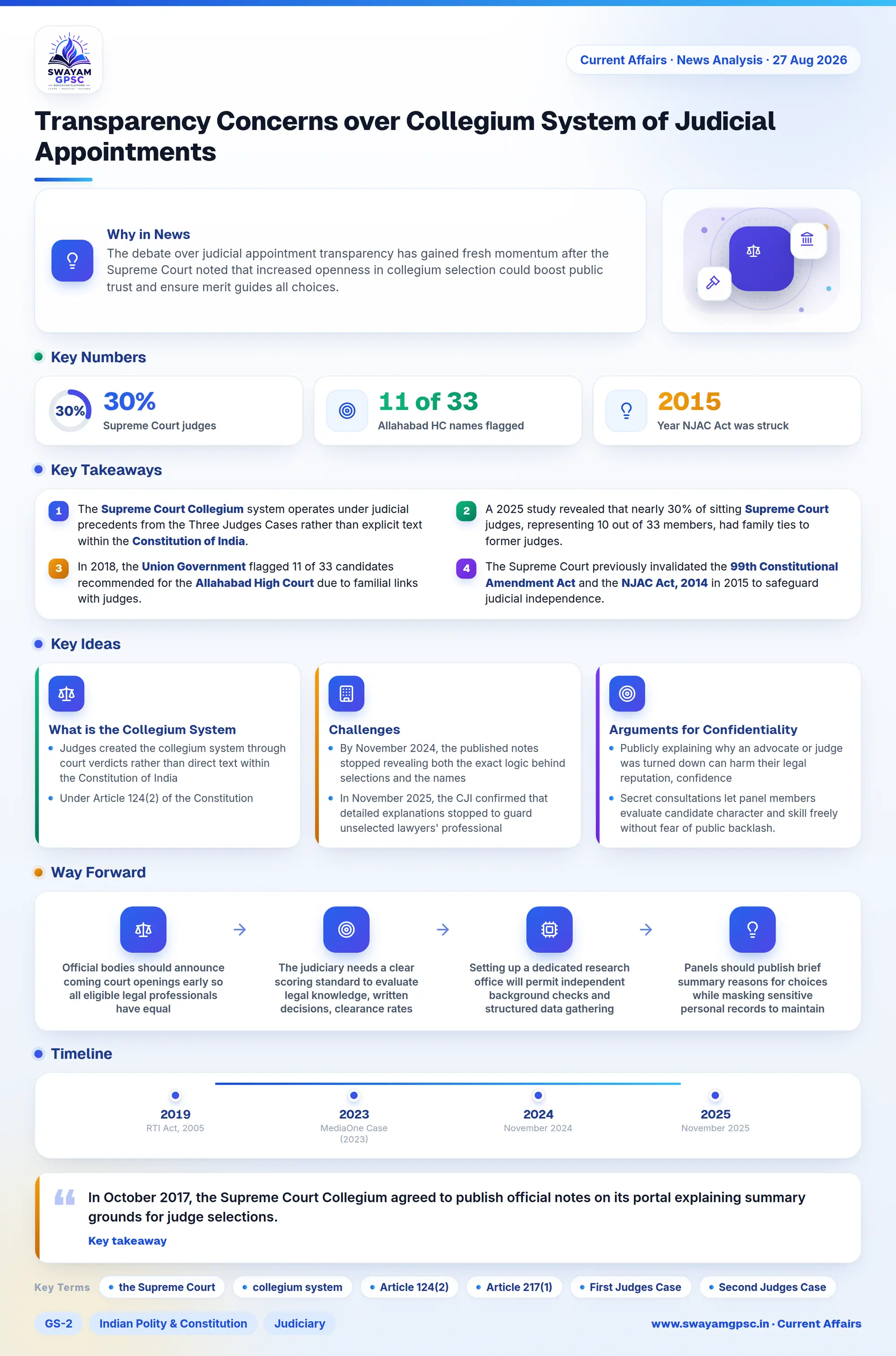
- The Supreme Court Collegium system operates under judicial precedents from the Three Judges Cases rather than explicit text within the Constitution of India.
- A 2025 study revealed that nearly 30% of sitting Supreme Court judges, representing 10 out of 33 members, had family ties to former judges.
- In 2018, the Union Government flagged 11 of 33 candidates recommended for the Allahabad High Court due to familial links with judges.
- The Supreme Court previously invalidated the 99th Constitutional Amendment Act and the NJAC Act, 2014 in 2015 to safeguard judicial independence.
Why in News
- The debate over judicial appointment transparency has gained fresh momentum after the Supreme Court noted that increased openness in collegium selection could boost public trust and ensure merit guides all choices.
- This discussion holds immense value because while the collegium system guards judges from political pressure, critics frequently question its operation behind closed doors with minimal public inspection.
What is the Collegium System of Judicial Appointments
- Judges created the collegium system through court verdicts rather than direct text within the Constitution of India to handle judge selection and transfers for the top courts.
- Under Article 124(2) of the Constitution, the President appoints Supreme Court judges after consultation with judges from the apex court and high courts.
- Under Article 217(1), high court appointments require the President to consult the Chief Justice of India, the state Governor, and the high court Chief Justice.
- In the First Judges Case (S.P. Gupta v. Union of India, 1981), the court ruled that consultation did not mean agreement, giving the central government main authority over judicial choices.
- In the Second Judges Case (1993), the court overturned its prior view by equating consultation with full agreement, establishing a three-member collegium of top judges.
- In the Third Judges Case (1998), the court expanded the apex court collegium to five judges, led by the CJI alongside four senior colleagues.
- Under this expanded framework, high court collegiums consist of the court Chief Justice working together with two senior judges.
- In the Fourth Judges Case (2015), the court declared the 99th Constitutional Amendment Act and the NJAC Act, 2014 unconstitutional, ruling that judicial independence forms part of the Basic Structure.
Challenges
- In October 2017, the Supreme Court Collegium agreed to publish official notes on its portal explaining summary grounds for judge selections.
- By November 2024, the published notes stopped revealing both the exact logic behind selections and the names of participating collegium judges.
- In November 2025, the CJI confirmed that detailed explanations stopped to guard unselected lawyers' professional careers, a reason experts say public bodies rarely accept.
- The system lacks a written grading matrix to judge candidates systematically on legal expertise, work speed, ruling standards, character, or social background.
- Authorities do not publish judicial openings in advance, which blocks talented lawyers outside existing networks from submitting applications directly.
- Closed nomination channels inherently benefit established legal dynasties while leaving first-generation lawyers at a distinct disadvantage.
- Unclear procedures spur repeated claims that family members of current or past judges receive improper preference during selections.
- For instance, the Union Government flagged 11 out of 33 names proposed at the Allahabad High Court in 2018 over family connections to judges.
- A 2025 study showed that nearly 30% of serving Supreme Court judges, roughly 10 out of 33, had family roots in the judiciary.
- In January 2025, panel members debated banning relatives of judges before deciding to apply stricter checks on such applicants.
- The current Memorandum of Procedure (MoP) omits candidate demographic reporting, making independent equality audits impossible to run.
- In the MediaOne Case (2023), the court ruled that hidden reasons conflict with accountability, yet judicial selections still rely on secret discussions.
- In Umadevi (2006), the court held that public posts require open procedures under Article 14 and Article 16, contrasting with closed judge selections.
- Under the Subhash Chandra Agarwal Judgment (2019), the RTI Act, 2005 covers the judicial office, but core selection talks remain secret.
- Modern digital platforms subject court actions to immediate scrutiny, making transparent logic vital to retain public confidence.
Arguments for Confidentiality in Judicial Appointments
- Publicly explaining why an advocate or judge was turned down can harm their legal reputation, confidence, and career prospects.
- Secret consultations let panel members evaluate candidate character and skill freely without fear of public backlash.
- Shielding appointment talks from outside pressure helps uphold the division of state powers under Article 50.
Global Practices in Judicial Appointments
- In the United Kingdom, the independent Judicial Appointments Commission (JAC) advertises positions publicly and uses structured tests alongside public board members.
- In South Africa, the constitutional Judicial Service Commission (JSC) collects public nominations and broadcasts live candidate interviews on television.
- In the United States, presidential nominations undergo detailed public vetting and live questioning before the Senate Judiciary Committee.
Way Forward
- Official bodies should announce coming court openings early so all eligible legal professionals have equal time to apply or gain nomination.
- The judiciary needs a clear scoring standard to evaluate legal knowledge, written decisions, clearance rates, character, and diversity background objectively.
- Setting up a dedicated research office will permit independent background checks and structured data gathering before panel members meet.
- Panels should publish brief summary reasons for choices while masking sensitive personal records to maintain public trust.
- Updating the official Memorandum of Procedure (MoP) will establish firm, time-bound steps for both judges and government officials to follow.
Conclusion
- Preserving judicial independence and establishing operational openness work together to strengthen public faith in courts.
- The collegium system can protect confidential personal data while still sharing its selection criteria and basic logic with the public.