Transforming India's Space Ecosystem: Reforms, Missions, and Future Outlook
#GS-2 #Governance & Social Justice #Current Events #National #GS-3 #Science & Technology #Space #Economy #Infrastructure #Government Policies & Interventions
Key takeaways
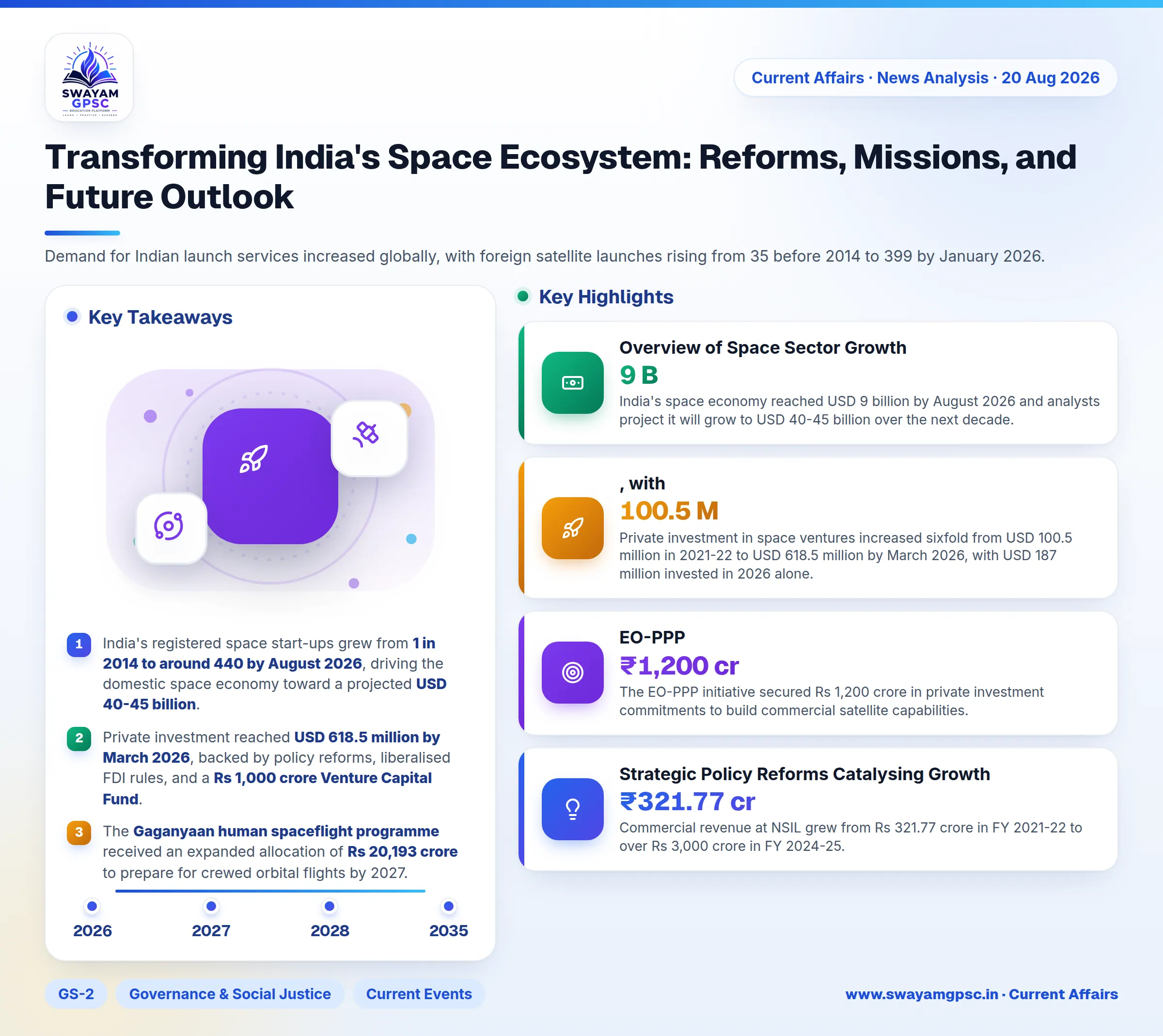
- India's registered space start-ups grew from 1 in 2014 to around 440 by August 2026, driving the domestic space economy toward a projected USD 40-45 billion.
- Private investment reached USD 618.5 million by March 2026, backed by policy reforms, liberalised FDI rules, and a Rs 1,000 crore Venture Capital Fund.
- The Gaganyaan human spaceflight programme received an expanded allocation of Rs 20,193 crore to prepare for crewed orbital flights by 2027.
- India plans to launch its first space station module BAS-01 by 2028 and complete the Bharatiya Antariksh Station by 2035.
- Commercial demand grew rapidly as India completed 399 foreign satellite launches by January 2026 and established 300 international space agreements.
Why in News
- As India celebrates its 80th Independence Day, the government has highlighted the country's expanding space capabilities, growing private space ecosystem, and future plans for human spaceflight and deep space exploration.
Overview of Space Sector Growth
- Registered space start-ups in India expanded rapidly from 1 in 2014 to around 440 by August 2026, showing strong private sector growth.
- India's space economy reached USD 9 billion by August 2026 and analysts project it will grow to USD 40-45 billion over the next decade.
- Private investment in space ventures increased sixfold from USD 100.5 million in 2021-22 to USD 618.5 million by March 2026, with USD 187 million invested in 2026 alone.
- By mid-2026, regulators granted 113 authorisations to 52 Non-Government Entities, including 18 start-ups, for satellite operations and launch activities.
- IN-SPACe launched the Earth Observation Public-Private Partnership (EO-PPP) framework to create India's first privately owned Earth observation satellite constellation.
- The EO-PPP initiative secured Rs 1,200 crore in private investment commitments to build commercial satellite capabilities.
- Demand for Indian launch services increased globally, with foreign satellite launches rising from 35 before 2014 to 399 by January 2026.
- India signed more than 300 space-cooperation agreements with 61 countries and 5 multilateral organisations for technology sharing and joint research.
Strategic Policy Reforms Catalysing Growth
- India opened its space sector to private businesses in 2020, allowing commercial firms to build satellites, launch systems, and space applications.
- The Indian Space Policy 2023 clearly divided operational roles between NewSpace India Limited (NSIL) and IN-SPACe across the space industry.
- As the commercial arm of ISRO, NSIL manages commercial launch services and transfers state-developed space technologies to local firms.
- Commercial revenue at NSIL grew from Rs 321.77 crore in FY 2021-22 to over Rs 3,000 crore in FY 2024-25.
- NSIL executed 118 Technology Transfer Agreements covering 83 ISRO technologies to support domestic aerospace manufacturing.
- IN-SPACe operates as a single-window regulatory authority that grants approvals and guides private space ventures.
- By January 31, 2026, IN-SPACe facilitated 71 technology transfers from ISRO directly to private start-ups and industry partners.
- The government liberalised FDI rules in February 2024, permitting up to 74% automatic FDI in satellite manufacturing, 49% in launch vehicles, and 100% in components.
- The Norms, Guidelines and Procedures (NGP) 2024 established clear rules and predictable compliance steps to simplify business operations.
- Early-stage space start-ups receive direct financial support through the IN-SPACe Seed Fund Scheme.
- A dedicated Rs 1,000 crore Venture Capital Fund provides growth capital to help private space companies scale their operations.
- The government established a Rs 500 crore Technology Adoption Fund to commercialise space technologies developed within India.
- The Satellite Bus as a Service (SBaaS) Scheme received Rs 75 crore to build standardized domestic satellite platforms.
Self-Reliant Space Transportation
- India operates four operational indigenous rockets: PSLV, GSLV, GSLV Mk III, and SSLV.
- These launch vehicles deploy payloads for Earth observation, communication, navigation, planetary science, and commercial clients.
- Between July 2023 and June 2026, India completed 12 launch missions carrying 11 national and 9 foreign satellites.
- Sriharikota operates two launch pads, and ISRO is building a third pad for next-generation heavy rockets.
- A new launch site at Kulasekarapattinam in Tamil Nadu will focus on SSLV and private rocket launches.
Lunar Exploration through Chandrayaan
- Launched in 2008, Chandrayaan-1 confirmed the discovery of water molecules and hydroxyl on the lunar surface.
- Launched in 2019, Chandrayaan-2 orbited at an altitude of 100 km and captured high-resolution surface images down to 30 cm.
- In 2023, Chandrayaan-3 made India the first nation to land near the lunar south pole and the fourth country to soft-land on the Moon.
- Targeted for 2027, Chandrayaan-4 will collect soil samples from the Moon and return them safely to Earth.
- The upcoming Chandrayaan-5/LUPEX joint mission with JAXA will explore water ice near the Moon's south pole.
Planetary and Deep Space Exploration
- The Mars Orbiter Mission (Mangalyaan) entered orbit on September 24, 2014, and operated for over eight years.
- AstroSat functions as India's dedicated space observatory, studying celestial objects across X-ray, optical, and ultraviolet spectrums.
- Launched in 2023, Aditya-L1 studies the Sun from the L1 point 1.5 million km from Earth and has released 27 TB of solar data.
- Launched in January 2024, XPoSat measures X-ray polarisation to study black holes and neutron stars.
- In January 2025, SpaDeX demonstrated autonomous space docking, making India the fourth country to master this technology.
Axiom-4 and Human Spaceflight Training
- Group Captain Shubhanshu Shukla travelled to the International Space Station aboard Axiom-4 on June 25, 2025.
- This flight gave India practical experience in astronaut safety, space station operations, and microgravity research.
- The Axiom-4 mission completed on July 15, 2025, providing crucial operational inputs for the upcoming Gaganyaan mission.
NavIC Indigenous Navigation System
- NavIC provides reliable positioning and timing coverage across India and extends up to 1,500 km beyond its borders.
- ISRO launched second-generation satellites NVS-01 in May 2023 and NVS-02 in January 2025 to upgrade the system.
- Satellite NVS-03 is ready for launch, while NVS-04 and NVS-05 are in advanced stages of production.
- Engineers are integrating NavIC into power grids, train tracking systems, Aadhaar geo-tagging, and commercial smartphones.
Advanced Launch Technologies
- ISRO is developing a 200-tonne-thrust semi-cryogenic engine to boost rocket payload capacities.
- Engineers are adding a semi-cryogenic stage to the LVM3 rocket to carry heavier payloads into high orbits.
- Tests on Vertical Take-off and Vertical Landing (VTVL) technology will help build reusable rocket boosters to cut launch costs.
- ISRO is designing a partially reusable Next Generation Launch Vehicle (NGLV) powered by LOX-Methane engines.
- The Reusable Launch Vehicle (RLV) programme tests winged craft designed for autonomous orbital re-entry and runway landings.
- Development of scramjet air-breathing engines aims to make atmospheric flight more efficient for future spaceplanes.
Human Spaceflight and Space Station Goals
- The government expanded the Gaganyaan programme budget to Rs 20,193 crore in September 2024, covering eight planned space missions.
- Gaganyaan aims to send three astronauts into a 400 km orbit for three days and bring them back safely to Earth.
- An uncrewed test flight carrying the Vyommitra half-humanoid robot is planned for the fourth quarter of 2026.
- India plans to launch its first crewed Gaganyaan mission by 2027.
- India will build the five-module Bharatiya Antariksh Station (BAS) by 2035, with the first module BAS-01 targeting launch by 2028.
- The BAS space station will host astronauts for long periods and support microgravity scientific experiments.
Advanced Orbital Docking Capabilities
- Future test missions SPADEX-2 and SPADEX-3 will refine spacecraft docking, propellant transfer, and crew transfer procedures for Chandrayaan-4 and BAS.
Venus Orbiter Mission
- Slated for launch in March 2028, the Venus Orbiter Mission will study the atmosphere, ionosphere, and surface geology of Venus.
- The mission will test aerobraking and heat management techniques essential for future interplanetary journeys.
Way Forward
- Combining policy reforms, private sector investments, and human spaceflight programs positions India as a major commercial power and technological leader in the global space economy.