Transforming Connectivity in Jammu and Kashmir
#GS-2 #Governance & Social Justice #Government Policies & Interventions #GS-3 #Economy #Infrastructure #Current Events #National
Key takeaways
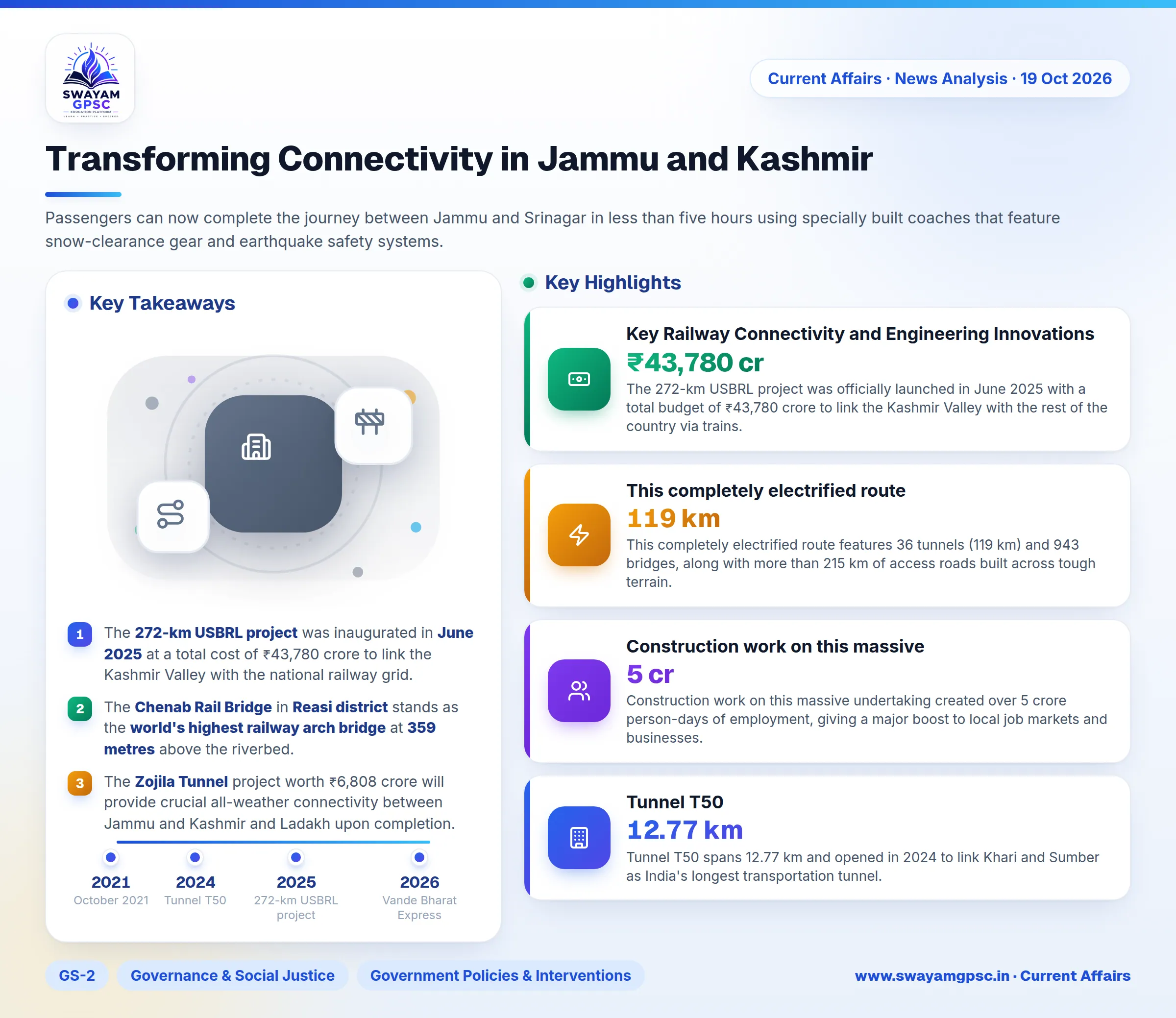
- The 272-km USBRL project was inaugurated in June 2025 at a total cost of ₹43,780 crore to link the Kashmir Valley with the national railway grid.
- The Chenab Rail Bridge in Reasi district stands as the world's highest railway arch bridge at 359 metres above the riverbed.
- The Zojila Tunnel project worth ₹6,808 crore will provide crucial all-weather connectivity between Jammu and Kashmir and Ladakh upon completion.
- The Delhi-Amritsar-Katra Expressway is a 667-km greenfield expressway designed to cut travel time between Delhi and Katra from 14 hours to six hours.
Why in News
- India is currently upgrading multimodal transport networks in Jammu and Kashmir by building advanced railways, highways, tunnels, and airports.
- A prime example of this effort is the Udhampur-Srinagar-Baramulla Rail Link (USBRL) project, which aims to boost all-weather travel, regional trade, and national security.
Key Railway Connectivity and Engineering Innovations
- The 272-km USBRL project was officially launched in June 2025 with a total budget of ₹43,780 crore to link the Kashmir Valley with the rest of the country via trains.
- This completely electrified route features 36 tunnels (119 km) and 943 bridges, along with more than 215 km of access roads built across tough terrain.
- Construction work on this massive undertaking created over 5 crore person-days of employment, giving a major boost to local job markets and businesses.
- Special Vande Bharat Express trains began running between Katra and Srinagar in June 2025 and extended their service to Jammu Tawi in April 2026.
- Passengers can now complete the journey between Jammu and Srinagar in less than five hours using specially built coaches that feature snow-clearance gear and earthquake safety systems.
- The Chenab Rail Bridge in Reasi district stands as the world's highest railway arch bridge, soaring 359 metres above the Chenab riverbed.
- Opened in June 2025, the Chenab bridge measures 1,315 metres long and features a 467-metre arch span.
- The Anji Khad Bridge, also in Reasi district, serves as India's first cable-stayed railway bridge with a 193-metre-high inverted-Y tower and a length of 473.25 metres.
- Tunnel T50 spans 12.77 km and opened in 2024 to link Khari and Sumber as India's longest transportation tunnel.
- Workers built Tunnel T50 using the modern New Austrian Tunnelling Method (NATM) and included a separate parallel escape passage for safety.
- The entire existing Broad Gauge network in Jammu and Kashmir is electrified, putting the region ahead of the nationwide electrification rate of roughly 99.6%.
- Four local railway stations including Budgam, Jammu Tawi, Martyr Captain Tushar Mahajan (Udhampur) and Shri Mata Vaishno Devi Katra are undergoing modern upgrades under the Amrit Bharat Station Scheme.
- Future rail expansion plans feature the Jalandhar Cantt.-Jammu Tawi third line (216 km), the Jammu-Katra additional line (78 km), and the Jammu/Reasi-Poonch new line (190 km).
Key Road and Tunnel Connectivity Projects
- The Sonamarg (Z-Morh) Tunnel is a 6.4-km bi-directional tunnel that opened in January 2025 to ensure all-weather connectivity between Srinagar and Sonamarg on the way to Leh.
- Constructed with an investment exceeding ₹2,700 crore, this tunnel bypasses dangerous avalanche zones to promote winter tourism, adventure sports and local livelihoods.
- The Zojila Tunnel measures 13.153 km and runs between Baltal and Minamarg on NH-1, achieving its primary excavation breakthrough in June 2026.
- Once fully ready, this ₹6,808-crore project will provide all-weather connectivity between Jammu and Kashmir and Ladakh, cutting the travel time between Sonamarg and Minamarg from two hours to 30 minutes.
- This highway link will improve defence logistics, strategic mobility, tourism and trade while cutting down winter travel blockages caused by snow and avalanches.
- The Dr Syama Prasad Mookerjee Tunnel, previously known as the Chenani-Nashri Tunnel, started operations in 2017 to connect Udhampur and Ramban.
- This 9-km tunnel cuts down the driving distance by 31 km and shortens travel time by roughly two hours.
- Under the Pradhan Mantri Gram Sadak Yojana (PMGSY)-IV in August 2026, authorities launched 110 road projects covering 598.455 km worth over ₹1,500 crore to help 46,972 people across the Udhampur-Kathua-Doda-Kishtwar belt.
- Several of these rural road projects make use of waste plastics to promote eco-friendly and durable civil engineering.
- The Delhi-Amritsar-Katra Expressway is a 667-km greenfield expressway designed to shrink the travel time between Delhi and Katra from 14 hours to six hours.
- Initial stretches of this expressway opened in July 2026 to make travel easier for pilgrims and cargo transporters alike.
- The widening of the Rafiabad-Kupwara Road (NH-701) began in June 2025 through Project Beacon to upgrade remote and border-area roads.
- The Shopian Bypass (NH-444) spans 8.925 km and received an outlay of ₹224.44 crore to connect Shopian, Pulwama and Kulgam, helping farmers move their fruit and crops to markets much faster.
Key Airport and Regional Air Connectivity Projects
- A ₹1,677-crore project approved in February 2026 will expand the Civil Enclave at Srinagar International Airport inside the IAF's Budgam Airbase.
- The upgraded terminal will cover a 71,500 sq m area to handle 10 million passengers every year alongside 15 aircraft parking bays.
- Designers plan to use traditional Kashmiri architecture, rainwater harvesting, natural lighting and eco-friendly materials to secure a 5-star GRIHA rating for the terminal.
- Local airports in Udhampur and Kishtwar are lined up for upgrades under the UDAN scheme to boost regional travel, tourism, and local business investments.
- The PM Gati Shakti National Master Plan, launched in October 2021, brings together railways, highways, ports, waterways, and airports using a shared GIS-based planning platform involving 44 Central Ministries and 36 States/UTs.
- The Gati Shakti Multi-Modal Cargo Terminal (GCT) Policy was introduced in December 2021 to encourage private companies to build modern cargo hubs linked directly to railway lines.
- Across the country, authorities have commissioned 142 GCTs, and the regional Samba GCT is already active while Kathua, Anantnag and Jammu have secured preliminary clearances for new terminals.
Conclusion
- The rapid expansion of rail, road, air and multimodal connectivity across Jammu and Kashmir is boosting market access, tourism, trade and local livelihoods for everyday citizens, farmers, and business owners.
- Integrated infrastructure building also strengthens regional economic integration, border security, disaster response and strategic mobility, ensuring long-term prosperity for the Union Territory.