Towards a TB-Free India
#GS-2 #Governance & Social Justice #Health #Poverty #Social Justice #Current Events #National
Key takeaways
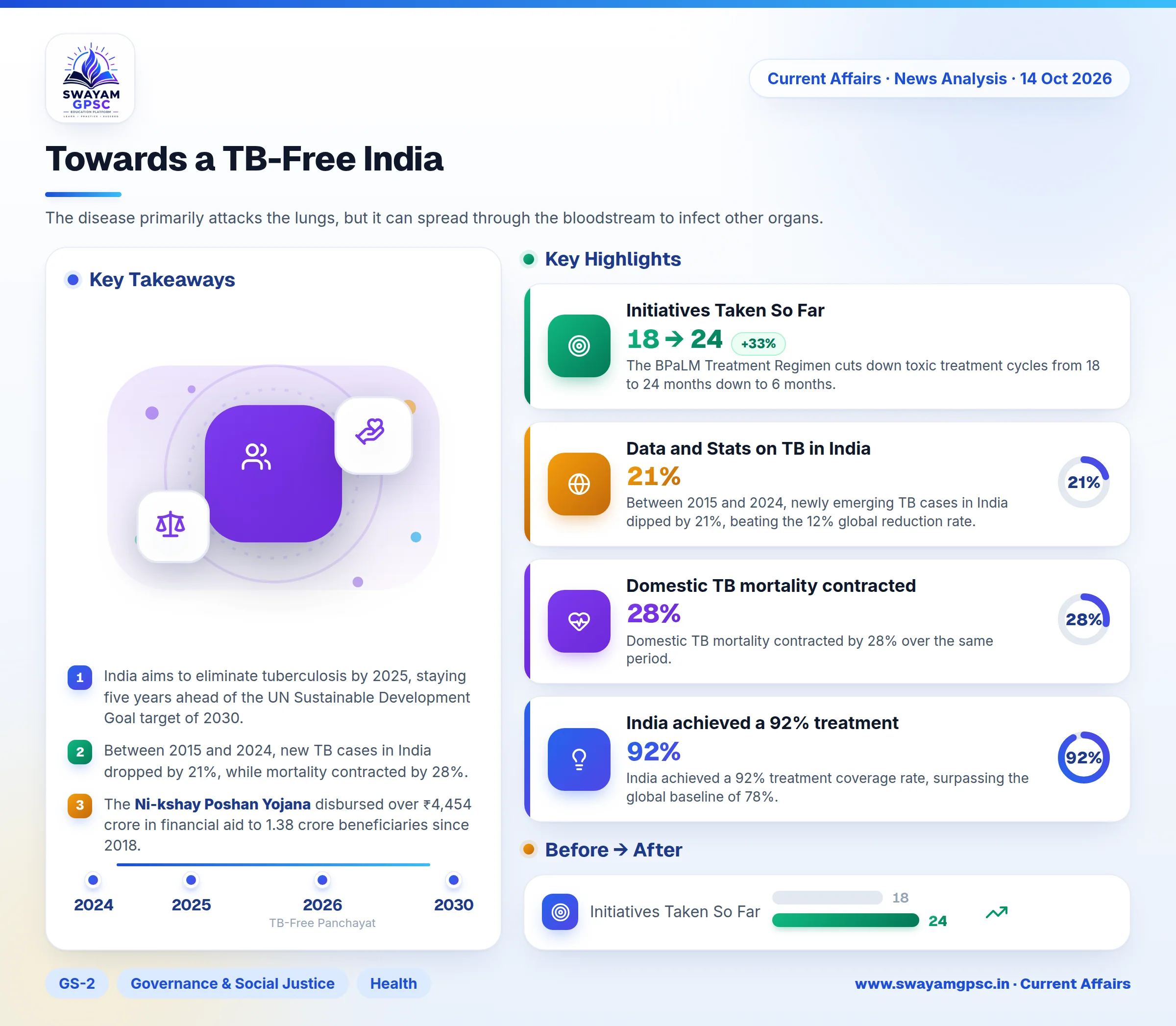
- India aims to eliminate tuberculosis by 2025, staying five years ahead of the UN Sustainable Development Goal target of 2030.
- Between 2015 and 2024, new TB cases in India dropped by 21%, while mortality contracted by 28%.
- The Ni-kshay Poshan Yojana disbursed over ₹4,454 crore in financial aid to 1.38 crore beneficiaries since 2018.
- Undernutrition remains a major risk factor, feeding the disease pool and increasing susceptibility among vulnerable daily wage workers.
Why in News
- The Ministry of Health and Family Welfare launched the nationwide JOSH campaign across 11 states and 55 districts.
- The campaign aims to mobilize youth networks, NCC cadets, and grassroots communities in the push toward a TB-free India.
About Tuberculosis and its Types
- Tuberculosis is a chronic, airborne infectious disease caused by the bacterium Mycobacterium tuberculosis.
- The disease primarily attacks the lungs, but it can spread through the bloodstream to infect other organs.
- It spreads through respiratory droplet nuclei when infected individuals cough, sneeze, or speak.
- Latent TB infection occurs when bacteria stay in the body without causing sickness, while active TB develops when the immune system weakens.
- Pulmonary TB affects the lungs and remains contagious, whereas Extra-Pulmonary TB infects other biological sites and is generally non-contagious.
- Drug-susceptible TB uses standard first-line drugs, while Drug-Resistant TB demands specialized and toxic regimens.
Data and Stats on TB in India
- Between 2015 and 2024, newly emerging TB cases in India dipped by 21%, beating the 12% global reduction rate.
- Domestic TB mortality contracted by 28% over the same period.
- India achieved a 92% treatment coverage rate, surpassing the global baseline of 78%.
- The national treatment success rate under the intensified TB Mukt Bharat Abhiyaan rose to 90%.
- As of 2026, over 46,118 Gram Panchayats received official TB-Free Panchayat certifications.
India and TB: Strategic Posture
- India set a national goal to end TB by 2025, which is five years ahead of the UN Sustainable Development Goal target of 2030.
- The NTEP restructured clinical protocols into active case-finding, quality-assured regimens, preventive therapies, and health system scaling.
- The government shifted TB eradication into a people movement called Jan Andolan, involving leaders, corporations, and volunteers.
- India houses the world largest molecular diagnostic network alongside direct benefit transfer platforms.
Initiatives Taken So Far
- The Pradhan Mantri TB Mukt Bharat Abhiyaan and Ni-kshay Mitra initiative engages 6.77+ lakh registered volunteers to provide food baskets.
- The Ni-kshay Poshan Yojana provides ₹1,000 monthly financial aid to every notified TB patient.
- The government disbursed over ₹4,454 crore to 1.38 crore beneficiaries since 2018.
- The BPaLM Treatment Regimen cuts down toxic treatment cycles from 18 to 24 months down to 6 months.
- India deployed over 500 handheld digital X-ray units, the Khushi chatbot, and molecular machines across 9,800+ facilities.
Challenges
- Substantial proportions of patients seek care from unorganized private practitioners, risking unnotified and incomplete therapy.
- Informal clinics prescribe irrational antibiotic cocktails for persistent coughs, delaying testing and accelerating drug resistance.
- Undernutrition is the single largest population risk factor, increasing susceptibility to bacterial activation.
- Impoverished daily-wage workers cannot sustain the high-protein diets required to tolerate harsh drug toxicity.
- Deep social shame surrounding a TB diagnosis leads to social ostracization, concealment of symptoms, and marital disruption.
- Logistical constraints in reaching remote tribal, hilly, and conflict-prone terrains delay early case-finding and sample transit.
Way Forward
- Scale up preventive chemoprophylaxis regimens to all household contacts, immuno-compromised patients, and slum clusters.
- Enforce real-time pharmacy and clinical reporting through the Ni-kshay digital portal.
- Replace conventional smear microscopy by placing battery-operated Truenat units at every Ayushman Arogya Mandir.
- Implement mandatory cross-ventilation retrofits, ultraviolet germicidal irradiation, and N95 respiratory protection in clinics and prisons.
- Expand financial protections beyond clinical cure by offering skill rehabilitation and lung-health pensions to survivors.