Tigress Reintroduced to Buxa Tiger Reserve
#GS-2 #Governance & Social Justice #Current Events #National #GS-3 #Environment #Biodiversity #Wildlife #Government Policies & Interventions
Key takeaways
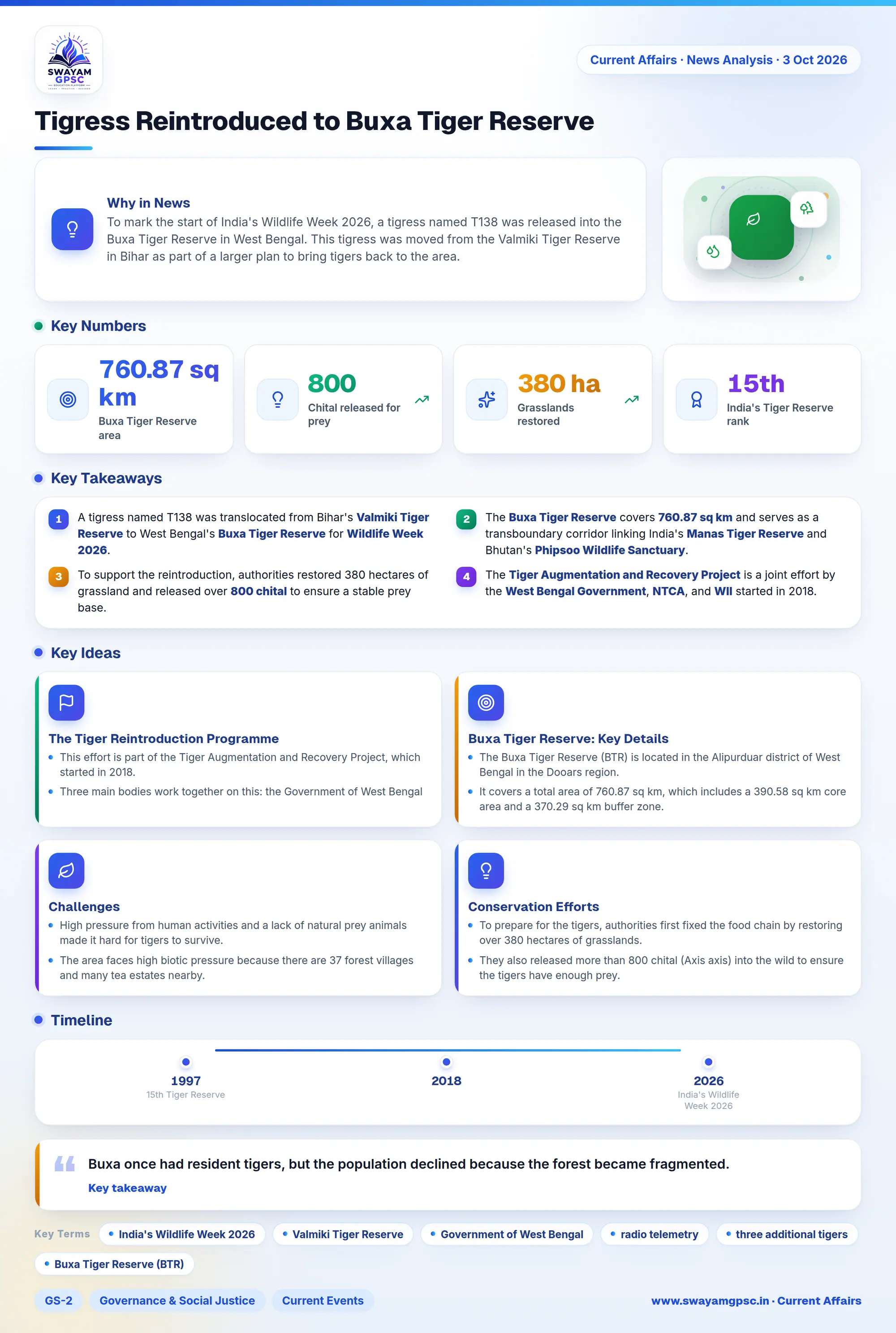
- A tigress named T138 was translocated from Bihar's Valmiki Tiger Reserve to West Bengal's Buxa Tiger Reserve for Wildlife Week 2026.
- The Buxa Tiger Reserve covers 760.87 sq km and serves as a transboundary corridor linking India's Manas Tiger Reserve and Bhutan's Phipsoo Wildlife Sanctuary.
- To support the reintroduction, authorities restored 380 hectares of grassland and released over 800 chital to ensure a stable prey base.
- The Tiger Augmentation and Recovery Project is a joint effort by the West Bengal Government, NTCA, and WII started in 2018.
Why in News
- To mark the start of India's Wildlife Week 2026, a tigress named T138 was released into the Buxa Tiger Reserve in West Bengal.
- This tigress was moved from the Valmiki Tiger Reserve in Bihar as part of a larger plan to bring tigers back to the area.
- India's Wildlife Week 2026 takes place from 2nd October to 8th October to teach people about protecting nature.
- The theme for this year is "Connecting Habitats, Thriving Wildlife," which highlights how wildlife corridors are essential for animals to move and survive safely.
The Tiger Reintroduction Programme
- This effort is part of the Tiger Augmentation and Recovery Project, which started in 2018.
- Three main bodies work together on this: the Government of West Bengal, the National Tiger Conservation Authority (NTCA), and the Wildlife Institute of India (WII).
- The goal is to build a breeding population of tigers that can sustain itself naturally over time.
- The process follows the legal rules set by the Wildlife (Protection) Act, 1972.
- Experts use genetic mapping and habitat checks to pick the right tigers, usually young animals that can establish new territories.
- Tigers are not just released; they first stay in soft-release enclosures to get used to the new environment.
- Once free, officials track them using radio telemetry, camera traps, and direct field observations.
- The government plans to introduce three additional tigers to ensure the population can grow.
Buxa Tiger Reserve: Key Details
- The Buxa Tiger Reserve (BTR) is located in the Alipurduar district of West Bengal in the Dooars region.
- It covers a total area of 760.87 sq km, which includes a 390.58 sq km core area and a 370.29 sq km buffer zone.
- It was first named India's 15th Tiger Reserve in 1983 and later became a National Park in 1997.
- The landscape is diverse, covering Terai, Bhabar, and sub-Himalayan ecosystems with altitudes reaching up to 1,750 metres.
- The forest is home to over 350 tree species and 144 orchid species, including Sal, Champ, and Simul trees.
- Several rivers flow through the park, including the Sankosh, Raidak, Jayanti, Churnia, Turturi, Phashkhawa, Dima, and Nonani.
- Besides tigers, the reserve supports Asian elephants, gaurs, sambar, wild dogs, wild boars, clouded leopards, leopard cats, and marbled cats.
- It is also a sanctuary for rare species like the Bengal florican and Chinese pangolin, while its streams host mahseer fish.
Challenges
- Buxa once had resident tigers, but the population declined because the forest became fragmented.
- High pressure from human activities and a lack of natural prey animals made it hard for tigers to survive.
- The area faces high biotic pressure because there are 37 forest villages and many tea estates nearby.
- This proximity between humans and wildlife often leads to conflicts.
Conservation Efforts
- To prepare for the tigers, authorities first fixed the food chain by restoring over 380 hectares of grasslands.
- They also released more than 800 chital (Axis axis) into the wild to ensure the tigers have enough prey.
- Eco-Development Committees and JFMCs work with local people to provide jobs and pay for livestock losses.
- These community groups help reduce the conflict between humans and tigers.
Strategic Significance
- Buxa Tiger Reserve acts as a vital bridge for wildlife moving across borders.
- It connects the North East and Brahmaputra Valley tiger landscape with other protected areas.
- Specifically, it links Manas Tiger Reserve (Assam), Phipsoo Wildlife Sanctuary (Bhutan), and Jaldapara National Park (West Bengal).
- This connectivity allows tigers to move and mix their genes, which keeps the species healthy.