PM E-DRIVE Scheme for Electric Mobility
#GS-2 #GS-3 #Governance & Social Justice #Regulatory Bodies #Government Policies & Interventions #Economy #Infrastructure #Environment #Climate Change #Sustainable Development
Key takeaways
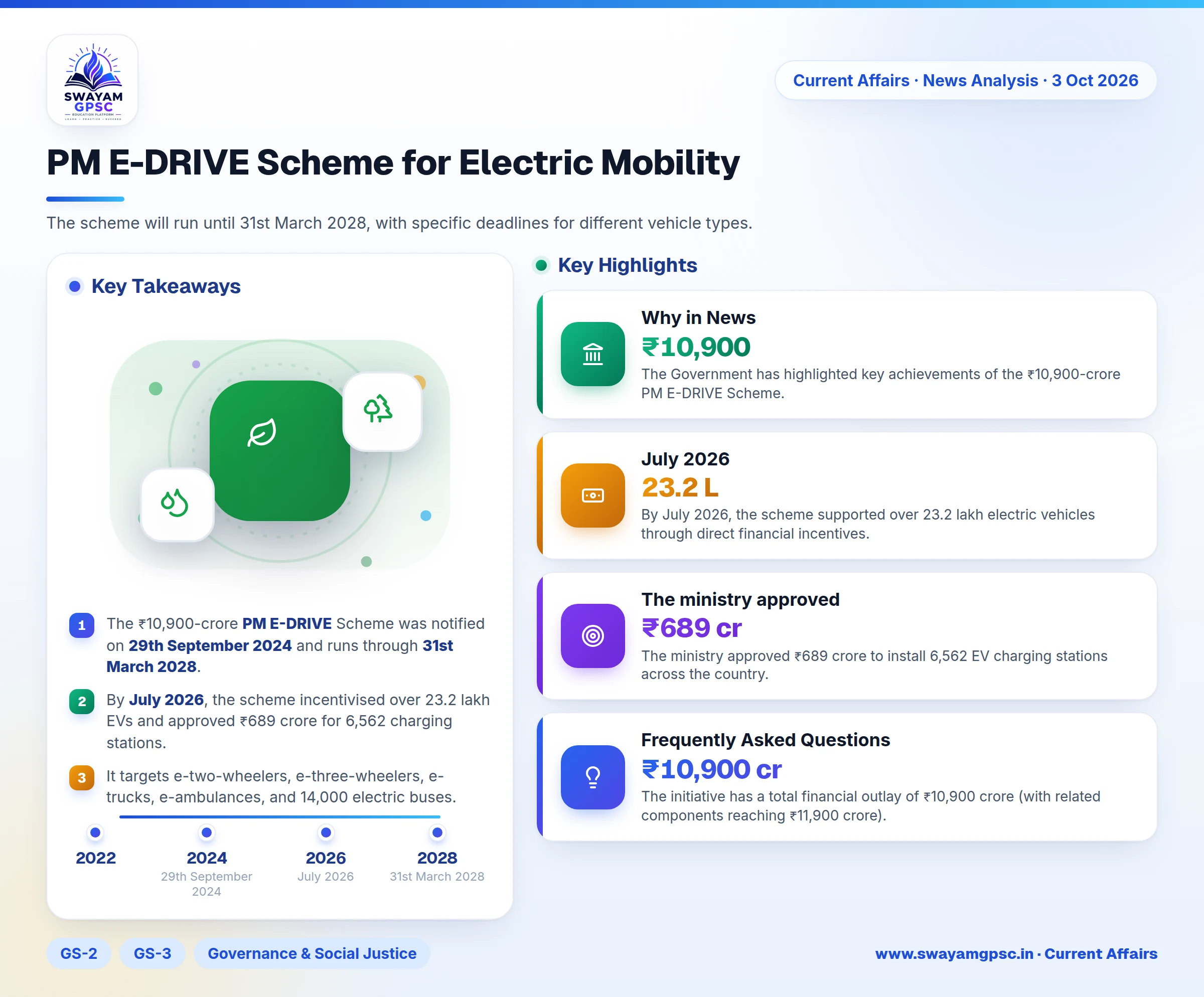
- The ₹10,900-crore PM E-DRIVE Scheme was notified on 29th September 2024 and runs through 31st March 2028.
- By July 2026, the scheme incentivised over 23.2 lakh EVs and approved ₹689 crore for 6,562 charging stations.
- It targets e-two-wheelers, e-three-wheelers, e-trucks, e-ambulances, and 14,000 electric buses.
- Local manufacturing is enforced through the Phased Manufacturing Programme (PMP) alongside the PLI Scheme for ACC Battery Storage.
- Waste management is regulated under the Battery Waste Management Rules, 2022 to build a circular battery economy.
Why in News
- The Government has highlighted key achievements of the ₹10,900-crore PM E-DRIVE Scheme.
- The primary goal of this initiative is to speed up EV adoption, build more charging stations, and strengthen domestic manufacturing.
- By July 2026, the scheme supported over 23.2 lakh electric vehicles through direct financial incentives.
- The ministry approved ₹689 crore to install 6,562 EV charging stations across the country.
What is the PM E-DRIVE Scheme
- The scheme was officially notified on 29th September 2024 with retrospective effect from 1st April 2024.
- It subsumed the earlier Electric Mobility Promotion Scheme (EMPS) 2024.
- The scheme will run until 31st March 2028, with specific deadlines for different vehicle types.
- The initiative aims to boost EV sales, set up public chargers, and strengthen local manufacturing.
- It provides targeted demand incentives for electric two-wheelers, three-wheelers, trucks, ambulances, and buses.
- A dedicated financial allocation will support public charging networks and fund 14,000 electric buses.
Promoting Domestic EV Manufacturing
- The scheme enforces strict local component rules through the Phased Manufacturing Programme (PMP).
- Registered manufacturers must localize their vehicle components and get approved certificates from testing agencies.
- This programme works alongside the PLI Scheme for Advanced Chemistry Cell (ACC) Battery Storage.
- Battery recycling follows the strict standards set by the Battery Waste Management Rules, 2022.
Significance of the Scheme
- The policy helps clean up city air by moving transport away from fossil fuels.
- It lowers expensive oil imports and improves national energy security.
- The initiative creates new jobs in component assembly, charging operations, and battery recycling.
- It builds a circular battery economy by supporting safe reuse and recycling of critical materials.
Frequently Asked Questions
- PM E-DRIVE stands for PM Electric Drive Revolution in Innovative Vehicle Enhancement.
- The initiative has a total financial outlay of ₹10,900 crore (with related components reaching ₹11,900 crore).
- The scheme runs through 31 March 2028 to provide long-term clarity for investors.
- Eligible vehicle categories include electric two-wheelers, three-wheelers, ambulances, trucks, and buses.