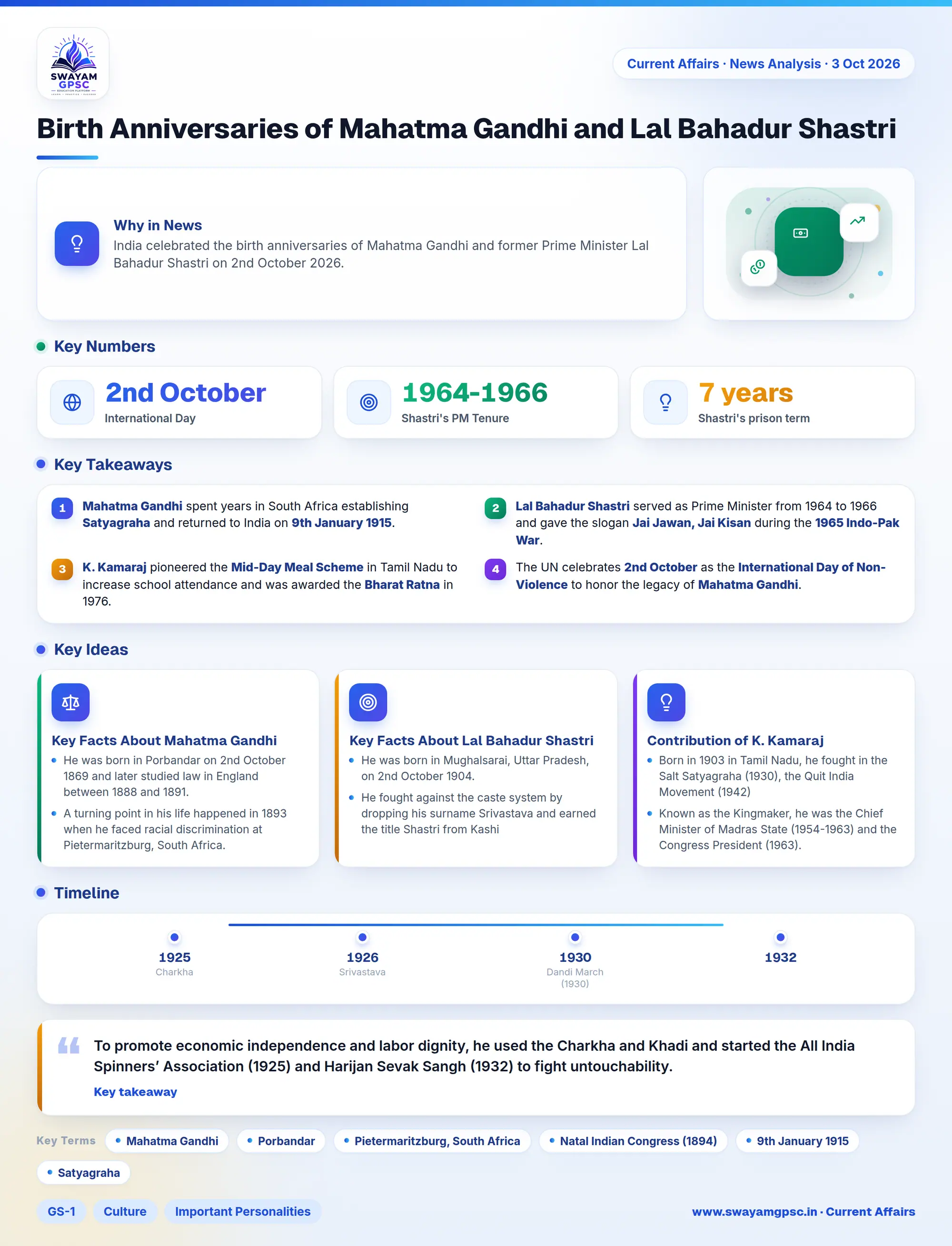
Birth Anniversaries of Mahatma Gandhi and Lal Bahadur Shastri
#GS-1 #Culture #Important Personalities #GS-2 #Current Events #National
Key takeaways
- Mahatma Gandhi spent years in South Africa establishing Satyagraha and returned to India on 9th January 1915.
- Lal Bahadur Shastri served as Prime Minister from 1964 to 1966 and gave the slogan Jai Jawan, Jai Kisan during the 1965 Indo-Pak War.
- K. Kamaraj pioneered the Mid-Day Meal Scheme in Tamil Nadu to increase school attendance and was awarded the Bharat Ratna in 1976.
- The UN celebrates 2nd October as the International Day of Non-Violence to honor the legacy of Mahatma Gandhi.
Why in News
- India celebrated the birth anniversaries of Mahatma Gandhi and former Prime Minister Lal Bahadur Shastri on 2nd October 2026.
Key Facts About Mahatma Gandhi
- He was born in Porbandar on 2nd October 1869 and later studied law in England between 1888 and 1891.
- A turning point in his life happened in 1893 when he faced racial discrimination at Pietermaritzburg, South Africa.
- While in South Africa, he started the Natal Indian Congress (1894), the *Indian Opinion* newspaper, and set up the Phoenix Settlement (1904) and Tolstoy Farm (1910) to practice Satyagraha.
- He returned to India on 9th January 1915, a day we now celebrate as Pravasi Bharatiya Diwas, and founded the Sabarmati Ashram (1917) to promote self-reliance.
- His entire philosophy rested on two pillars: Satyagraha (the force of truth) and Ahimsa (non-violence), believing that the way we achieve a goal must be as pure as the goal itself.
- He led his first major Indian struggles with the Champaran Satyagraha (1917), Kheda Satyagraha (1918), and Rowlatt Satyagraha (1919).
- He later guided the nation through massive movements like the Non-Cooperation Movement (1920-22), the Dandi March (1930) for Civil Disobedience, and the Quit India Movement (1942).
- To promote economic independence and labor dignity, he used the Charkha and Khadi and started the All India Spinners’ Association (1925) and Harijan Sevak Sangh (1932) to fight untouchability.
- He focused on Gram Swaraj (village self-reliance), Hindu-Muslim unity, and the upliftment of the marginalized sections of society.
- He wrote about his political views in *Hind Swaraj* and shared his personal life lessons in his book *An Autobiography: The Story of My Experiments with Truth*.
- After he was killed on 30th January 1948, the world continued to honor him, and the United Nations named 2nd October as the International Day of Non-Violence.
Key Facts About Lal Bahadur Shastri
- He was born in Mughalsarai, Uttar Pradesh, on 2nd October 1904.
- He fought against the caste system by dropping his surname Srivastava and earned the title Shastri from Kashi Vidyapeeth in 1926.
- He was deeply influenced by Mahatma Gandhi, joining the Non-Cooperation Movement at age 16 and choosing a charkha and Khadi over a dowry.
- He was an active part of the Civil Disobedience Movement and spent over seven years in British jails.
- His political journey included roles as Parliamentary Secretary in 1946, Home Minister of Uttar Pradesh, and Union Minister for Railways, Home Affairs, and Commerce.
- He showed great integrity by resigning as Railway Minister in 1956 to take moral responsibility for a train accident.
- He served as the Prime Minister of India from 1964 to 1966 after Jawaharlal Nehru.
- He helped start the Green Revolution to increase food production and supported the White Revolution by backing the Amul co-operative and the National Dairy Development Board.
- During the 1965 Indo-Pak War, he gave the famous slogan Jai Jawan, Jai Kisan to emphasize that both soldiers and farmers are vital for the country.
- He passed away in Tashkent on 11th January 1966 shortly after signing the Tashkent Declaration.
Contribution of K. Kamaraj
- Born in 1903 in Tamil Nadu, he fought in the Salt Satyagraha (1930), the Quit India Movement (1942), and joined the Constituent Assembly in 1946.
- Known as the Kingmaker, he was the Chief Minister of Madras State (1954-1963) and the Congress President (1963).
- He introduced the Kamaraj Plan, which asked senior leaders to quit their government jobs to rebuild the party's strength.
- He started the Mid-Day Meal Scheme to get more children into schools, and Tamil Nadu now marks his birthday as Education Development Day.
- He died in 1975 and received the Bharat Ratna in 1976.